The Karnataka High Court has clarified a critical boundary in third-party motor insurance liability: an insurer cannot be held liable when the claimant’s own conduct violates statutory road regulations and the driver operates without a valid license. This judgment reinforces the principle that insurance coverage is contingent on compliance with policy terms and statutory obligations.
Background & Facts
The Dispute
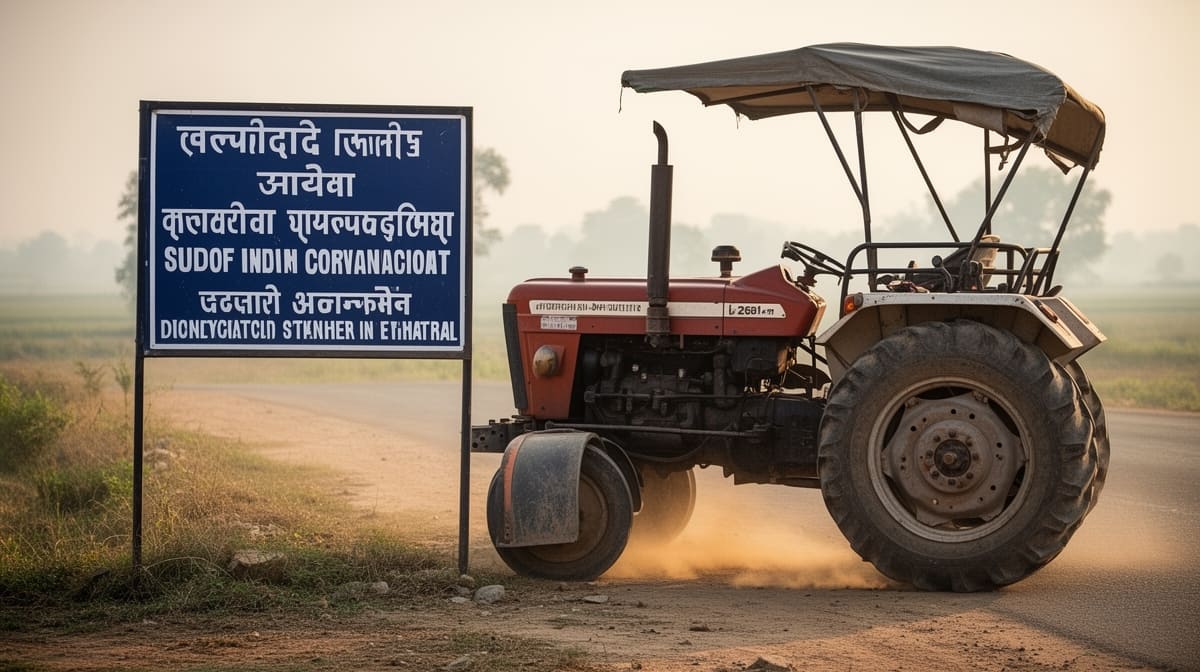
The dispute arose from a road accident on 30.08.2011 involving a tractor-trailer bearing registration numbers KA-26/TA-3805 and KA-26/TA-3806. The claimant, Shri Bailappa, was returning from agricultural work when he was seated on the mudguard of the tractor. The driver, allegedly operating without a valid driving license, lost control and collided with a roadside signboard. As a result, Bailappa fell and sustained grievous injuries when the rear wheel of the tractor ran over his leg. He filed a claim petition under Section 166 of the Motor Vehicles Act, 1988 against both the owner and the insurer, United India Insurance Co. Ltd.
Key Facts
- The accident occurred on 30.08.2011 at Ron, Gadag district, Karnataka
- Claimant Bailappa, aged 62, was seated on the mudguard of the tractor at the time of the accident
- The driver of the tractor was prosecuted under Section 279 IPC (rash driving) and Section 185 IPC (driving without license)
- A charge sheet was filed against the driver on the ground that he did not possess a valid driving license
- Regulation 28 of the Karnataka Road Regulations, 1989, explicitly prohibits carriage of passengers on the mudguard of a tractor
- The claimant submitted documents (Exs. P1 to P163) including medical reports, police records, and accident details
- The owner of the tractor, respondent no. 1, did not appear before the Tribunal despite service of notice
Procedural History
- 30.08.2011: Accident occurred
- 2013: Claim petition (MVC No. 04/2013) filed before Senior Civil Judge and Additional MACT, Ron
- 30.06.2014: Tribunal awarded compensation of Rs. 2,76,356/- against the insurer and owner
- 17.03.2014: Notice of appeal served to insurer
- 10.03.2014: Insurer filed Miscellaneous First Appeal No. 102554 of 2014 under Section 173(1) of the Motor Vehicles Act, 1988
- 17.03.2026: Judgment delivered by the Karnataka High Court, Dharwad Bench
The Parties' Positions
For the Appellant (Insurer)
- Argued that the claimant’s act of sitting on the mudguard violated Regulation 28 of the Karnataka Road Regulations, 1989
- Contended that the driver was operating without a valid license, which constituted a material breach of the insurance policy
- Asserted that the claimant was not a third party but a passenger in violation of law, thereby excluding coverage under the policy
- Relied on policy clauses requiring lawful operation and compliance with statutory norms
For the Respondent (Claimant)
- Did not contest the factual allegations regarding seating on the mudguard or the driver’s lack of license
- Focused on the insurer’s statutory liability under Section 147 of the Motor Vehicles Act, 1988
- Did not lead any evidence to rebut the insurer’s claims regarding policy breach
Relief Sought
The insurer sought to set aside the Tribunal’s award dated 30.06.2014, arguing that liability should not be fastened on it due to breach of policy terms. It also sought refund of the amount deposited with the Tribunal.
The Legal Issue
The central question was whether an insurer can be held liable under Section 147 of the Motor Vehicles Act, 1988 when the claimant was traveling in violation of statutory road regulations and the driver was operating the vehicle without a valid license.
Arguments Presented
For the Appellant
The insurer relied on Regulation 28 of the Karnataka Road Regulations, 1989, which explicitly prohibits passengers from sitting on the mudguard of a tractor. It further cited the driver’s prosecution for driving without a license as a clear breach of the insurance policy’s terms, which require lawful operation of the vehicle. The insurer argued that Section 147 does not extend protection to claims arising from illegal or unauthorized use of the vehicle, and that the claimant, by virtue of his unlawful conduct, ceased to be a "third party" as contemplated under the Act.
For the Respondent
The respondent did not contest the factual basis of the insurer’s arguments. No evidence was led to challenge the police records or the applicability of Regulation 28. The claimant’s counsel did not dispute that the driver lacked a license or that the claimant was seated on the mudguard. The only argument advanced was the general statutory liability of insurers under Section 147, without addressing the specific policy breaches.
The Court's Analysis
The Court examined the interplay between statutory obligations under the Motor Vehicles Act and the terms of the insurance contract. It noted that while Section 147 imposes a mandatory obligation on insurers to cover third-party liability, this obligation is not absolute. The Court emphasized that the insurer’s liability arises only when the vehicle is being used in accordance with the law and the policy conditions.
"The claimant was not a third party in the true sense, as he was himself engaged in an unlawful act by sitting on the mudguard, which is expressly prohibited by Regulation 28 of the Road Regulations, 1989."
The Court further held that the driver’s operation of the vehicle without a valid license constituted a fundamental breach of the insurance policy, rendering the insurer’s liability inapplicable. The Court distinguished this case from those where the insured vehicle is driven by a licensed driver and the claimant is a bona fide third party. It observed that the Tribunal erred in ignoring these material breaches, which directly impacted the enforceability of the insurance contract.
The Court also noted that the owner, who was present in the proceedings and had not contested the claim, remained fully liable for the compensation. The insurer’s liability, however, was extinguished by the combined effect of statutory violation and policy breach.
The Verdict
The appellant insurer succeeded. The High Court allowed the appeal and modified the Tribunal’s award dated 30.06.2014. The claim petition against the insurer was dismissed. The owner of the tractor (respondent no. 1) was held solely liable to pay compensation of Rs. 2,76,356/- with interest as awarded by the Tribunal. The amount deposited by the insurer with the Tribunal was ordered to be refunded to the appellant.
What This Means For Similar Cases
Policy Breach Overrides Statutory Liability
- Practitioners must now rigorously examine whether the claimant’s conduct or the driver’s actions constitute a breach of policy terms or statutory norms before asserting insurer liability
- Even under Section 147, insurer liability is conditional on lawful use of the vehicle
- Claims arising from illegal seating, unlicensed driving, or overloading are likely to be excluded
Third-Party Status Is Not Automatic
- A claimant seated illegally on a vehicle cannot claim protection as a "third party" under the Act
- Courts will now scrutinize the claimant’s own conduct to determine if they fall within the scope of protected third parties
- Legal arguments must distinguish between innocent third parties and those contributing to the illegality
Documentation Is Critical
- Insurers must preserve and produce police reports, charge sheets, and regulatory provisions to establish breach
- Claimants must be prepared to rebut allegations of unlawful conduct; silence or non-appearance may be construed as admission
- Medical reports alone are insufficient to establish insurer liability if underlying legality is compromised