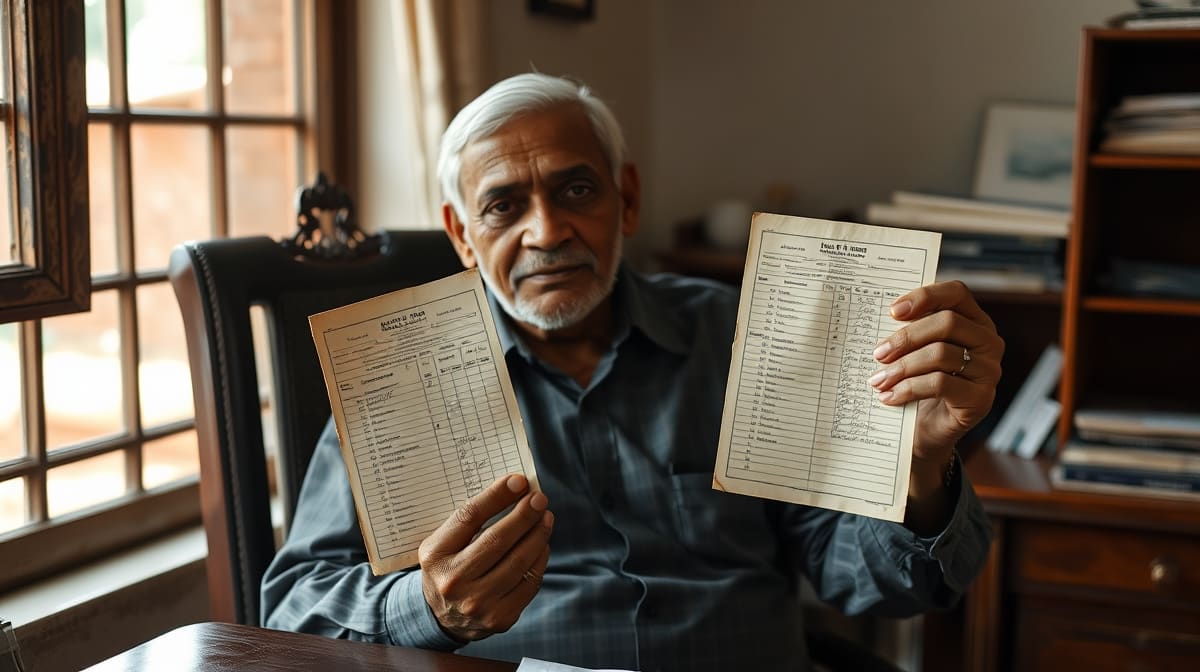
The Bombay High Court has reaffirmed that pre-Constitutional documentary evidence is the bedrock of Scheduled Tribe identity claims, rendering secondary tests like affinity irrelevant when such evidence is conclusive. This judgment provides critical clarity for public servants and applicants whose caste certificates have been invalidated on speculative grounds.
Background & Facts
The Dispute
The petitioner, Shri Nayabrao S/o Ashru Shinde, a retired primary school teacher and Head Master, claimed membership in the "Thakur" Scheduled Tribe listed at Sr. No. 44 of the Presidential (Scheduled Tribes) Order, 1950. He was appointed to a reserved post on 01/09/1987 based on a Caste Certificate issued on 18/07/1983 by the Naib Tehsildar, Lonar, Dist. Buldana. He was promoted to Head Master on 20/12/1993 and retired on 28/02/2022. In 2013, his employer, the Zilla Parishad Buldana, initiated verification of his caste claim before the Schedule Tribe Caste Certificate Scrutiny Committee, Amravati.
Key Facts
- The petitioner submitted multiple pre-Constitutional documents establishing his lineage and caste:
- Birth entry in Revenue Record of his grandfather, Punjaji, dated 06/10/1930, recording caste as "Thakur"
- Mutation Register (Ferfar) of Punjaji dated 20/06/1934, recording caste as "Thakur"
- School Leaving Certificate of his father, Ashru, dated 16/06/1943, recording caste as "Thakur"
- The Vigilance Cell Enquiry conducted on 29/09/2017 confirmed that all documents, including those prior to 1950, consistently recorded caste as "Thakur"
- The Committee issued a Show Cause Notice dated 12/09/2018, to which the petitioner submitted a detailed reply
- The petitioner appeared before the Committee on 07/10/2022 and was heard at length
- The impugned order dated 19/12/2022 invalidated the caste claim on three grounds: (i) insufficient documentary proof, (ii) failure to establish affinity with the Thakur Scheduled Tribe, and (iii) reliance on area restrictions
Procedural History
- 18/07/1983: Caste Certificate issued by Naib Tehsildar, Lonar
- 01/09/1987: Appointment to post reserved for Scheduled Tribes
- 20/12/1993: Promotion to Head Master
- 17/07/2013: Employer initiated verification of caste claim
- 29/09/2017: Vigilance Cell Enquiry completed
- 12/09/2018: Show Cause Notice issued
- 07/10/2022: Petitioner heard before the Committee
- 19/12/2022: Impugned order invalidating caste claim issued
- 23/03/2026: Narendrasingh Thakur v. State of Maharashtra decided by Bombay HC
- 30/03/2026: Judgment reserved
- 23/04/2026: Judgment pronounced
Relief Sought
The petitioner sought quashing of the impugned order dated 19/12/2022, restoration of his caste certificate, and directions to the Zilla Parishad to refrain from taking coercive action regarding his service benefits.
The Legal Issue
The central question was whether the rejection of a Scheduled Tribe claim based solely on failure of the affinity test is lawful when conclusive pre-Constitutional documentary evidence establishes caste identity, and whether area restrictions continue to apply after the 1976 Amendment.
Arguments Presented
For the Petitioner
Counsel relied on Anand v. Committee for Scrutiny and Verification of Tribe Claims (2012) 1 SCC 113, Madhuri Patil v. Addl. Commissioner, Tribal Development (1994) 6 SCC 241, and Nikhil Anil Thakur v. State of Maharashtra (2021) 5 Mh.L.J. 104 to argue that pre-1950 documents carry the highest probative value and must be accepted as conclusive. He contended that the affinity test cannot override documentary evidence and that area restrictions were abolished by the Scheduled Castes and Scheduled Tribes Orders (Amendment) Act, 1976. He further cited Narendrasingh Thakur v. State of Maharashtra (25/03/2026) to show that affinity is irrelevant once pre-Constitutional documents are produced.
For the Respondent/State
The Assistant Government Pleader argued that the father’s school certificate showed overwriting, inconsistent ink, and handwriting, suggesting fraud. It was submitted that "Thakur" is also a title used by non-tribal communities like Rajputs and Marathas, and that Thakur Scheduled Tribe members are geographically restricted to Thane, Nashik, Pune, and Ahmadnagar districts. Reliance was placed on Dattu Namdeo Thakur v. State & Others (2010 Mh.L.J. 494), upheld by the Supreme Court, to argue that socio-cultural affinity must be proven.
The Court's Analysis
The Court began by noting that the Scheduled Castes and Scheduled Tribes Orders (Amendment) Act, 1976, which came into force on 20.09.1976, removed all area restrictions for the "Thakur" Scheduled Tribe across Maharashtra. The Committee’s reliance on geographical limitations was therefore legally untenable.
"The persons claiming to belong to Thakur Scheduled Tribe did not foresee that their caste would be recognized as Scheduled Tribe and therefore never recorded their caste as 'Thakur, Scheduled Tribe'."
The Court emphasized that pre-Constitutional documents are the most reliable indicators of tribal identity, as held in Madhuri Patil and Anand. The Vigilance Cell itself had confirmed the consistency of the "Thakur" entry across generations. The Court rejected the argument that overwriting or inconsistent handwriting in the father’s school certificate amounted to fraud, noting that the Committee is not a forensic expert body and cannot draw such conclusions without expert opinion.
The Court further held that the affinity test cannot be used as a litmus test to reject claims where pre-1950 documents are conclusive. Citing Anand, the Court observed that modernization, migration, and cultural assimilation have altered tribal practices, making rigid anthropological criteria inappropriate. The Court cited its own recent decision in Narendrasingh Thakur to reinforce that once pre-Constitutional documents are submitted, the affinity test is not required.
The Court condemned the Committee’s approach as adversarial rather than quasi-judicial, stating:
"Such an approach is wholly contrary to the mandate of law and the settled principles laid down by the Hon'ble Supreme Court and this Court, and deserves to be deprecated."
The Verdict
The writ petition was allowed. The impugned order dated 19/12/2022 was quashed and set aside. Respondent No. 1, the Schedule Tribe Caste Certificate Scrutiny Committee, was directed to issue a Caste Validity Certificate to the petitioner certifying him as belonging to the "Thakur" Scheduled Tribe within four weeks of receipt of a certified copy of this order. Respondent No. 2, the Zilla Parishad Buldana, was directed not to take any coercive action against the petitioner regarding his service benefits.
What This Means For Similar Cases
Pre-Constitutional Documents Are Conclusive
- Practitioners must prioritize submission of pre-1950 documents (birth entries, mutation registers, school certificates) in all ST claims
- Any rejection based on "inconsistencies" in handwriting or ink without forensic evidence is legally unsustainable
- Vigilance Cells and Scrutiny Committees cannot act as forensic experts
Affinity Test Is Corroborative, Not Determinative
- The affinity test may be used to supplement documentary evidence but cannot override it
- Socio-cultural traits like language, religion, or surnames cannot be used to negate claims supported by pre-Constitutional records
- Courts will not permit subjective or speculative rejections based on perceived "lack of affinity"
Area Restrictions Are Abolished
- The 1976 Amendment removed all geographical limitations for "Thakur" Scheduled Tribe status in Maharashtra
- Any reliance on district-wise restrictions is now legally invalid
- Practitioners must cite the 1976 Amendment and Jaywant Dilip Pawar to counter area-based objections