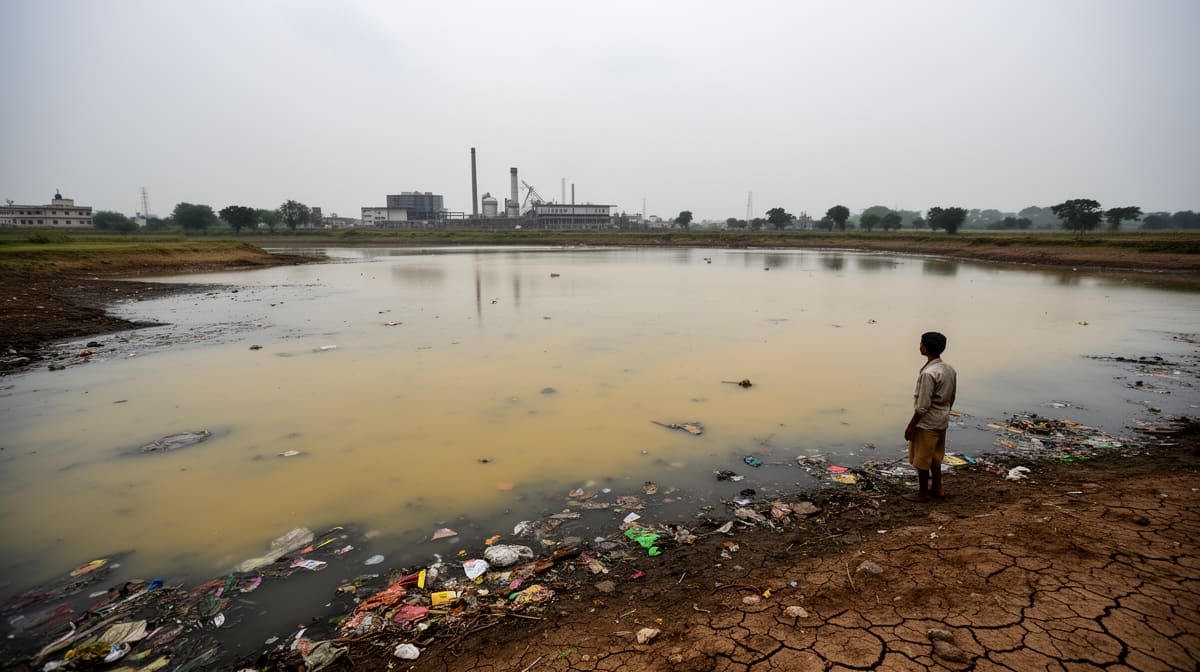
The Jharkhand High Court has affirmed that the constitutional right to health under Article 21 extends to workers in hazardous industries and the public affected by industrial operations, while also establishing that equitable use of public roads is non-negotiable where commercial enterprises disproportionately burden infrastructure. This judgment sets binding obligations on state authorities and industrial units to comply with statutory norms and ensure systemic safeguards.
Background & Facts
The Dispute
The petitioners, Nageshwar Acharya and Suraj Pradhan, filed a public interest litigation challenging systemic failures in the operation of the Chaliyama Steel Plant (CSP), operated by M/s Rungta Mines Limited, located in Rajnagar, District Saraikela Kharsawan. They alleged that the plant’s operations violate statutory requirements for parking and healthcare, endangering both workers and the general public.
Key Facts
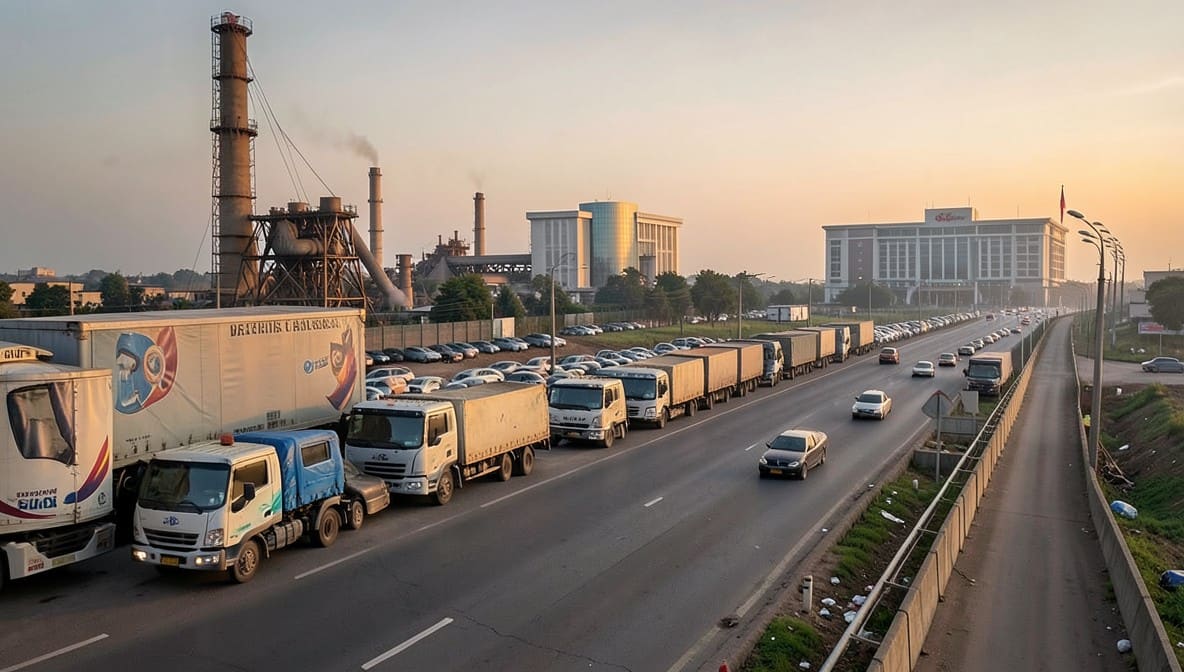
- The CSP is situated near National Highway 220, a major corridor for transporting raw materials from mining areas including Noamundi and Kiriburu.
- No designated parking facilities exist within the CSP premises for heavy vehicles engaged in transporting goods to and from the plant.
- Trucks and heavy vehicles routinely park on public roads adjacent to the CSP, obstructing traffic flow and increasing accident risks.
- The nearest hospital providing secondary-level care is the Chaibasa Sadar Hospital, located 12 kilometres away.
- A Government Primary Health Centre exists approximately 1 km from CSP, but offers only basic first aid.
- A Community Health Centre (CHC) is located at Rajnagar, approximately 12 km from CSP.
- The petitioners submitted photographic evidence and multiple complaints documenting unsafe parking and lack of medical access.
- Representations made to the CSP and local authorities between 2023 and 2025 remained unaddressed.
Procedural History
- 05.01.2025: Writ Petition (PIL) No. 682 of 2025 filed before the Jharkhand High Court.
- 08.04.2026: Case reserved for judgment.
- 16.04.2026: Judgment pronounced.
The Parties' Positions
For the Petitioners:
- Argued that the absence of internal parking forces heavy vehicles onto public roads, violating Rule 41 of the Jharkhand Building Bye-laws, 2016.
- Contended that the 12-km distance to the nearest trauma-capable hospital violates the right to emergency healthcare under Article 21.
- Cited Consumer Education & Research Centre v. Union of India, Bandhua Mukti Morcha v. Union of India, and Peoples Rights and Social Research Centre v. Union of India to establish state obligations.
- Asserted that the state’s inaction constitutes a breach of constitutional duties under Articles 21, 39(e), and 42.
For the Respondents:
- Acknowledged the existence of challenges but submitted that a 20-acre internal parking area has been developed within CSP premises, capable of accommodating 800 - 1000 vehicles.
- Noted the presence of a functional Primary Health Centre and CHC.
- Submitted a report by the General Manager, District Industries Centre, Chaibasa, proposing road widening, designated parking zones, street lighting, and establishment of a trauma centre.
- Argued that congestion is a cumulative regional issue, not attributable solely to CSP.
- Opposed the formation of a fact-finding committee, suggesting instead that existing mechanisms suffice.
Relief Sought
The petitioners sought:
- A writ of mandamus directing the state to enforce Rule 41 of the Jharkhand Building Bye-laws, 2016, ensuring internal parking at CSP.
- A writ directing provision of accessible healthcare facilities for workers and accident victims.
- Constitution of a committee to investigate compliance with health, sanitation, and wage laws.
The Legal Issue
The central questions were: (1) Whether the state’s failure to ensure adequate parking facilities for industrial vehicles violates statutory norms and the public’s right to safe road use under Article 21; and (2) Whether the absence of emergency medical infrastructure within a reasonable distance of a hazardous industrial unit constitutes a violation of the right to health under Article 21.
Arguments Presented
For the Petitioner
The petitioners relied on Bandhua Mukti Morcha v. Union of India and Peoples Rights and Social Research Centre v. Union of India to argue that the state has a non-delegable duty to protect workers in hazardous industries from occupational hazards, including lack of medical access. They emphasized that Rule 41 of the Jharkhand Building Bye-laws, 2016, mandates internal parking for industrial units, and its non-compliance shifts the burden onto public infrastructure. They further cited M.C. Mehta v. Union of India to invoke the principle of absolute liability, asserting that industries must internalize the costs of their operational hazards.
For the Respondent
The respondents conceded the existence of traffic and healthcare gaps but contended that the 20-acre parking area within CSP premises was newly developed and functional. They argued that congestion is a regional phenomenon due to multiple industries and mining transport, not solely attributable to CSP. They also maintained that the existing Primary Health Centre and CHC met minimum standards, and that the proposed trauma centre could be addressed through policy, not judicial mandate.
The Court's Analysis
The Court began by affirming that the right to health is an inseparable component of the right to life under Article 21, as consistently held in Consumer Education & Research Centre v. Union of India, Parmanand Katara v. Union of India, and Paschim Banga Khet Mazdoor Samity v. State of West Bengal. The Court emphasized that this right is not contingent on economic status or location, and that executive inaction cannot defeat constitutional guarantees.
"The State cannot say that it would do nothing in the matter or take no steps to address this serious issue."
The Court rejected the respondents’ argument that the petition should be dismissed as a private dispute. It held that the cumulative impact on public safety, road infrastructure, and worker welfare rendered the matter squarely within the domain of public interest litigation.
Regarding parking, the Court found that Rule 41 of the Jharkhand Building Bye-laws, 2016, imposes a clear statutory obligation on industrial units to provide internal parking. The fact that trucks were using public roads as makeshift parking areas constituted a violation of this rule and an inequitable use of taxpayer-funded infrastructure. The Court noted that while the respondents claimed a 20-acre parking area had been developed, no evidence was presented to confirm its operational status or compliance.
On healthcare, the Court held that a Primary Health Centre offering only first aid and a CHC located 12 km away were grossly inadequate for a high-traffic industrial corridor. The Court cited Occupational Health & Safety Association v. Union of India to underscore the necessity of on-site or nearby trauma care in hazardous industries.
The Court declined to constitute a fact-finding committee, noting that such orders are not routine and that the respondents’ own report contained actionable proposals. It found the suggestions by the District Industries Centre - road widening, designated parking zones, traffic monitoring, and trauma centre establishment - to be comprehensive and worthy of implementation.
The Verdict
The petition was disposed of with the following directions:
- The Principal Secretary, Department of Industries, shall enforce Rule 41 of the Jharkhand Building Bye-laws, 2016, ensuring internal parking at CSP so public roads are not used for heavy vehicle parking.
- The same authority shall consider and decide on the District Industries Centre’s report within three months, and implement approved measures within 12 months.
- State authorities shall prohibit unauthorized roadside parking by CSP-linked vehicles and ensure traffic regulation.
- Designated heavy vehicle parking zones shall be developed along the affected highway corridor within 18 months.
- The Principal Secretary, Department of Health, shall take a policy decision on establishing emergency medical and trauma care facilities within three months, with implementation within 18 months.
- The State shall explore CSP’s participation under its Corporate Social Responsibility (CSR) obligations to fund medical infrastructure.
- The Superintendent of Police, Chaibasa, shall enforce traffic regulations and install monitoring mechanisms.
- A comprehensive compliance affidavit shall be filed before the Court within six months.
What This Means For Similar Cases
Statutory Compliance Is Non-Negotiable in Industrial Zones
- Practitioners must now argue that failure to comply with building bye-laws mandating internal parking (e.g., Rule 41) constitutes a public nuisance and constitutional violation.
- Industries cannot shift the burden of infrastructure costs onto public roads; compliance is mandatory, not discretionary.
Right to Emergency Healthcare Is a Constitutional Imperative
- Where hazardous industries operate, the state must ensure trauma-capable medical facilities are accessible within a reasonable distance.
- Primary Health Centres offering only first aid are insufficient; secondary or tertiary care must be within 10 - 15 km.
- CSR obligations of industrial units can be invoked as a funding mechanism for public health infrastructure.
Public Interest Litigation Is a Viable Tool for Systemic Reform
- PILs can compel state action even where respondents offer partial compliance, provided systemic gaps persist.
- Courts may decline to appoint committees if actionable reports exist, instead directing implementation timelines.
- Judicial directions must be specific, time-bound, and enforceable to prevent executive delay.