The tragic drowning of three minor children in an unfenced forebay tank has led the Jammu & Kashmir High Court to affirm that the State’s failure to secure hazardous public infrastructure constitutes a violation of the fundamental right to life under Article 21, entitling bereaved families to monetary compensation and systemic reform.
Background & Facts
The Dispute
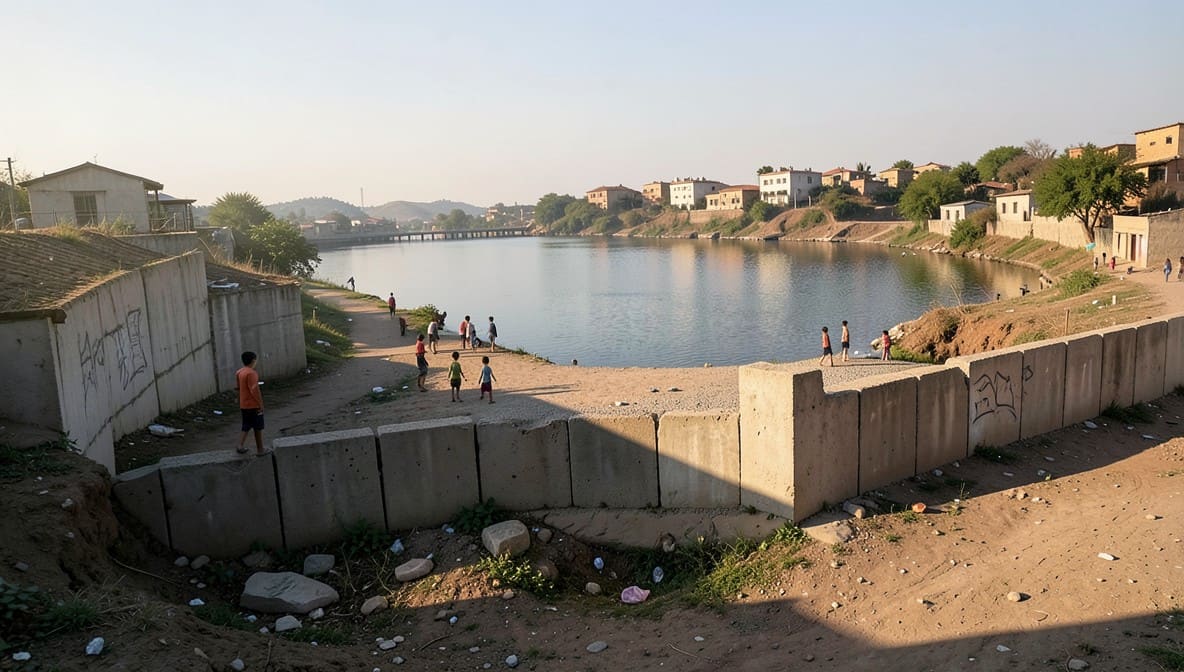
The petitioner, Arjun Kumar Sharma, a farmer from Village Pakhlai, Udhampur, filed a writ petition seeking compensation for the death of his three minor children - Anu Devi (8 years), Preeti Devi (6 years), and Sunil (3 years) - who drowned on 09.06.2008 in the forebay tank of the Chenani Hydel Project. The petitioner alleged that the tank, with steep plastered slopes and deep water, was left unprotected by adequate fencing or safety barriers, despite being located in a densely inhabited rural area.
Key Facts
- The incident occurred on 09.06.2008 when the children, unsupervised, wandered near the reservoir while following their parents to agricultural fields.
- The forebay tank was constructed prior to 1971 and was maintained by the Power Development Department, Government of J&K.
- The only safety measure present was a parapet wall of approximately two feet in height.
- The petitioner’s family lived below the poverty line, surviving on subsistence agriculture and daily wage labor.
- Two of the deceased children were enrolled in Government Middle School, Manglian, and were performing well academically.
- FIRs Nos. 329/2008, 330/2008, and 331/2008 were registered at Police Station Udhampur.
- The Revenue Department submitted a report on 15.06.2008 recommending humanitarian compensation due to the petitioner’s destitute condition.
- A legal notice dated 14.06.2008 demanding Rs. 15,00,000 in compensation was served on the respondents but remained unaddressed.
- The respondents claimed no prior incidents had occurred at the site and that the petitioner’s land was located at a considerable distance from the reservoir.
Procedural History
- 09.06.2008: Incident - drowning of three children in Chenani Hydel Project’s forebay tank.
- 14.06.2008: Legal notice sent to respondents demanding compensation.
- 15.06.2008: Revenue Department recommends humanitarian compensation.
- 05.03.2026: Judgment reserved.
- 24.03.2026: Judgment pronounced by Justice Wasim Sadiq Nargal.
- 25.03.2026: Judgment uploaded.
The Parties' Positions
Petitioner: Argued that the State’s failure to install proper fencing, barriers, or warning signs amounted to gross negligence. Emphasized that children of tender age cannot be expected to appreciate risks, and the State’s duty of care is non-delegable. Cited Nilabati Behera, Darshan, and Kanagaraj to establish State liability under Article 21.
Respondents: Contended that the writ petition was not maintainable as it involved disputed facts requiring a civil trial. Denied negligence, asserting that a two-foot parapet wall provided adequate safety. Attributed the incident to parental negligence and claimed no prior complaints had been received.
Relief Sought
The petitioner sought:
- Compensation of Rs. 15,00,000 for the loss of three children.
- Directions to install proper fencing, warning signs, and safety measures at the forebay tank and similar installations.
The Legal Issue
The central question was whether the State’s failure to secure a hazardous public installation, resulting in the death of minor children, constitutes a violation of the fundamental right to life under Article 21 of the Constitution, thereby entitling the family to compensation in writ proceedings, even in the absence of a civil suit.
Arguments Presented
For the Petitioner
Learned counsel relied on Nilabati Behera v. State of Orissa to argue that the State is liable for violation of Article 21 even without proof of intentional wrongdoing. Cited Darshan v. Union of India and Kanagaraj v. District Collector to establish that the doctrine of res ipsa loquitur applies when a hazardous structure causes death of minors. Emphasized that children cannot be attributed contributory negligence (Subramanium v. Delhi Metro) and that the State’s duty is strict and non-delegable. Highlighted the absence of any effective safety measures beyond a two-foot wall, which is insufficient to prevent access by children.
For the Respondent
The State contended that the petition was not maintainable under Article 226 because it involved disputed questions of fact, which must be adjudicated in a civil suit. Argued that the parapet wall was adequate and that the incident resulted from parental negligence. Asserted that the Revenue Department’s recommendation was purely humanitarian and did not imply legal liability. Claimed no prior complaints had been received, suggesting the site was safe.
The Court's Analysis
The Court began by rejecting the preliminary objection regarding maintainability. It held that where the State’s inaction results in the violation of Article 21, the writ jurisdiction is not barred merely because a civil remedy exists. The Court cited Nilabati Behera and Municipal Corporation of Delhi v. Uphaar Tragedy Victims to affirm that the State bears strict liability for harm caused by hazardous public installations.
"The drowning of three minor children in a reservoir maintained by the respondents is not an occurrence which would ordinarily take place if adequate safeguards had been in place. The incident, therefore, speaks for itself and raises a presumption of negligence against the authorities."
The Court found the respondents’ admission - through their reply affidavit - that only a two-foot parapet wall existed around the tank to be decisive. It held that such a barrier was wholly inadequate for a structure with steep slopes and deep water, particularly in a rural area frequented by children. The Court applied the doctrine of res ipsa loquitur, noting that the very occurrence of the tragedy implied negligence, shifting the burden to the State to prove otherwise. The respondents failed to produce any evidence of inspections, maintenance records, or safety protocols.
The Court further rejected the argument that parental negligence absolved the State. Citing Kanagaraj and Subramanium, it held that children of tender age cannot be expected to comprehend danger, and the law imposes a higher duty on those controlling hazardous premises. The Court emphasized that Article 38, 39(e), 39(f), and 47 of the Constitution impose a duty on the State to ensure public safety and welfare, making the failure to act not merely negligent but constitutionally impermissible.
The Court also noted the systemic nature of such failures, referencing recurring incidents of electrocution and drowning due to unsecured infrastructure. It held that reactive compensation is insufficient; preventive measures are constitutionally mandated.
The Verdict
The writ petition was allowed. The Court directed the respondents to pay compensation of Rs. 2,00,000 for each deceased child, totaling Rs. 6,00,000, to the petitioner within eight weeks from the date of the order. The respondents were further directed to immediately install proper fencing, warning signboards, and other safety measures at the Chenani Hydel Project’s forebay tank and all similar hazardous installations across the Union Territory. The Court emphasized that compensation is not a valuation of life but a constitutional remedy to acknowledge State failure and deter future negligence.
What This Means For Similar Cases
State Must Proactively Secure Hazardous Infrastructure
- Public authorities must install physical barriers of sufficient height (minimum 4 - 6 feet) around reservoirs, manholes, open drains, and high-tension installations.
- Warning signs in local languages must be placed at all entry points.
- Routine inspections and maintenance logs must be maintained and made available for audit.
Compensation Is Not Tied to Income or Dependency
- In cases involving death of minors or non-earning individuals, the multiplier method is inapplicable.
- Uniform compensation, based on the gravity of loss and State culpability, is the appropriate public law remedy.
- Courts will award compensation to acknowledge constitutional breach, not to replace pecuniary loss.
Contributory Negligence Cannot Be Imputed to Children
- Parents’ alleged lack of supervision cannot absolve the State of its duty to secure hazardous public installations.
- The law presumes children lack capacity to assess risk; the burden of protection lies entirely with the custodian of the hazard.
- This principle applies uniformly across all States and Union Territories.