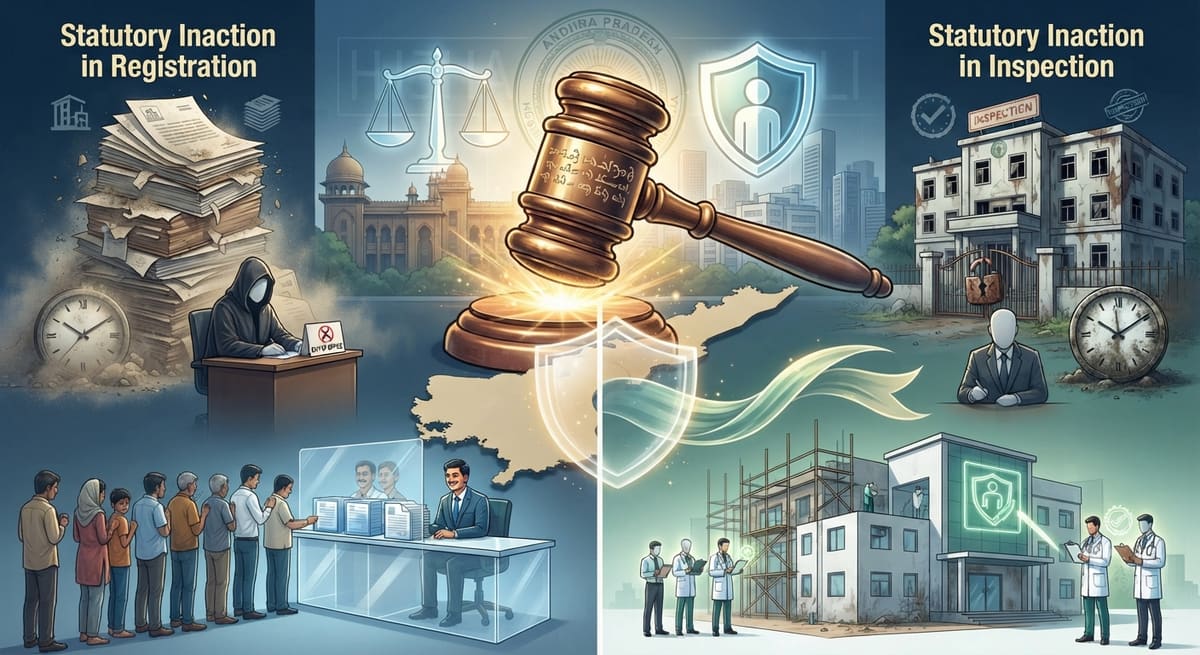
The Chhattisgarh High Court has reaffirmed that public authorities cannot remain passive in the face of documented violations of health and safety norms in clinical establishments. By directing the Chief Medical and Health Officer to act on a formal complaint regarding hazardous oxygen storage and illegal parking, the Court has underscored the non-discretionary duty of regulatory bodies under the Chhattisgarh Clinical Establishment Act and Nursing Home Rules 2013.
Background & Facts
The Dispute
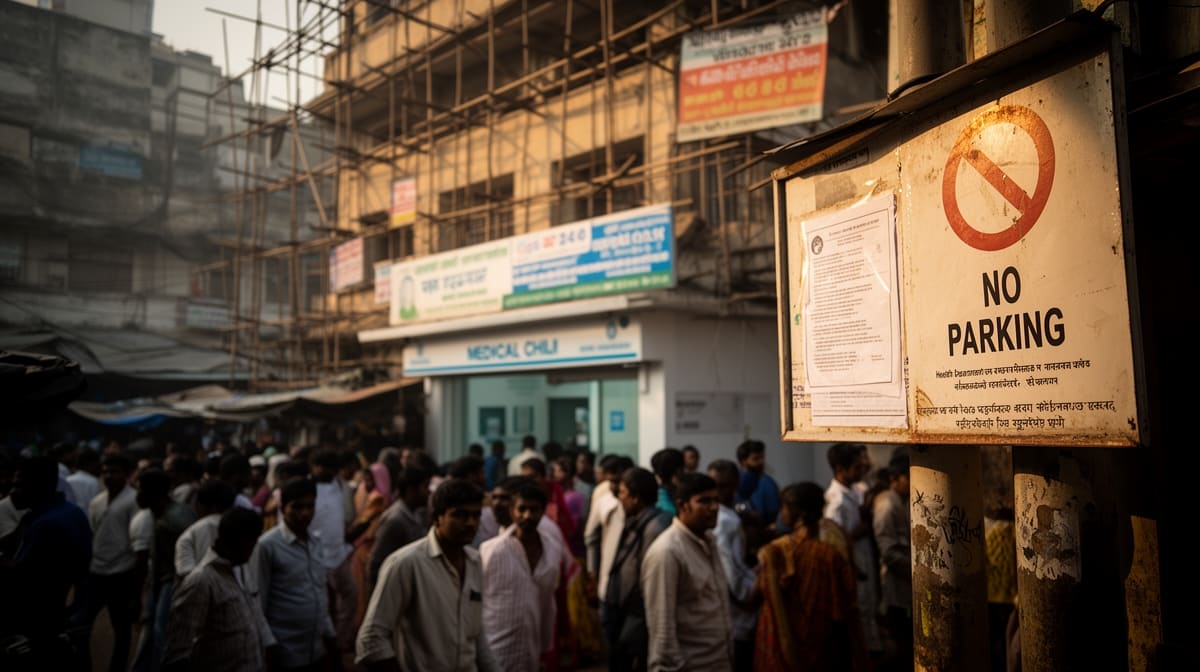
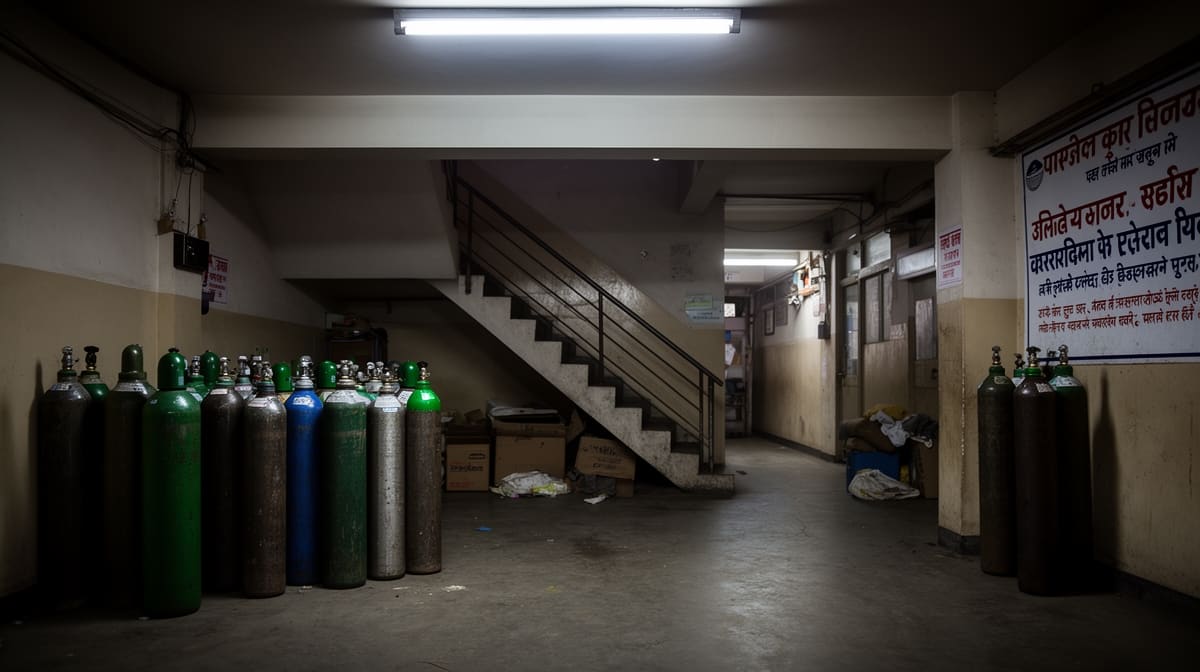
The petitioner, a resident of Bhilai, filed a writ petition under Article 226 of the Constitution alleging serious public safety violations by Sparsh Multispecialty Hospital. The hospital had installed an oxygen plant and stored multiple oxygen cylinders in the basement, contrary to safety norms, and had converted designated parking areas into storage space. This forced patients, visitors, and staff to park vehicles on public roads, creating congestion and safety hazards. On 20 January 2026, the petitioner parked her scooter outside a nearby shop due to lack of space and returned to find its seat cover damaged.
Procedural History
- The petitioner submitted a written complaint (Annexure-P/3) on 20.01.2026 to the Chief Medical and Health Officer (CMHO), District Durg.
- Similar complaints were filed by other residents with the District Collector and the Municipal Commissioner.
- No action was taken by any of the respondents despite repeated representations.
- The petitioner approached the High Court seeking a writ of mandamus to compel enforcement.
Relief Sought
The petitioner sought: (1) mandamus directing respondents 2 to 4 to initiate action against the hospital under the Chhattisgarh Clinical Establishment Act and Nursing Home Rules 2013; (2) removal of the oxygen plant and manifold from the basement; and (3) prohibition on using public roads for hospital vehicle parking.
The Legal Issue
The central question was whether a writ of mandamus can be issued to compel a statutory authority to perform its mandatory duty under health regulations when it has failed to act on a specific, documented complaint.
Arguments Presented
For the Petitioner
Learned counsel argued that the Chhattisgarh Clinical Establishment Act and Nursing Home Rules 2013 impose a statutory duty on the CMHO to inspect and regulate clinical establishments. The installation of oxygen cylinders in the basement violates Rule 17(2) of the Nursing Home Rules, which prohibits storage of flammable materials in basements. The obstruction of parking spaces and use of public roads for hospital vehicles further breaches municipal and health safety norms. Reliance was placed on State of Punjab v. Baldev Singh to establish that mandamus lies where a public duty is clear, specific, and unperformed.
For the Respondent/State
The State and Municipal authorities conceded that the complaint had been received but claimed no formal order had been passed yet. They submitted that the matter would be considered in accordance with law, without admitting any lapse or delay. No substantive legal defense was offered against the existence of the statutory duty.
The Court's Analysis
The Court examined the nature of the obligations imposed by the Chhattisgarh Clinical Establishment Act and the Nursing Home Rules 2013. It noted that these provisions are not directory but mandatory, designed to protect public health and prevent catastrophic incidents such as fire or explosion from improperly stored oxygen. The Court emphasized that the duty to act is not discretionary once a complaint is received and prima facie violations are apparent.
"The statutory authority cannot remain a silent spectator when safety norms are being flagrantly violated in a healthcare facility serving the public. The very purpose of the regulatory framework is to ensure proactive enforcement."
The Court rejected the notion that administrative inaction could be justified by procedural delays. It held that the petitioner’s complaint, supported by multiple similar representations, created a clear and enforceable obligation. The Court declined to adjudicate the merits of the alleged violations but affirmed that the CMHO must investigate and act within a stipulated time.
The Verdict
The petitioner succeeded. The Court held that the Chief Medical and Health Officer has a non-discretionary duty to act on complaints under the Clinical Establishment Act and directed the officer to dispose of the complaint within 45 days. The petition was disposed of with this direction, without adjudicating the underlying factual allegations.
What This Means For Similar Cases
Regulatory Authorities Cannot Remain Passive
- Practitioners may now invoke mandamus against health departments that ignore complaints about violations of clinical establishment norms.
- A formal written complaint, even without prior litigation, suffices to trigger the duty to act.
- Delay in responding to safety complaints can be challenged as a violation of Article 21 rights to life and health.
Mandamus Is Available For Procedural Enforcement
- Courts will not require proof of actual harm to issue mandamus; a credible risk of harm suffices.
- The remedy is not limited to cases of gross negligence - routine non-compliance with safety rules qualifies.
- Practitioners should file and preserve copies of all representations to authorities as evidence of prior notice.
Parking and Infrastructure Violations Are Health Issues
- Converting hospital parking into storage or allowing public road use for ambulances and vehicles is now recognized as a public health violation.
- Municipal and health authorities must coordinate to enforce land use and safety norms jointly.
- Hospitals must maintain compliant parking and storage facilities as part of their licensing obligations.