The Madras High Court has clarified a critical boundary in property registration law, reinforcing that registering officers lack authority to adjudicate title disputes even when third-party claims appear in revenue records. This ruling restores the limited, ministerial role of sub-registrars under the Registration Act, 1908, and provides immediate relief to parties facing arbitrary refusals based on patta anomalies.
Background & Facts
The Dispute
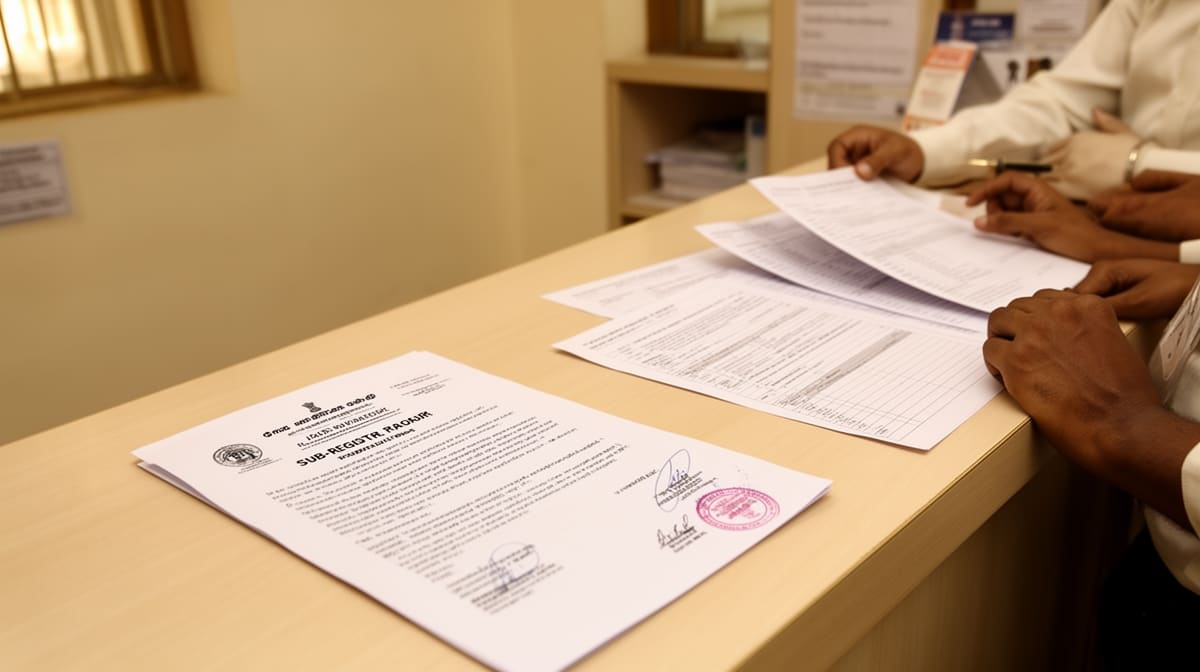
The petitioners sought registration of a sale deed dated 09.01.2026, transferring four parcels of land in Vattuvanahalli village, Dharmapuri District, to a buyer named Sampoornam. The sale deed was executed based on a partition deed dated 14.07.2008, which had allotted the subject properties to V.R. Thaiyanayagam. The petitioners, as legal heirs of V.R. Thaiyanayagam, presented the sale deed for registration. The Sub Registrar refused registration under an impugned refusal check slip dated 13.01.2026, citing the presence of third-party names in the patta records.
Procedural History
- 14.07.2008: Partition deed executed, allocating properties to V.R. Thaiyanayagam
- 12.12.2025: Sale deed executed by legal heirs of V.R. Thaiyanayagam and successfully registered
- 09.01.2026: Petitioners executed new sale deed in favor of Sampoornam for same properties
- 13.01.2026: Sub Registrar issued refusal check slip citing third-party names in patta
- 24.02.2026: Writ petition filed under Article 226 before Madras High Court
Relief Sought
The petitioners sought quashing of the refusal check slip and a direction to the Sub Registrar to register the sale deed dated 09.01.2026, subject to fulfillment of other statutory requirements.
The Legal Issue
The central question was whether a registering officer, under Section 34C of the Registration Act, 1908, may refuse registration of a sale deed solely on the ground that third-party names appear in the patta, even when the title chain from a previously registered partition deed is clear and uncontested.
Arguments Presented
For the Petitioner
Counsel for the petitioners relied on the prior registration of the sale deed dated 12.12.2025, executed by the same legal heirs of V.R. Thaiyanayagam, to establish a clear and unbroken title chain. They argued that Section 34C permits refusal only for defects in execution, form, or compliance with procedural requirements - not for adjudicating title disputes. The presence of third-party names in the patta, they contended, is a matter for civil courts under Section 9 of the CPC, not for the Sub Registrar.
For the Respondent
The Government Advocate conceded notice but defended the refusal on the basis that the patta reflected conflicting claims by third parties, suggesting potential title defects. He argued that the registering officer had a duty to prevent fraudulent registrations and that the patta’s anomalies justified scrutiny.
The Court's Analysis
The Court examined the scope of Section 34C of the Registration Act, 1908, as amended in Tamil Nadu, which expanded grounds for refusal to include "any other reason" deemed sufficient by the registering officer. However, the Court emphasized that even this expanded power does not empower the officer to act as a title adjudicator.
"The registering officer is not a court of competent jurisdiction to determine title disputes. His function is ministerial, not judicial."
The Court noted that the sale deed dated 12.12.2025, executed by the same legal heirs over the same properties, had already been registered without objection. This established a prima facie valid title. The mere presence of third-party names in the patta, without any registered claim or pending litigation, could not override this. The Court held that revenue records like patta are not conclusive proof of title and are subject to challenge in civil proceedings.
The Court further observed that allowing registration refusals based on patta entries would open the floodgates to arbitrary denials, undermining the statutory scheme of the Registration Act and exposing property buyers to administrative harassment.
The Verdict
The petitioners succeeded. The Madras High Court set aside the impugned refusal check slip and directed the Sub Registrar to permit re-presentation of the sale deed for registration within two weeks, subject to fulfillment of all other statutory requirements. The Court affirmed that title disputes must be resolved in civil courts, not by registering officers.
What This Means For Similar Cases
Registration Cannot Be Denied on Patta Anomalies
- Practitioners must now challenge refusals based on patta entries as ultra vires under Section 34C
- A previously registered deed by the same vendor establishes a strong prima facie title
- Revenue records alone cannot justify refusal; absence of registered title defects is sufficient
Title Disputes Are Civil Matters
- Any claim of third-party interest must be raised in a civil suit under Section 9 CPC
- Sub Registrars must not delay registration pending resolution of title disputes
- Petitioners may now seek writ relief under Article 226 where registration is unreasonably withheld on title grounds
Procedural Compliance Trumps Administrative Suspicion
- If the deed is properly executed, stamped, and presented with requisite documents, refusal is impermissible
- The burden lies on the registering officer to prove a procedural defect - not on the party to disprove speculative title claims
- This judgment reinforces the principle that registration is a public record function, not a gatekeeping mechanism for title validation