The Madras High Court has reaffirmed that Sub-Registrars have a mandatory statutory duty to receive and process lawfully presented documents for registration, irrespective of unverified third-party objections. This judgment clarifies that procedural non-receipt of a deed cannot be justified as a substantive bar to registration, reinforcing the principle that administrative inaction cannot override statutory obligations.
Background & Facts
The Dispute
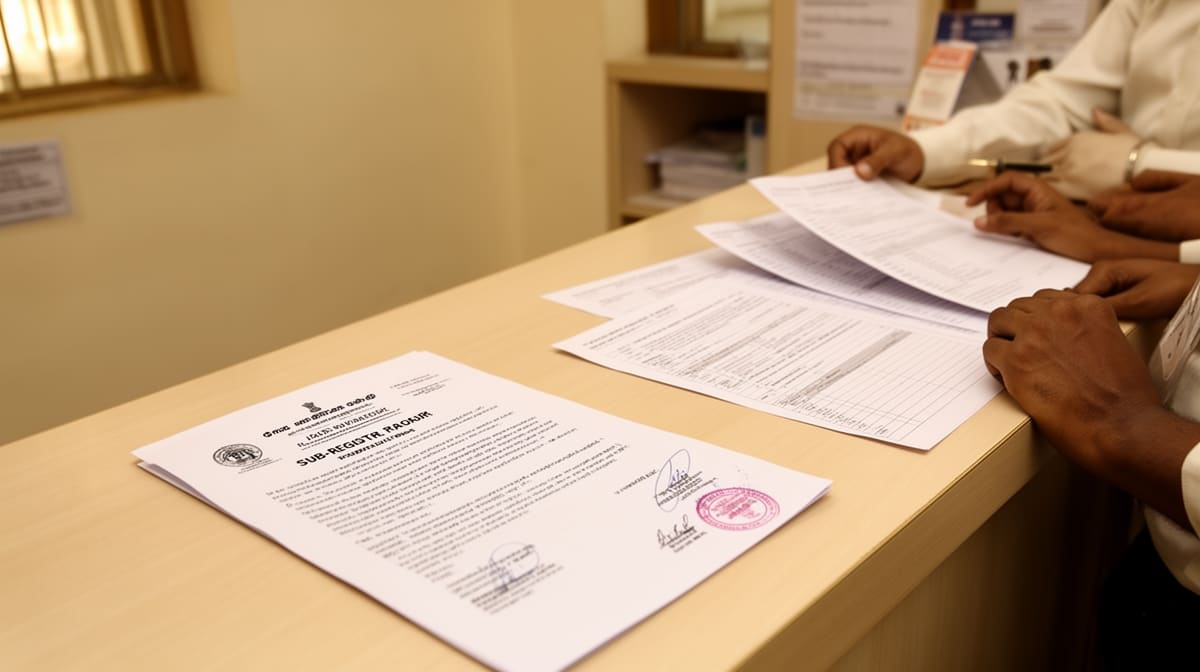
The petitioners, a group of eight individuals, sought registration of a release deed dated 20.06.2025, executed by the 6th and 8th petitioners in favor of the 1st petitioner. The deed was uploaded on the Tamil Nadu Registration Department’s web portal and presented to the first respondent, the Sub-Registrar of Perunkulam Range, Tuticorin District, on the same date. The petitioners had secured a token for registration between 12:00 and 13:00 hours on 20.06.2025, in accordance with the online appointment system.
Key Facts
- The release deed was duly executed, stamped, and uploaded on the official portal on 20.06.2025.
- The petitioners appeared at the Sub-Registrar’s office on 20.06.2025 within the allotted time slot.
- The document was not physically received by the Sub-Registrar’s office on that date.
- The 1st petitioner, T. Velsankar, holds Power of Attorney from petitioners 2 to 8.
- The second respondent, M/s. Tritoma Promotors Pvt. Ltd., was impleaded on 17.11.2025 in a related miscellaneous petition.
- No formal objection was filed or recorded by any third party prior to the presentation of the deed.
Procedural History
- 20.06.2025: Release deed presented at Sub-Registrar’s office during appointed slot; not received.
- 23.03.2026: Writ Petition (W.P.(MD) No. 28790 of 2025) filed under Article 226 of the Constitution.
- 17.11.2025: Second respondent impleaded by court order in W.M.P.(MD) No. 22907 of 2025.
- 23.03.2026: Hearing conducted before the Madurai Bench of the Madras High Court.
The Parties' Positions
Petitioners: Contended that they had complied with all procedural requirements under the Registration Act, 1908, and the Tamil Nadu Registration Rules. The refusal to receive the document, without any recorded objection or statutory ground, amounted to arbitrary administrative inaction.
Respondent 1 (Sub-Registrar): Through the Additional Government Pleader, submitted that the document was not received due to objections raised by third parties, though no written objections were produced or recorded.
Respondent 2 (Tritoma Promotors): Did not appear and filed no submissions.
Relief Sought
The petitioners sought a writ of mandamus directing the first respondent to receive and register the release deed dated 20.06.2025, and to process it in accordance with law.
The Legal Issue
The central question was whether a Sub-Registrar may lawfully refuse to receive a duly presented deed for registration on the basis of unsubstantiated third-party objections, without conducting any statutory enquiry or recording formal objections.
Arguments Presented
For the Petitioner
The petitioners relied on the mandatory duty imposed on Sub-Registrars under Section 32 of the Registration Act, 1908, which requires the officer to receive any document presented for registration during office hours. They argued that refusal to receive a document, even if objections are later raised, violates the statutory mandate and amounts to procedural arbitrariness. They cited State of Tamil Nadu v. K. Rajendran (2018) to emphasize that registration is a ministerial act, not discretionary, unless a valid legal impediment is established.
For the Respondent
The Additional Government Pleader contended that the Sub-Registrar refrained from receiving the document due to alleged third-party claims over the property, which, if unaddressed, could lead to future litigation. However, no written objections, affidavits, or court orders were produced to substantiate these claims.
The Court's Analysis
The Court observed that the Sub-Registrar’s role is not to adjudicate title disputes at the stage of document presentation. Under Section 32 of the Registration Act, 1908, the officer is bound to receive any document presented for registration, provided it is properly stamped and accompanied by requisite fees. The duty to examine the document for legal validity, including potential objections, arises only after receipt.
"When the petitioners duly present a release deed, it must be received by the first respondent / Sub-Registrar. Any objections, if raised, must be addressed through due enquiry and an order be passed in accordance with law."
The Court held that the refusal to receive the document on speculative grounds constituted a failure to perform a statutory duty. The Sub-Registrar cannot act as a preliminary adjudicator of title disputes. If third parties have legitimate claims, they must file formal objections under Section 72 of the Registration Act, which triggers a prescribed enquiry process. Mere verbal assertions, without documentation or legal filing, cannot justify non-receipt.
The Court further noted that the petitioners had complied with all procedural requirements: online booking, timely appearance, proper execution, and payment of fees. The failure to receive the document was therefore unlawful.
The Verdict
The writ petition was disposed of with directions. The petitioners shall appear before the first respondent on 02.04.2026 at 10:30 a.m. The Sub-Registrar shall receive the release deed and process it in accordance with law. If no legal impediment exists, the deed shall be registered. If objections are raised, a formal enquiry under Section 72 of the Registration Act, 1908 shall be conducted expeditiously, and an order passed within 15 days. No costs were awarded.
What This Means For Similar Cases
Registration Cannot Be Denied on Unverified Allegations
- Practitioners must insist that Sub-Registrars receive all lawfully presented documents, regardless of third-party claims.
- Verbal objections without written submissions or court filings are legally insufficient to justify non-receipt.
- Any refusal to receive a document must be challenged immediately under Article 226.
Statutory Enquiry Must Follow Receipt, Not Precede It
- Sub-Registrars must first receive the document before initiating any enquiry under Section 72.
- The burden of proving a legal impediment lies with the objecting party, not the presenter.
- Delayed registration due to unverified objections violates the principle of audi alteram partem.
Procedural Compliance Is Non-Negotiable
- Online token systems and appointment slots are legally recognized under the Tamil Nadu Registration Rules.
- Failure to receive a document presented within the appointed slot constitutes a breach of statutory duty.
- Courts will not tolerate administrative evasion of statutory obligations under the guise of caution.