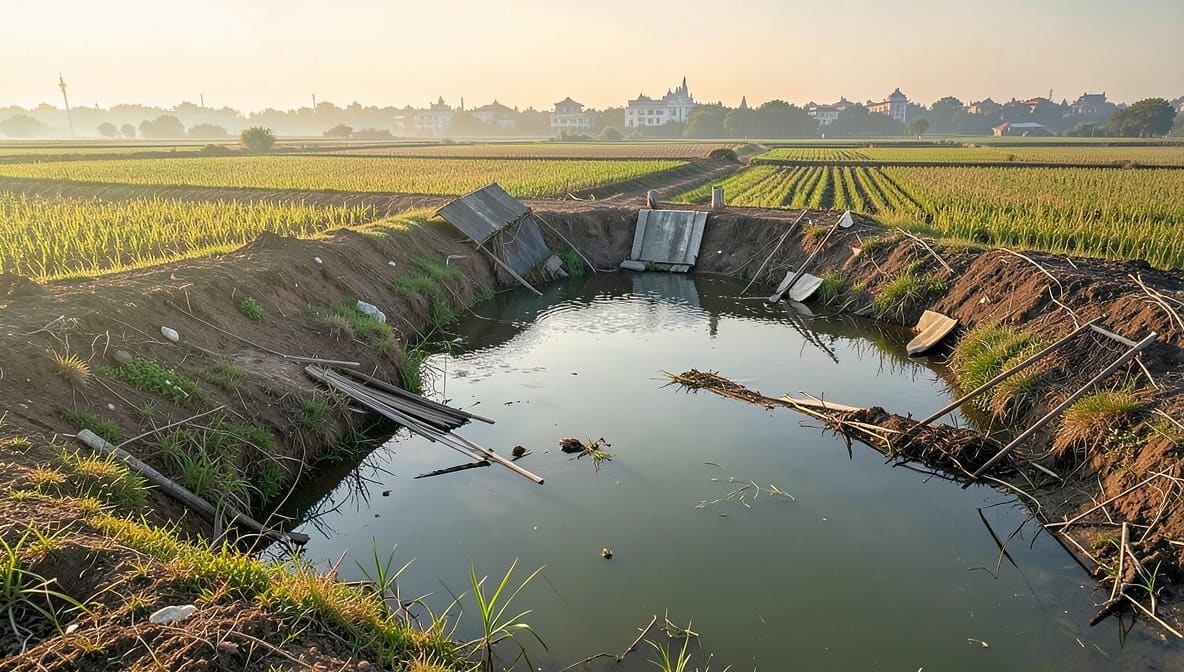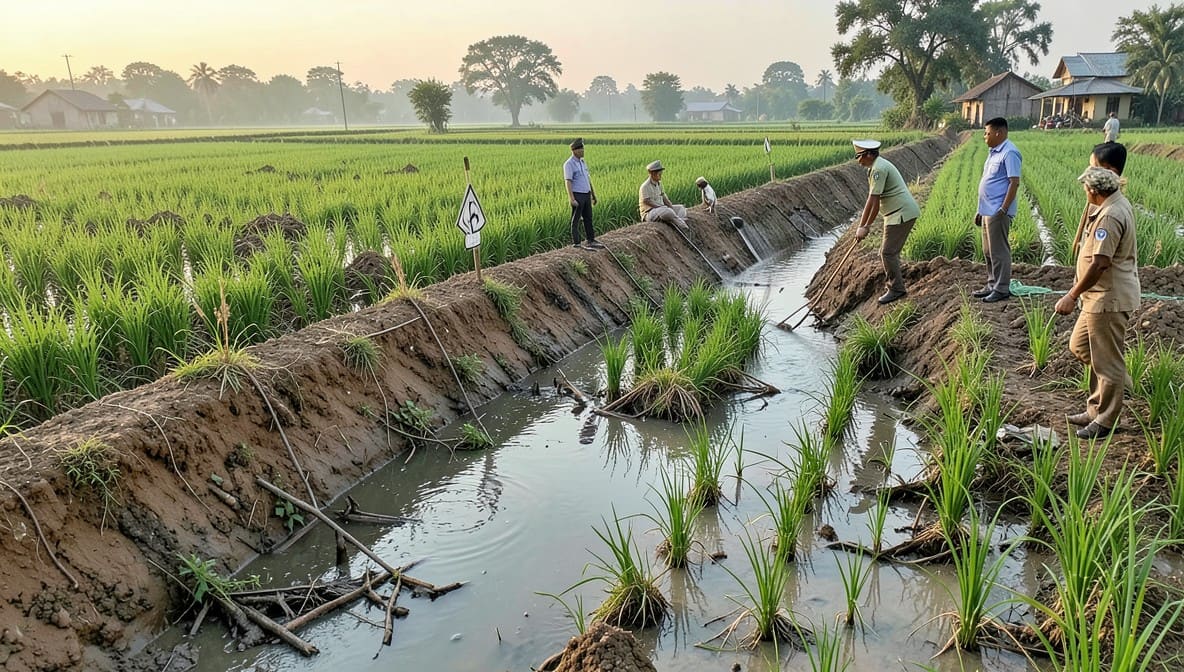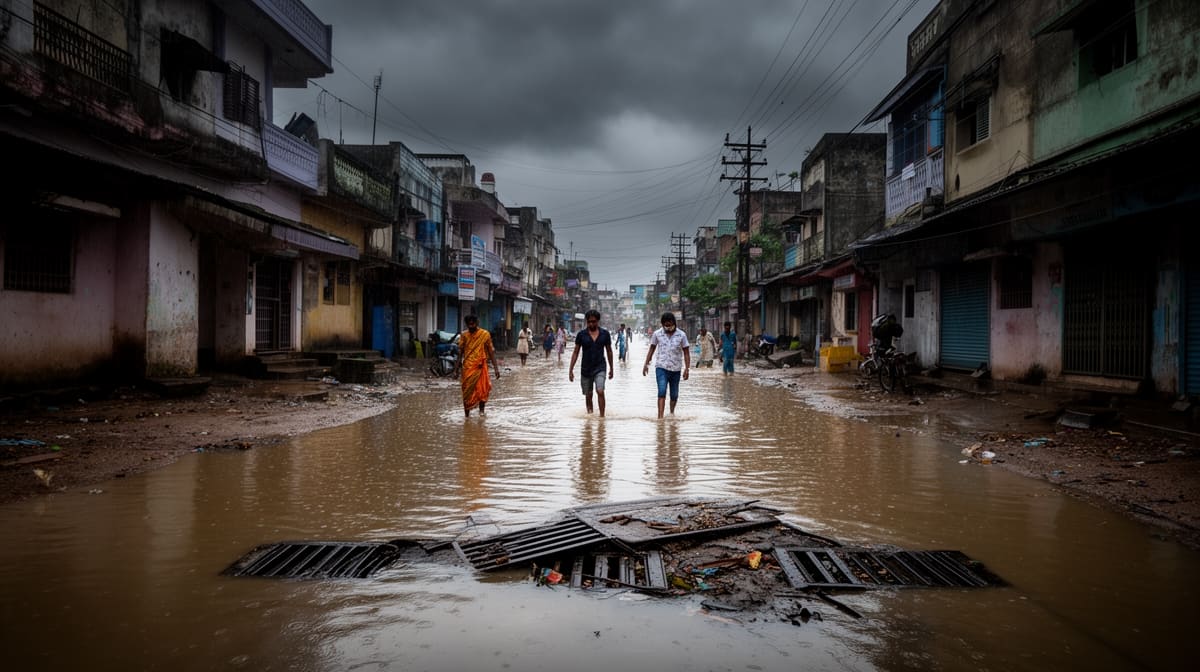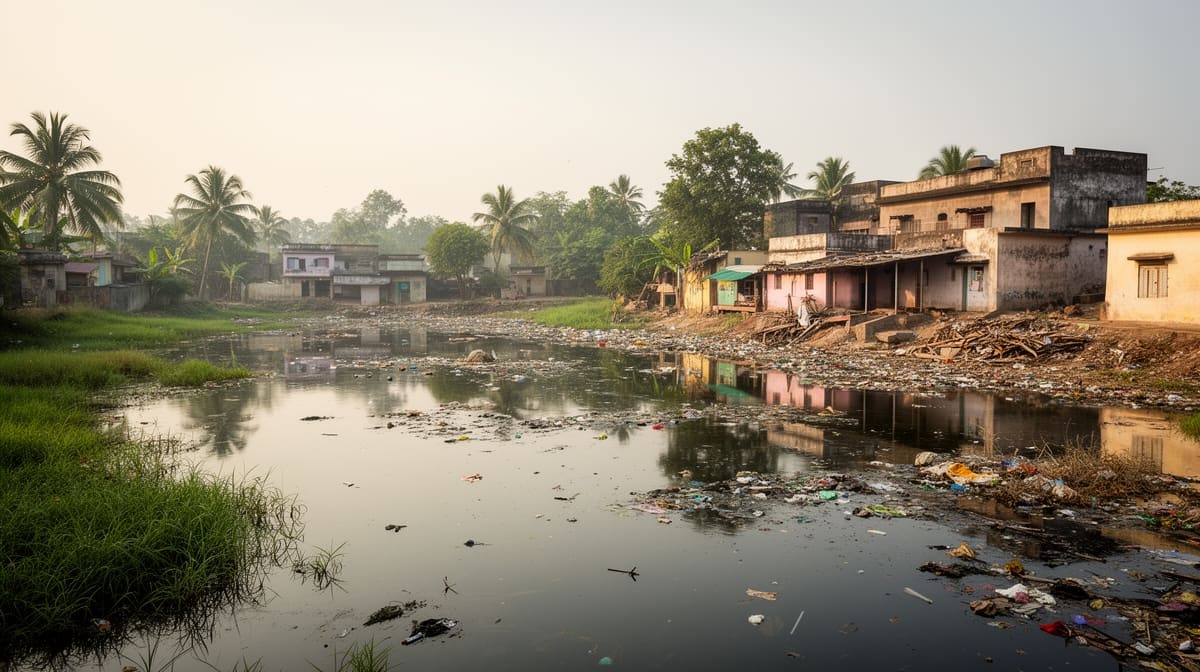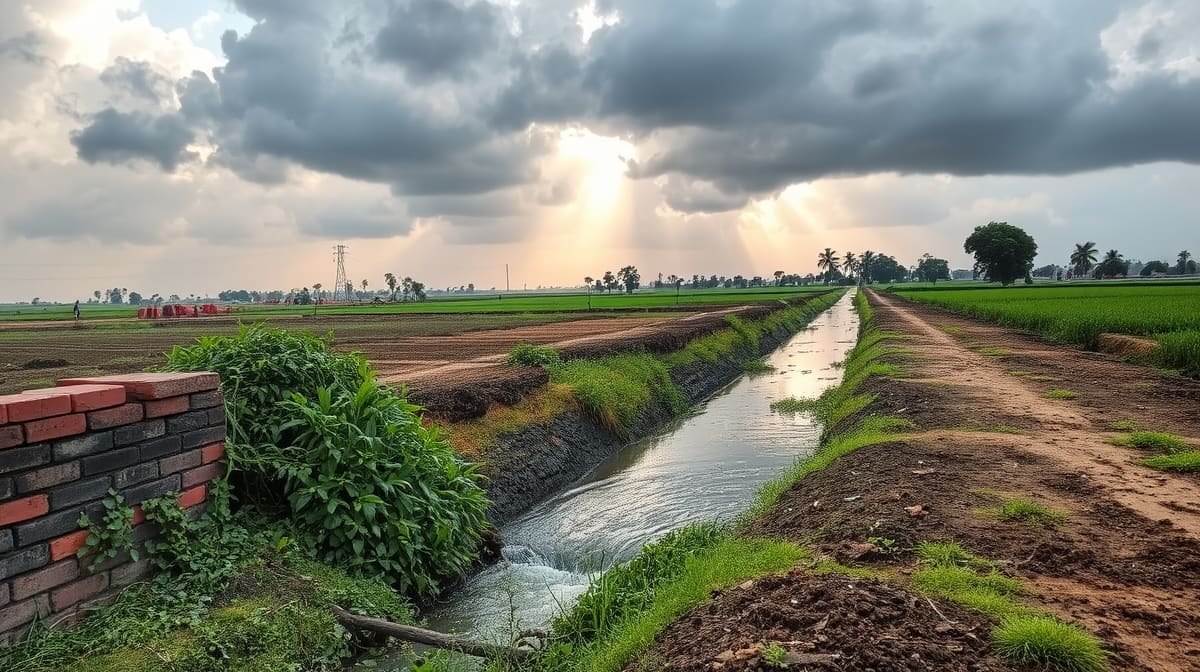
The Allahabad High Court has issued a directive to protect a revenue-recorded public drain from illegal encroachment, emphasizing that public infrastructure recorded in land records cannot be extinguished by private construction. This order reinforces the state’s duty to preserve natural drainage systems essential for flood prevention and public welfare.
Background & Facts
The Dispute
The petitioner, Mansha Devi, filed a Public Interest Litigation seeking removal of illegal encroachments on plot no. 590Kha, area 0.0050 hectare, recorded in the revenue records of Village Barwa, Tehsil Lalganj, District Azamgarh, as a Drain (Nali). The encroachment is allegedly constructed by respondent no. 6, the Gaon Sabha, which has blocked the natural flow of rainwater through the drain.
Key Facts
- Plot no. 590 is divided into three Khatas: 590M (0.007 hectare) held by Arvind Kumar, 590M (0.001 hectare) held by Sudhanshu, and 590Kha (0.005 hectare) recorded as Drain (Nali).
- The drain is a public drainage channel originating from upstream plots and terminating at plot no. 590Kha.
- According to the Tehsildar’s instruction dated 20.01.2026, plot no. 590Kha was described as vacant, but photographs annexed revealed that the drain ends abruptly under a structure built by respondent no. 6.
- The petitioner submitted that the drain’s flow is obstructed at plot no. 590Kha, causing water to back up into residential areas (Abadi sites), posing a risk of flooding during monsoon.
- The petitioner challenged the Tehsildar’s assertion that the drain is vacant, asserting that the physical reality on the ground contradicts the revenue record’s description.
Procedural History
- 14.01.2026: Petition filed before the Allahabad High Court as PIL No. 143 of 2026.
- 21.01.2026: Court issued notice to respondents and directed submission of the Tehsildar’s instruction and related documents.
- 25.01.2026: Petitioner filed objection to the Tehsildar’s report, attaching photographs showing the drain’s obstruction.
- 14.05.2026: Court heard arguments from petitioner’s counsel, Sri Rajesh Prasad Yadav, and respondents’ counsel, Sri Rameshwar Prasad Shukla and Sri Prem Bahadur Singh.
Relief Sought
The petitioner sought a direction to the state authorities to:
- Demarcate the entire length of the public drain recorded as plot no. 590Kha.
- Remove all encroachments obstructing the drain’s flow.
- Ensure the drain remains unobstructed before the onset of the rainy season.
The Legal Issue
The central question was whether a public drain recorded in revenue records as a Drain (Nali) can be lawfully encroached upon by private or institutional construction, and whether the state has a duty to restore its functionality before the monsoon season.
Arguments Presented
For the Petitioner
The petitioner’s counsel argued that:
- A drain recorded in revenue records as a public drainage channel is a public utility protected under the principles of public trust and environmental protection.
- The physical obstruction of the drain violates the natural flow of water, creating a public hazard.
- Revenue records are not merely fiscal documents but serve as legal evidence of land use and public infrastructure.
- The Tehsildar’s report, based on paper records without on-site verification, is inadequate and misleading.
- The Court must intervene to prevent imminent flooding during the rainy season.
For the Respondent
The respondents, including the State and the Gaon Sabha, did not contest the existence of the encroachment but argued that the matter involved a land dispute between private parties and required revenue adjudication, not judicial intervention. They contended that the petitioner’s remedy lay in filing a complaint before the revenue authorities.
The Court's Analysis
The Court rejected the respondents’ contention that this was a mere land dispute. It emphasized that the drain, as recorded in revenue records, is not private property but a public utility essential for drainage and flood control. The Court observed that the drain’s physical termination under respondent no. 6’s construction is inconsistent with its function as a continuous public channel.
"As a public drain, which is coming over other plots to plot no.590, cannot end on a particular plot."
The Court held that revenue records are not merely fiscal instruments but carry legal weight in identifying public infrastructure. The obstruction of such a drain constitutes a public nuisance and a threat to public safety, especially with the monsoon season approaching.
The Court further noted that the Tehsildar’s report, based solely on documents without field verification, was insufficient. It stressed that the District Magistrate, as the chief executive officer of the district, bears the responsibility to ensure public infrastructure is preserved and functional.
The Verdict
The petitioner succeeded. The Court directed the District Magistrate, Azamgarh, to:
- Conduct a field demarcation of the entire length of the public drain recorded as plot no. 590Kha, from its origin to its termination point.
- Ensure the drain is free of all encroachments before the onset of the rainy season.
- Conduct the enquiry in the presence of an officer not below the rank of Deputy District Magistrate.
- Submit a detailed report along with a personal affidavit of the District Magistrate before the next date of hearing.
- The next hearing is fixed for the second week of July 2026.
What This Means For Similar Cases
Public Drains Cannot Be Erased by Encroachment
- Practitioners must treat any drainage channel recorded in revenue records as protected public infrastructure, regardless of whether it is currently visible or functional.
- Encroachments on such drains are not mere civil disputes but public nuisance issues warranting immediate judicial intervention.
Revenue Records Are Evidence of Public Infrastructure
- Revenue records are admissible as prima facie evidence of land use, including public drains, nullahs, and water channels.
- Courts may rely on these records to issue preventive orders, especially when public safety is at stake.
Proactive Enforcement Before Monsoon Is Mandatory
-
District administrations must proactively identify and clear encroachments on drainage systems before the rainy season.
-
Failure to do so may result in judicial directions and personal accountability of District Magistrates.
-
Always verify physical status of drains recorded in revenue records before accepting revenue department reports.
-
File PILs to compel action on encroachments affecting public drainage, especially when monsoon is imminent.
-
Cite this judgment to argue that public utility infrastructure cannot be extinguished by private or institutional construction.