The Bombay High Court has reinforced the affirmative duty of municipal corporations to prevent urban water logging through concrete, time-bound action - not mere assurances. In a public interest litigation concerning systemic drainage failures in Nagpur, the Court mandated detailed remedial plans before the upcoming monsoon, setting a new standard for civic accountability in infrastructure governance.
Background & Facts
The Dispute
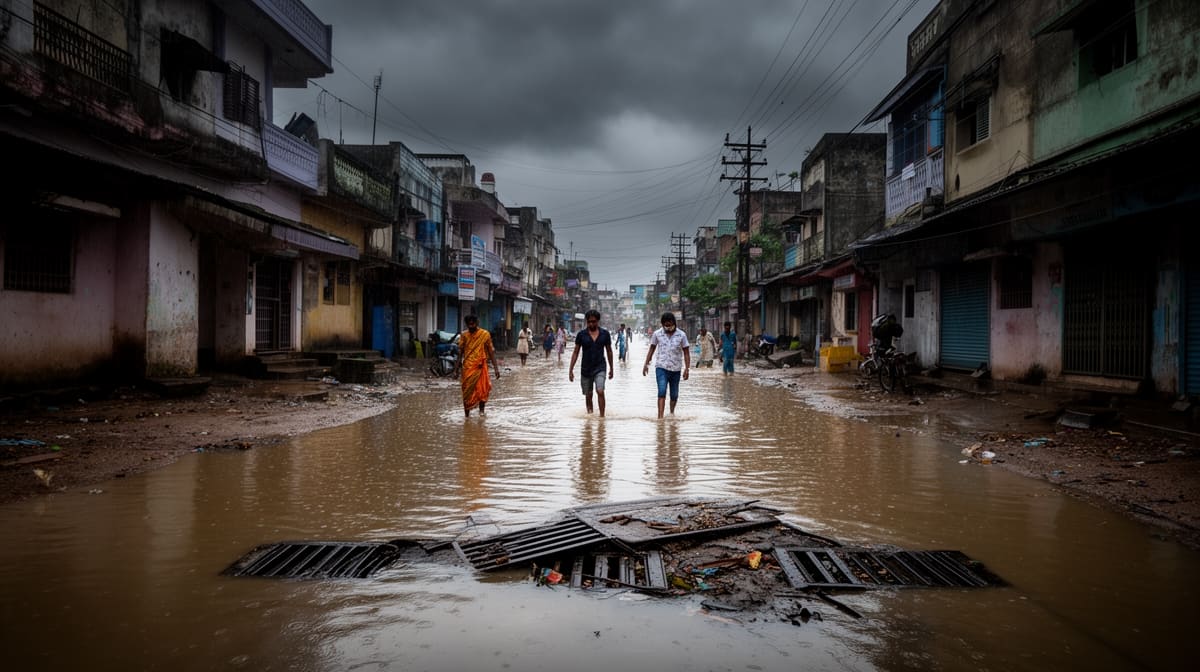
The petitioner, Janmanch, a civic action group, raised concerns over recurrent water logging in residential areas of Nagpur due to unauthorized raising of road levels by municipal authorities. This elevation disrupted natural drainage, causing rainwater to flow into homes, damage property, and create public health hazards, particularly in localities where side drains were either absent or non-functional.
Procedural History
- 2025: Public Interest Litigation filed under Article 226 of the Constitution seeking remedial action against Nagpur Municipal Corporation and state agencies.
- 23 December 2025: Court issued interim directions requiring budgetary allocation for court building projects and water logging mitigation.
- 25 February 2026: Hearing on compliance, during which the Court examined the adequacy of responses from civic and state authorities.
Relief Sought
The petitioner sought binding directions to the Nagpur Municipal Corporation to implement permanent drainage solutions, submit a time-bound action plan for the 2026 rainy season, and ensure that road construction projects do not compromise natural water flow.
The Legal Issue
The central question was whether municipal corporations have a non-discretionary duty under constitutional and statutory obligations to proactively prevent urban water logging, or whether their responsibility is limited to reactive measures after damage occurs.
Arguments Presented
For the Petitioner
The petitioner relied on M.C. Mehta v. Union of India and S.P. Gupta v. Union of India to argue that the right to a healthy environment under Article 21 imposes a positive obligation on civic bodies to prevent foreseeable harm. It was contended that failure to design drainage infrastructure in tandem with road elevation constitutes a violation of the duty of care owed to citizens.
For the Respondent
The Nagpur Municipal Corporation submitted that instructions had been issued to officials and that remedial works were underway. It argued that water logging was a complex issue involving multiple agencies, including the National Highways Authority of India, and that budgetary constraints limited immediate action.
The Court's Analysis
The Court rejected the notion that municipal responsibility is confined to issuing administrative instructions. It emphasized that constitutional rights demand tangible outcomes, not procedural compliance. The Court noted that the mere existence of internal memos or verbal directions does not discharge the obligation to protect citizens from environmental harm.
"The State cannot hide behind bureaucratic inertia when the lives and livelihoods of citizens are at stake. A promise to act is not a substitute for a plan to act."
The Court distinguished State of U.P. v. Ram Swarup by holding that in matters of public health and safety, proactive planning is mandatory, not optional. It further observed that the failure to construct side drains in areas where topography permits them constitutes a failure of reasonable foresight, a standard derived from the doctrine of public trust.
The Court also held that the State’s budgetary allocation for court buildings cannot be prioritized over basic civic infrastructure that directly impacts public safety. The two issues, while distinct, reflect a systemic neglect of infrastructure equity.
The Verdict
The petitioner succeeded. The Court held that municipal corporations must proactively design and implement drainage solutions before the monsoon season, and that mere administrative orders are insufficient. The Nagpur Municipal Corporation was directed to file a detailed affidavit outlining specific measures to drain water from affected localities.
What This Means For Similar Cases
Proactive Planning Is Non-Negotiable
- Municipal bodies must now prepare and submit monsoon-ready drainage plans before each rainy season, not after damage occurs.
- Courts will no longer accept vague assurances or pending approvals as compliance.
- Practitioners should cite this judgment when challenging inaction in water logging, sewage overflow, or flood-prone urban areas.
Budgetary Constraints Are Not a Defense
- The Court explicitly rejected financial limitations as justification for inaction where fundamental rights are involved.
- Petitioners may now demand disclosure of budgetary allocations for civic infrastructure alongside progress reports.
- State agencies must justify prioritization of funds for non-essential projects over life-sustaining infrastructure.
Inter-Agency Coordination Is Judicially Enforceable
- When multiple agencies (e.g., NHAI, Municipal Corporation, Public Works Department) contribute to a problem, the Court will hold each accountable for their role.
- Affidavits must specify which agency is responsible for which segment of the solution.
- Failure to coordinate may result in contempt proceedings for non-compliance.