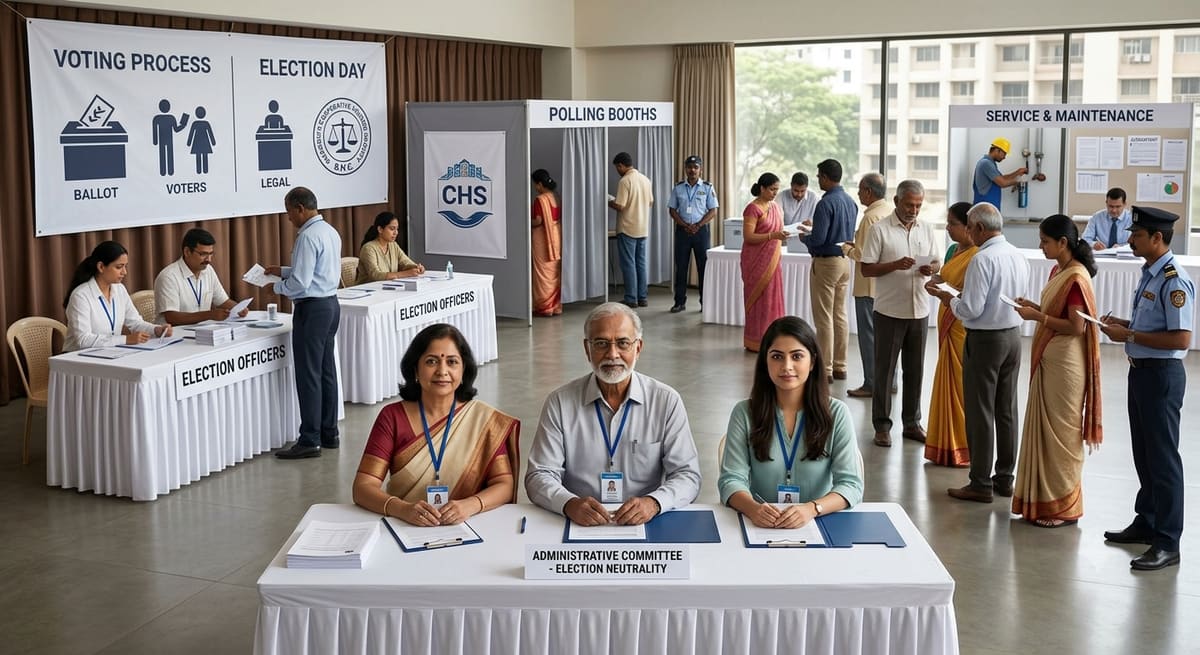
The Supreme Court has delivered a decisive rebuke to institutional favoritism in housing allotments by public-spirited societies, affirming that even private entities performing quasi-public functions must adhere to constitutional norms of fairness and non-arbitrariness. This judgment redefines the boundaries of accountability for societies funded or enabled by state land and staffed by government officers.
Background & Facts
The Dispute
The appellant, a deputed employee of Haryana Urban Development Authority (HUDA), challenged the allotment of two super deluxe flats by the Haryana Urban Estate and Town and Country Planning Employees Welfare Organization (HEWO), a society registered under the Societies Registration Act, 1860. HEWO, established to provide housing benefits to HUDA employees and their families, allocated one flat to a governing body member and another to his subordinate through a draw of lots, despite the appellant meeting all eligibility criteria and having participated in the process.
Procedural History
- 2020: HEWO Governing Body resolved to invite applications for two super deluxe flats arising from cancellations.
- 2021: The appellant submitted a timely application with earnest money, satisfying all eligibility conditions including six months’ deputation and pay band level 11.
- May 2021: One flat was preemptively allotted to Mr. K. Makrand Pandurang, then presiding member of the Governing Body, before the application deadline.
- September 2021: After Pandurang became Chief Controller of Finance (and thus a governing body member), he surrendered his allotment and immediately sought re-allotment - despite having missed the application deadline.
- October 2021: The High Court dismissed the writ petition, holding the appellant estopped from challenging the draw of lots.
Relief Sought
The appellant sought quashing of the allotments to the third and fourth respondents, a declaration that the process was arbitrary and biased, and a direction for a fresh, transparent allotment process.
The Legal Issue
The central question was whether a society like HEWO, though privately registered, can lawfully grant preferential housing allotments to its governing body members who fail to meet eligibility criteria, and whether such conduct violates the principles of fairness, transparency, and non-arbitrariness under Article 14 of the Constitution.
Arguments Presented
For the Petitioner
The appellant’s counsel argued that HEWO’s allotment process was tainted by favoritism and self-aggrandizement, as the third respondent was not a governing body member at the time of application and had not submitted any application or paid earnest money before the deadline. The appellant relied on S.P. Gupta v. Union of India to assert that entities performing public functions, especially those using state land and staffed by government officers, are subject to constitutional scrutiny. The process violated the rule of law and procedural fairness.
For the Respondent
The respondents contended that HEWO was a private society not covered under Article 12, and that its internal rules permitted preferential allotment to governing body members. They argued that the appellant had participated in the draw and lost, thereby acquiescing to the process. The State and HEWO also claimed that the allotment was consistent with past practice and that the fourth respondent’s eligibility was later regularized by a Governing Body resolution.
The Court's Analysis
The Court rejected the notion that HEWO’s private registration insulated it from constitutional accountability. It emphasized that the society’s land was allotted by the Government, its governing body comprised ex officio government officers, and its beneficiaries were exclusively government employees. Therefore, HEWO operated as an instrumentality of the State in substance, even if not in form.
"The Governing Body members in that capacity too, should act in a fiduciary capacity for the common good, ensuring fairness, transparency and accountability, while eschewing favouritism, bias and arbitrariness."
The Court found the allotment to the third respondent to be a blatant act of favoritism. He was not a governing body member when applications closed, had not submitted any application, and had not paid any fees. The subsequent letter from him in his official capacity requesting allotment to himself in his personal capacity was deemed a "complete farce." The Court held that preference cannot override eligibility - even if a governing body member, they must satisfy the same criteria as others.
Regarding the fourth respondent, the Court noted he was ineligible under the pay band criteria, and his application lacked critical details: no date, no proof of earnest money deposit. His position as subordinate to the third respondent raised a clear conflict of interest. The Court dismissed the Governing Body’s post-hoc regularization as an abuse of power.
The Court further held that a draw of lots cannot be validated merely because fewer applicants qualified - the process must remain rooted in objective criteria, not convenience.
The Verdict
The appellant won. The Supreme Court set aside the High Court’s judgment and quashed both allotments. It held that preferential allotment to governing body members who fail eligibility criteria violates Article 14 and ordered a fresh draw from the original pool of eligible applicants. Costs were imposed on all respondents, and the flats were to be refunded and vacated.
What This Means For Similar Cases
Preferential Allotment Cannot Override Eligibility Criteria
- Practitioners must challenge any housing or benefit scheme where governing body members receive priority despite failing objective eligibility thresholds.
- Even if internal rules permit preference, such provisions are void if they conflict with constitutional fairness.
- Courts will not uphold post-facto regularization of ineligible beneficiaries.
Public-Spirited Societies Are Not Beyond Constitutional Scrutiny
- Entities like HEWO, funded by state land and staffed by government officers, are subject to Article 14 and Article 21 even if not formally "State" under Article 12.
- The functional test - not just legal form - determines constitutional applicability.
- Any society performing a public function must maintain transparent, non-discriminatory processes.
Documentary Compliance Is Non-Negotiable
- Applications lacking dates, payment proofs, or signatures are legally invalid, regardless of the applicant’s position.
- Courts will not infer compliance from circumstantial evidence; strict adherence to procedural norms is mandatory.
- Practitioners should routinely verify documentary completeness in administrative allotments.