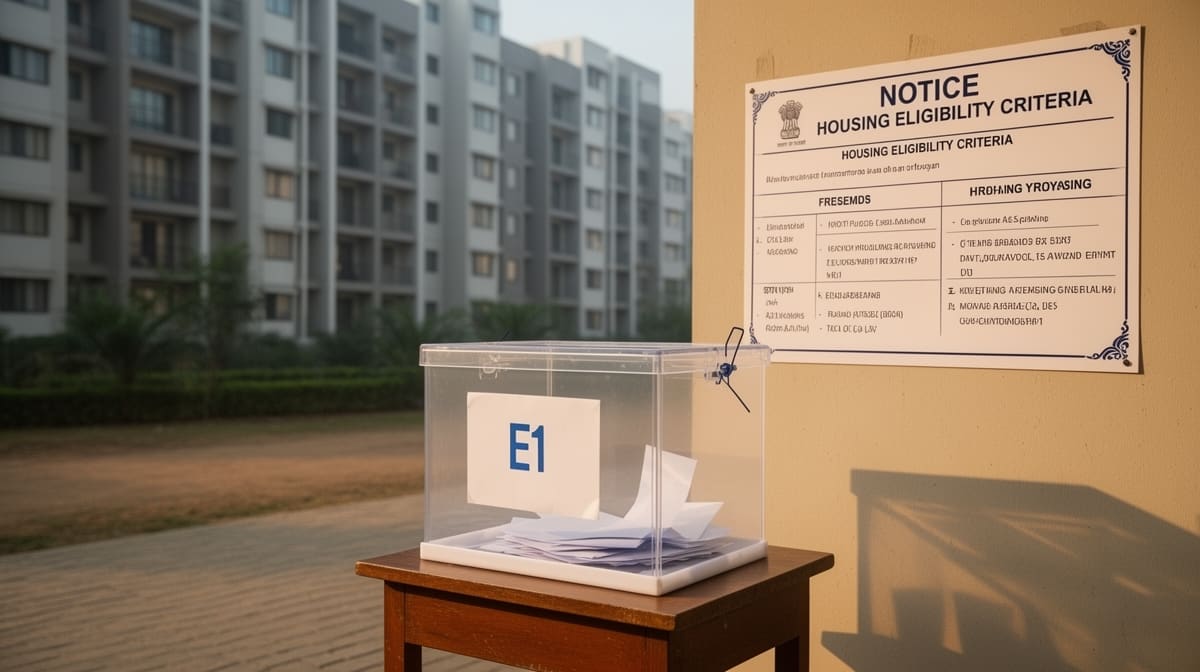
The Jharkhand High Court has firmly rejected the notion that former legislators are entitled to preferential treatment in the allotment of state-owned land. In a decisive ruling, the Court held that any system permitting selective allocation based on political status violates the foundational principle of equality under Article 14 of the Constitution. This judgment reinforces the requirement for transparent, non-discriminatory mechanisms in public resource distribution.
Background & Facts
The Dispute
The petitioner, Md. Hasan Rizvi, a former Member of the Legislative Assembly (MLA) from the Jamshedpur West constituency, sought the allotment of a residential plot of land measuring 0.12 acre in Mouza Beldih, P.S. No. 1154, Khata No. 2, R.S. Plot No. 1853 Part, as per the 1934-37 Record of Survey. He claimed entitlement based on his status as an ex-MLA and alleged that another ex-MLA had previously received similar allotment. The land in question is part of a larger parcel leased to M/s Tata Steel Ltd. and remains under state ownership pending renewal of the lease.
Key Facts
- The petitioner submitted an application to the Deputy Commissioner cum President of the appropriate machinery committee, and to the Secretary, Department of Revenue and Land Reforms, Government of Jharkhand, seeking allotment
- The Deputy Commissioner recommended allotment of the plot to the petitioner, citing his status as an ex-MLA
- The land is currently under lease to Tata Steel Ltd. and is not under the direct administrative control of the state revenue department for private allotment
- No public policy or statutory provision permits preferential allotment of state land to former legislators
- The petitioner did not allege any procedural irregularity in the lease to Tata Steel, nor did he participate in any competitive or transparent process for land acquisition
Procedural History
- 2019: Petitioner filed Writ Petition (WP(C) No. 1968 of 2019) before the High Court of Jharkhand
- 09.04.2026: Hearing conducted before Justice Ananda Sen
- 09.04.2026: Judgment delivered dismissing the petition
The Parties' Positions
Petitioner’s Position: Claimed entitlement to the plot based on his former position as MLA, citing alleged precedent of another ex-MLA receiving similar allotment. Argued that the recommendation by the Deputy Commissioner was a legitimate administrative action.
Respondents’ Position: The State and Tata Steel Ltd. contended that the land is state property leased to Tata Steel, and no authority has the power to unilaterally allot such land to private individuals. No policy exists permitting preferential allotment to ex-MLAs.
Relief Sought
The petitioner sought a writ of mandamus directing the respondents to settle the land in his name, based on his status as an ex-MLA and the alleged precedent.
The Legal Issue
Can a former legislator claim a right to preferential allotment of state-owned land on the grounds of political status or alleged precedent of similar allotment to another ex-MLA?
Arguments Presented
For the Petitioner
The petitioner’s counsel argued that the Deputy Commissioner’s recommendation was a legitimate administrative action and that the petitioner’s service as an MLA entitled him to a residential plot as a form of recognition. He relied on the alleged allotment to another ex-MLA as a precedent justifying similar treatment.
For the Respondent/State
The State’s counsel contended that the land in question is not under the discretionary control of the revenue department for private allotment, as it is leased to Tata Steel Ltd. under a valid lease agreement. No statutory or policy framework permits preferential allotment to ex-MLAs. The petitioner’s claim, if granted, would set a dangerous precedent of political patronage in public land distribution.
The Court's Analysis
The Court examined the nature of the land and the legal framework governing its use. It observed that the land is state property, leased to Tata Steel Ltd., and therefore not available for arbitrary or discretionary allotment to private individuals. The Court emphasized that the Deputy Commissioner’s recommendation, based solely on the petitioner’s former political position, was legally unsustainable.
"Admittedly, the land was leased out to Tata Steel and same is pending for renewal in favour of the Tata Steel. Even the Tata Steel, also without a proper policy, cannot deal or settle land to any private individual or any person. These lands are primarily of the State, leased out to the Tata Steel."
The Court further rejected the petitioner’s reliance on the alleged allotment to another ex-MLA, holding that illegality cannot be justified by prior illegality. The principle that "if a wrong has been committed, the same cannot be allowed to be perpetuated" was invoked to underscore the constitutional imperative of equal treatment.
"Prima facie, I am of the opinion that if these lands are settled in such manner, in which the Deputy Commissioner has proposed, it will create anarchy. These types of lands, if at all needs to be settled, should be by way of auction or by way of lottery and not by the said manner, which has been done here, i.e. pick and choose method, which has got no space in our Constitution."
The Court held that any allotment of state land must follow a transparent, non-discriminatory policy accessible to all citizens, and that the "pick and choose" method violates Article 14 of the Constitution. The absence of a policy permitting such allotment rendered the petitioner’s claim legally untenable.
The Verdict
The writ petition was dismissed. The Court held that the petitioner has no legal right to preferential allotment of state land based on his former status as an MLA. No direction was issued for allotment, and the recommendation by the Deputy Commissioner was declared legally invalid. The Court affirmed that state land must be allocated only through transparent, non-arbitrary mechanisms such as auction or lottery.
What This Means For Similar Cases
Preferential Allotment Based on Political Status Is Unconstitutional
- Practitioners must challenge any administrative recommendation that grants land or public resources based on political affiliation, former office, or personal influence
- Claims invoking "precedent" of prior illegal allotments will be rejected under the doctrine that illegality cannot be legitimized by repetition
- Any policy permitting discretionary allotment to public officials must be struck down as violative of Article 14
Transparency Is Mandatory in Public Land Allocation
- State-owned land must be allocated only under a published, objective policy
- Auctions, lotteries, or open bidding are the only constitutionally permissible methods
- Administrative recommendations based on personal status, without statutory backing, are void ab initio
- Legal challenges to arbitrary allotments should be framed under Article 14 and Article 19(1)(g) (right to property as a constitutional right)
No Entitlement Without Policy
- Former legislators, ministers, or public servants have no automatic right to state land or benefits
- Any claim must be grounded in a clear, publicly accessible policy, not in personal influence or historical precedent
- Courts will not entertain claims based on equity or moral entitlement where no legal right exists