The Allahabad High Court has reaffirmed that even in administrative allotment processes, the principle of natural justice is non-negotiable. The cancellation of a flat allotment without affording the allottee an opportunity to be heard constitutes a fundamental violation of procedural fairness, rendering the order void ab initio.
Background & Facts
The Dispute
The U.P. Awas Evam Vikas Parishad (UPHDP) launched a housing scheme offering a 15% discount on flat sales to the general public. The scheme was initially open from 30.10.2025 to 31.01.2026, and later extended until 31.03.2026. The petitioner’s husband, Manoj Kumar Verma, applied for a flat under this scheme through the official website.
Key Facts
The petitioner’s husband was allotted Flat No. HN/C-3/704 at Himalaya Enclave, Phase-II, Vrindavan Yojna, Sector-17, Lucknow by an allotment letter dated 27.02.2026.
At the time of allotment, he had deposited Rs. 4,70,000 and was required to deposit the remaining balance of Rs. 79,43,315 within 60 days.
The allotment was made in accordance with the published scheme terms and no prior disqualification or objection was raised against the applicant.
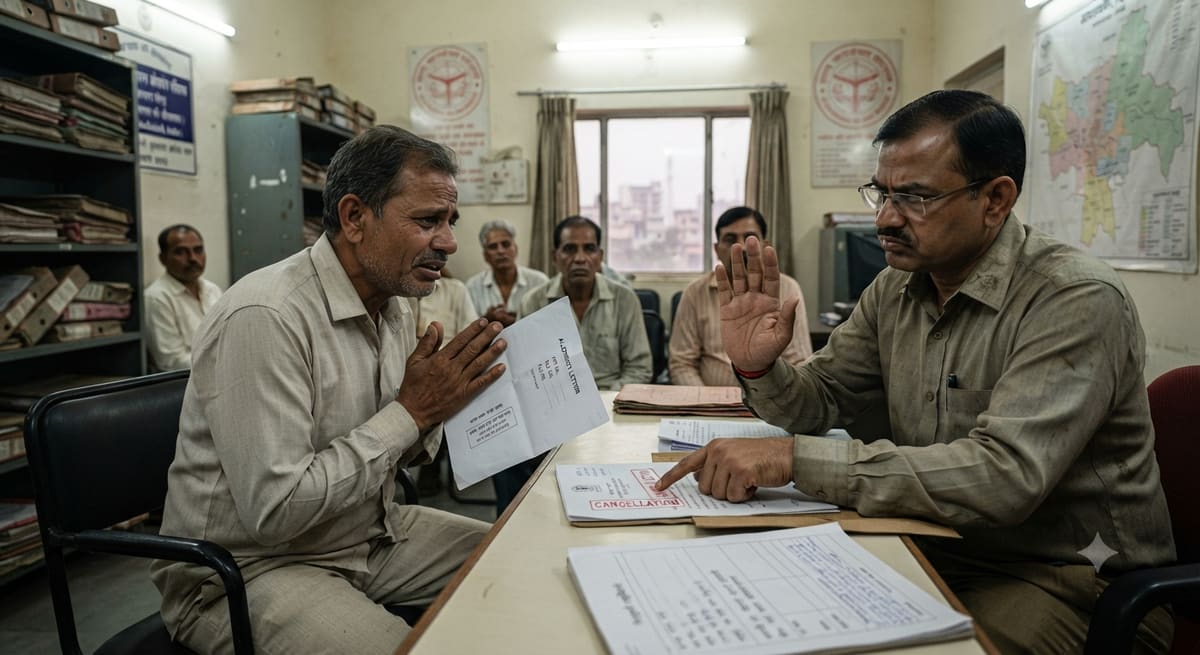
Before the 60-day payment deadline expired, the UPHDP issued an order cancelling the allotment on 13.04.2026, citing that the flat was being reserved for staff.
No notice, show-cause, or opportunity of hearing was provided to the petitioner or her husband prior to cancellation.
The petitioner challenged the cancellation as arbitrary and violative of fundamental principles of administrative law.
Procedural History
27.02.2026: Allotment letter issued to petitioner’s husband.
13.04.2026: Impugned order cancelling allotment issued by Asset Manager/Property Manager, UPHDP, Lucknow, without notice or hearing.
06.05.2026: Writ Petition (WP(C) No. 6949 of 2026) filed before the Allahabad High Court.
09.07.2026: Hearing conducted before Division Bench.
The Parties' Positions
For the Petitioner:
Argued that once an allotment is made, valuable and substantial rights accrue to the allottee.
Contended that cancellation without notice or hearing violates the principles of audi alteram partem under Article 14 and 21 of the Constitution.
Emphasized that the scheme was open to the general public and no provision permitted unilateral cancellation without due process.
For the Respondents (UPHDP):
Did not dispute the factual sequence or the absence of notice.
Did not contest that the petitioner was not heard before cancellation.
Did not produce any statutory rule or policy justifying cancellation without opportunity of hearing.
Relief Sought
The petitioner sought quashing of the cancellation order dated 13.04.2026, restoration of the allotment, and direction to the authority to decide the matter afresh in accordance with law.
The Legal Issue
The central question was whether an administrative authority can cancel a flat allotment made to a member of the general public without providing any notice or opportunity of hearing, and whether such action violates the doctrine of natural justice.
Arguments Presented
For the Petitioner
The petitioner’s counsel relied on the foundational principle of audi alteram partem and cited State of U.P. v. Mohd. Noor and K. S. Puttaswamy v. Union of India to argue that any administrative action affecting a vested right must be preceded by a fair hearing. He emphasized that the allotment letter constituted a binding administrative decision creating enforceable rights, and that cancellation without notice rendered the action arbitrary under Article 14. He further submitted that the respondents had not invoked any statutory provision permitting summary cancellation.
For the Respondent
The counsel for the U.P. Awas Evam Vikas Parishad did not dispute the petitioner’s factual assertions. He conceded that no notice or hearing was afforded and offered no legal justification for the cancellation. He did not cite any rule, policy, or precedent supporting unilateral cancellation of allotments made to the general public.
The Court's Analysis
The Court observed that the allotment of a flat under a public housing scheme is not a mere administrative formality but a transaction that creates substantial rights in favor of the allottee. Once the allotment letter is issued and partial payment is accepted, the applicant is entitled to expect that the allotment will not be revoked arbitrarily.
"The principle of natural justice is not a mere procedural formality; it is a constitutional imperative that safeguards individuals from arbitrary state action."
The Court noted that the respondents did not dispute the absence of notice or hearing, nor did they produce any rule permitting cancellation without opportunity to be heard. The Court held that even in the absence of an express statutory provision, the doctrine of natural justice applies to all administrative decisions affecting rights or interests.
The Court further distinguished this case from those involving preliminary applications or pre-allotment rejections, emphasizing that the present case involved a completed allotment with partial payment made. The cancellation, therefore, was not a pre-decisional administrative step but a post-decisional revocation, which demands procedural fairness.
The Court rejected the notion that reservation for staff could justify bypassing natural justice, holding that such internal policy considerations cannot override the rights of a lawfully allotted member of the public.
The Verdict
The writ petition was allowed. The impugned order dated 13.04.2026 cancelling the allotment of Flat No. HN/C-3/704 is set aside. The matter is remanded to the Deputy Housing Commissioner, Awas Vikas Office, Lucknow, who shall decide the matter afresh after giving the petitioner a full opportunity of hearing. The petitioner is entitled to submit a reply within two weeks from the date of judgment. The authority shall decide the matter within two months of receipt of the reply, and must issue a reasoned, speaking order. If the petitioner seeks personal hearing, the authority shall fix a date, time, and place and communicate it well in advance.
What This Means For Similar Cases
Allotment Creates Vested Rights
Practitioners must now argue that any cancellation of a flat, plot, or housing unit after issuance of an allotment letter and partial payment constitutes a deprivation of a vested right.
Authorities cannot rely on internal policy or administrative convenience to bypass natural justice.
Procedural Compliance Is Non-Negotiable
All housing boards and development authorities must issue show-cause notices before cancelling any allotment.
Failure to provide hearing renders the order void, not merely irregular.
This applies equally to schemes for general public, employees, or reserved categories.
Burden of Justification Lies with the Authority
When an allotment is made and accepted, the burden shifts to the authority to prove a lawful ground for cancellation with procedural compliance.
Silence or non-objection by the authority’s counsel does not cure the violation.