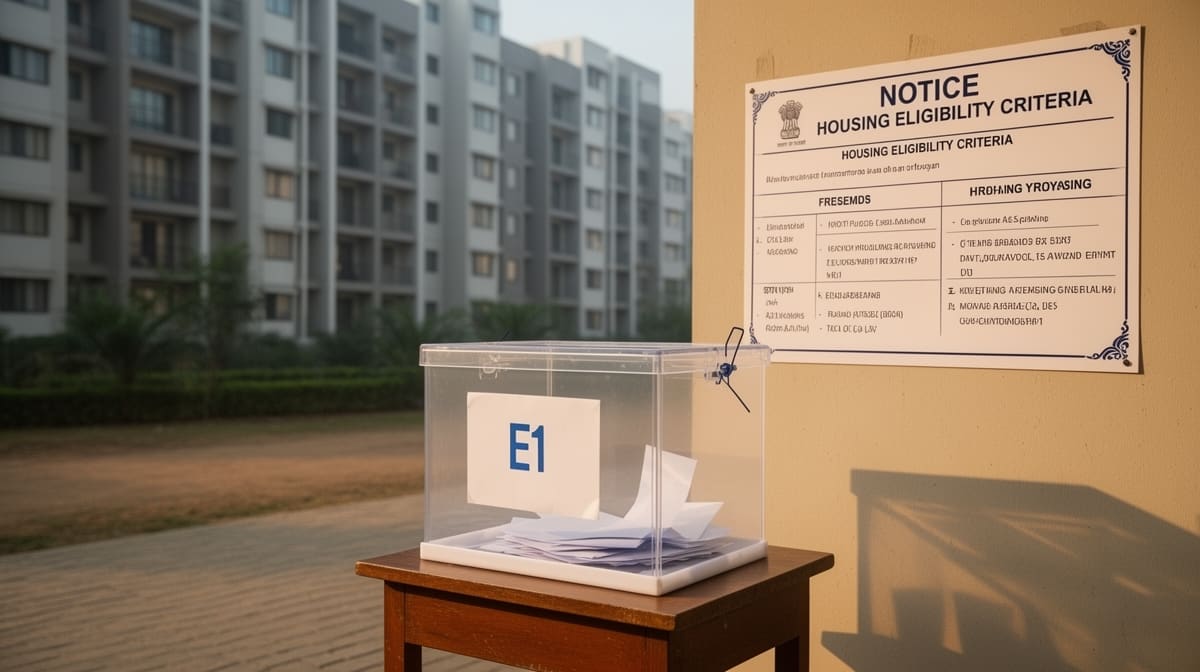
The Supreme Court has delivered a decisive rebuke to institutional favoritism in housing allotments by public-service societies, affirming that even private entities performing quasi-public functions must adhere to principles of fairness, transparency, and non-arbitrariness. This judgment redefines the boundaries of accountability for societies funded or enabled by state resources, setting a new benchmark for equitable distribution of public benefits.
Background & Facts
The Dispute
The appellant, Dinesh Kumar, a deputed employee of Haryana Urban Development Authority (HUDA), challenged the allotment of two super deluxe flats by the Haryana Urban Estate and Town and Country Planning Employees Welfare Organization (HEWO), a society registered under the Societies Registration Act, 1860. HEWO, established to provide housing benefits to HUDA employees and their families, allotted one flat to a governing body member and another to his subordinate, despite both allegedly violating eligibility norms. The appellant, who met all criteria and participated in the draw, was denied allotment.
Procedural History
- 2020: HEWO Governing Body resolved to invite applications for two super deluxe flats arising from cancellations.
- 2021: One flat was preemptively allotted to Mr. K. Makrand Pandurang, a governing body member, before the application deadline.
- 2021: After Pandurang resigned from his position, the flat was reallocated to the third respondent, who had not yet joined HUDA at the time of application.
- 2023: The fourth respondent, a subordinate of the third, was allotted the second flat via draw of lots despite failing to meet pay-band eligibility.
- 2025: Punjab and Haryana High Court dismissed the writ petition under Article 226, holding the appellant estopped due to participation in the draw.
Relief Sought
The appellant sought quashing of the allotments to the third and fourth respondents, demanding a fresh, transparent draw of lots among eligible applicants, and sought costs for abuse of process.
The Legal Issue
The central question was whether preferential allotment to governing body members, who fail to meet eligibility criteria or apply after the deadline, violates the principles of fairness, transparency, and non-arbitrariness under Article 14 and Article 226, particularly when the society operates on land allotted by the state and serves public-sector employees.
Arguments Presented
For the Petitioner
The appellant’s counsel argued that the allotments were arbitrary and violative of natural justice and equal protection. The third respondent was not a governing body member at the time of application, and the fourth respondent failed to meet the stipulated pay-band criteria. No valid application or earnest money deposit was submitted by either before the deadline. Reliance was placed on S.P. Gupta v. Union of India to establish that entities performing public functions are subject to judicial review under Article 226.
For the Respondent
The respondents contended that HEWO, as a registered society, was a private entity not covered under Article 12. They argued that the Governing Body had the autonomy to frame rules and that past practices of preferential allotment to members were legitimate. They further claimed the appellant had participated in the draw and could not challenge the outcome under the doctrine of estoppel.
The Court's Analysis
The Court rejected the notion that HEWO’s private legal status insulated it from constitutional scrutiny. It emphasized that when a society is created to serve government employees, funded by state land, and governed by ex-officio state officers, it performs a public function. The Court held that such entities are bound by Article 14 and must act with transparency, fairness, and accountability.
"The Governing Body members, as responsible officers of the Government, in that capacity too, should act in a fiduciary capacity for the common good, ensuring fairness, transparency and accountability, while eschewing favouritism, bias and arbitrariness."
The Court found the allotment to the third respondent to be a blatant act of self-aggrandizement. He was not a member of HEWO’s Governing Body at the time applications closed, and no application or earnest money was submitted before the deadline. The letter of allotment, addressed by him in his official capacity to himself, was deemed a "complete farce."
Regarding the fourth respondent, the Court noted his pay-band eligibility was explicitly excluded by the rules, and the Governing Body’s post-hoc regularization was arbitrary. The application lacked critical details - no date, no proof of earnest money deposit - and his position under the third respondent raised clear conflict-of-interest concerns.
The Court dismissed the doctrine of estoppel, holding that no one can be estopped from challenging an illegal act. Participation in a flawed process does not validate illegality.
The Verdict
The appellant won. The Supreme Court set aside the High Court’s judgment, quashed both allotments, and ordered a fresh draw among eligible applicants. It imposed costs totaling ₹1.75 lakh on the respondents and directed immediate refund of all deposits and vacating of premises.
What This Means For Similar Cases
Preferential Allotment Is Not Permissible Even by Internal Rules
- Practitioners must challenge any internal policy granting preference to governing body members if it contradicts eligibility criteria.
- Societies receiving state land or subsidies cannot override statutory or advertised eligibility norms under the guise of "customary practice."
- Any deviation from advertised rules must be justified by a rational, non-discriminatory rationale.
Documentary Compliance Is Non-Negotiable
- Applications lacking dates, signatures, or proof of payment are legally invalid, regardless of the applicant’s status.
- Courts will not validate procedural lapses even if the applicant is otherwise eligible.
- Practitioners should insist on strict adherence to application protocols in all quasi-public allotments.
Article 226 Applies to Quasi-Public Societies
- Entities performing public functions - such as housing allotments for government employees - are amenable to writ jurisdiction even if registered as private societies.
- The test is not legal form but functional reality: if the entity is state-enabled, state-staffed, and state-benefitted, it is subject to constitutional norms.
- This expands the scope of public law remedies in housing, education, and welfare schemes run by affiliated societies.