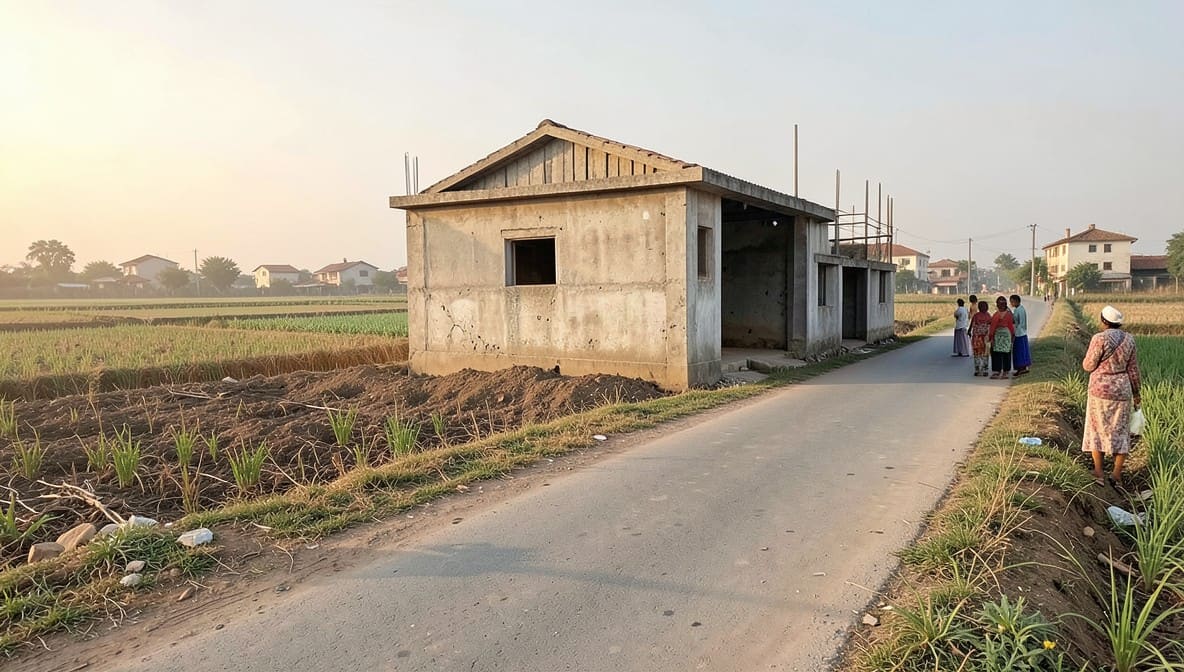
The Calcutta High Court has invalidated a land allotment by the Kolkata Metropolitan Development Authority (KMDA) after finding it to be a clear violation of Article 14 of the Constitution, procedural fairness, and the principle of constitutional morality. The judgment underscores that public property cannot be disposed of without adherence to transparent, non-discriminatory policies and that haste, secrecy, and deviation from established norms render such actions arbitrary and void.
Background & Facts
The Dispute
The dispute arose from the allotment of two plots - Plot Nos. 8 and 9 in Block BD, Category-GRH - at the East Kolkata Development Project (EKADP) to Krishnav Cooperative Housing Society Ltd., with Arunangshu Chakraborty, a practicing advocate, filing a public interest litigation challenging the legality of the allotment. The petitioner alleged that the allotment was made in violation of KMDA’s own rules, statutory provisions, and constitutional mandates, amounting to favoritism and arbitrariness.
Key Facts
- On 12.05.2008, the Chief Promoter of the proposed Krishnav Cooperative Housing Society Ltd., respondent no. 6, submitted an application on plain paper to the Minister-in-charge of Municipal Affairs and Urban Development, seeking allotment of land for a group of eight officers and professionals.
- On 20.05.2008, the Land and Flat Allotment Committee of KMDA recommended the allotment of the two plots at Rs. 4 lakhs per cottah, without any public advertisement or competitive bidding.
- On 02.06.2008, KMDA issued an allotment letter to respondent no. 6, despite the cooperative society not yet being registered.
- On 08.10.2009, possession of the plots was handed over to respondent no. 6.
- On 14.09.2009, the Krishnav Cooperative Housing Society Ltd. was formally registered under the West Bengal Cooperative Societies Act, 2006.
- On 23.10.2009, a registered lease deed was executed by KMDA in favor of the now-registered society.
- The KMDA’s 1987 brochure mandated that all applications for land allotment must be submitted in a prescribed format and that selection would be based on public lottery and eligibility verification.
- No public advertisement was issued inviting applications for the plots.
- The application submitted by respondent no. 6 did not conform to the prescribed format in the 1987 brochure.
- The allotment process was completed within 21 days of application, raising concerns of undue haste.
- The petitioner filed a representation on 19.05.2012 seeking cancellation of the allotment, which remained unaddressed.
- The writ petition was filed on 20.12.2012.
Procedural History
- 12.05.2008: Application submitted by respondent no. 6 on plain paper.
- 20.05.2008: Land and Flat Allotment Committee recommends allotment.
- 02.06.2008: KMDA issues allotment letter.
- 08.10.2009: Possession certificate issued to respondent no. 6.
- 14.09.2009: Krishnav Cooperative Housing Society Ltd. registered.
- 23.10.2009: Registered lease deed executed.
- 19.05.2012: Petitioner’s representation to KMDA seeking cancellation.
- 20.12.2012: WPA 20959 of 2012 filed before Calcutta High Court.
- 21.12.2012: WPA 21739 of 2012 filed (related matter).
- 01.01.2013: CAN 1 of 2013 filed (consolidated application).
- 09.03.2026: Hearing concluded.
- 18.03.2026: Judgment delivered.
The Parties' Positions
Petitioner (Arunangshu Chakraborty): Argued that the allotment violated:
- The KMDA’s own 1987 brochure requiring prescribed application format and public lottery.
- Section 17(2) of the West Bengal Cooperative Societies Act, 2006, by allotting land before registration.
- Article 14 of the Constitution due to lack of transparency, arbitrariness, and favoritism.
- Section 3(2) and Section 22 of the KMDA Act, 1972, by acting beyond its statutory mandate.
- The principle of constitutional morality and public trust doctrine.
Respondents (KMDA and Krishnav Cooperative Housing Society Ltd.): Contended that:
- The allotment was made under a permissible ‘group housing’ category.
- Section 17(2) of the 2006 Act validates pre-registration transactions.
- The delay in filing the petition (2012) amounted to laches.
- The petitioner lacked bona fides, having previously challenged KMDA decisions on behalf of a client.
- The allotment was ratified by internal committee procedures.
Relief Sought
The petitioner sought:
- Cancellation of the allotment dated 02.06.2008.
- Setting aside of the registered lease deed dated 23.10.2009.
- Direction to KMDA to take back possession of the plots.
- Refund of premium paid with interest.
The Legal Issue
The central question was whether the allotment of public land by KMDA without public advertisement, in deviation from its own published policy, and with undue haste, violates Article 14 of the Constitution, and whether such an action can be validated merely because the cooperative society was later registered.
Arguments Presented
For the Petitioner
The petitioner relied on Akhil Bhartiya Upbhokta Congress v. State of Madhya Pradesh (2011) to argue that any state largesse must be based on a transparent, published policy and implemented without arbitrariness. He cited Dipak Babaria v. State of Gujarat (2014) to assert that statutory procedures must be strictly followed. He emphasized that the 1987 brochure was a binding policy document, and its violation rendered the allotment illegal. He further invoked Manoj Narula v. Union of India (2014) to argue that the action breached constitutional morality. The petitioner also relied on Fuljit Kaur v. State of Punjab (2010) and Mandeep Singh v. State of Punjab (2025) to show that haste in administrative action raises a presumption of mala fides.
For the Respondent
The respondents argued that Section 17(2) of the West Bengal Cooperative Societies Act, 2006, validates transactions entered into before registration. They contended that the delay of four years in filing the petition constituted laches and that the petitioner lacked clean hands, having previously litigated against KMDA on behalf of another client. They relied on Joydeep Mukherjee v. State of West Bengal (2011) to argue that settled rights should not be reopened. They also claimed that KMDA had the power under Section 3(2) of the KMDA Act, 1972, to dispose of property and that internal committee procedures were sufficient.
The Court's Analysis
The Court undertook a rigorous analysis of the statutory and constitutional framework governing public land allotment. It began by examining the KMDA Act, 1972, and found that while Section 3(2) granted KMDA the power to hold and dispose of property, this power was not unfettered. The Court held that the power to dispose of public property must be exercised in accordance with constitutional norms, particularly Article 14.
The Court then turned to the 1987 KMDA brochure, which explicitly required applications to be submitted in a prescribed format and selection to be made through public lottery. The Court observed that this brochure was not merely a guideline but a binding administrative policy, and its violation amounted to a breach of the principle laid down in Dipak Babaria: “where the statute provides for a thing to be done in a particular manner, then it has to be done in that manner and in no other manner.”
“The KMDA had failed to advance any logical explanation as to why being an authority under Article 12 of the Constitution it has made a departure from its own regulation especially in the case of largesse in favour of the private respondent no. 6...”
The Court further held that the allotment process, completed in 21 days, was “post-haste” and thus prima facie arbitrary, invoking Fuljit Kaur and Mandeep Singh. The absence of public advertisement, the lack of eligibility verification, and the failure to classify the allotment under any recognized quota (e.g., for distinguished personalities) rendered the decision non-transparent and discriminatory.
The Court rejected the respondents’ reliance on Joydeep Mukherjee, distinguishing it on the ground that in that case, the State had consciously discontinued future allotments and the rights of allottees had been settled over time. Here, no such policy shift had occurred, and the allotment was not part of a broader, known scheme.
The Court also dismissed the argument of laches, noting that the petitioner had made a representation in 2012 and that the allotment was clandestine - no public notice was issued, and the minutes of the 20.05.2008 meeting were not published. The Court held that a petitioner cannot be penalized for delay when the violation is hidden from public knowledge.
Crucially, the Court invoked the doctrine of constitutional morality, citing Manoj Narula and Samdariya Builders, to emphasize that public authorities must act with institutional integrity and avoid arbitrariness. The Court held that the KMDA, as a state instrumentality, held the land in trust for the public, and its alienation without transparency was a breach of that trust.
The Court also clarified that Section 17(2) of the 2006 Act did not validate the initial illegality - while it deems pre-registration transactions as valid post-registration, it does not sanctify actions that violate constitutional or statutory norms at the time of initiation.
The Verdict
The writ petition succeeded. The Court:
- Cancelled the allotment dated 02.06.2008 of Plot Nos. 8 and 9 in Block BD, Category-GRH.
- Set aside the registered lease deed dated 23.10.2009 executed by KMDA in favor of Krishnav Cooperative Housing Society Ltd.
- Directed respondent no. 6 and the society to hand over vacant possession of the plots and any structures erected thereon to KMDA within 120 working days.
- Directed KMDA to refund the premium amount of Rs. 28 lakhs together with the present market value of the construction, plus 10% interest on the premium amount, within 60 working days of receiving vacant possession.
- Declared the time limits peremptory and mandatory.
What This Means For Similar Cases
Public Land Allotments Must Be Transparent and Published
- Any policy for land allotment by state authorities must be formally published in the official gazette or widely circulated public notice.
- Internal committee decisions without public disclosure cannot serve as the basis for alienating public property.
- Practitioners must challenge any allotment lacking a published policy or public advertisement under Article 14.
Haste in Administrative Action Raises Presumption of Mala Fides
- Allotments completed within weeks of application, especially without competitive bidding, are vulnerable to being struck down.
- Courts will presume arbitrariness and mala fides where procedural timelines are compressed without justification.
- Delay in filing a PIL will not bar relief if the violation was concealed from public knowledge.
Pre-Registration Transactions Do Not Validate Illegality
- While Section 17(2) of the West Bengal Cooperative Societies Act, 2006, validates pre-registration transactions, it does not cure violations of constitutional or statutory norms.
- Practitioners must scrutinize whether the initial act of allotment was lawful, not merely whether registration followed.
- A cooperative society’s subsequent registration cannot retrospectively legitimize an unlawful allocation.
Constitutional Morality as a Ground for Judicial Review
- Courts may now invoke constitutional morality to invalidate administrative actions that, while technically compliant with procedural rules, lack transparency, fairness, or public accountability.
- This judgment elevates constitutional morality from a philosophical concept to a justiciable standard in public property cases.
- Authorities must now demonstrate not just legality, but legitimacy in their dealings with public assets.