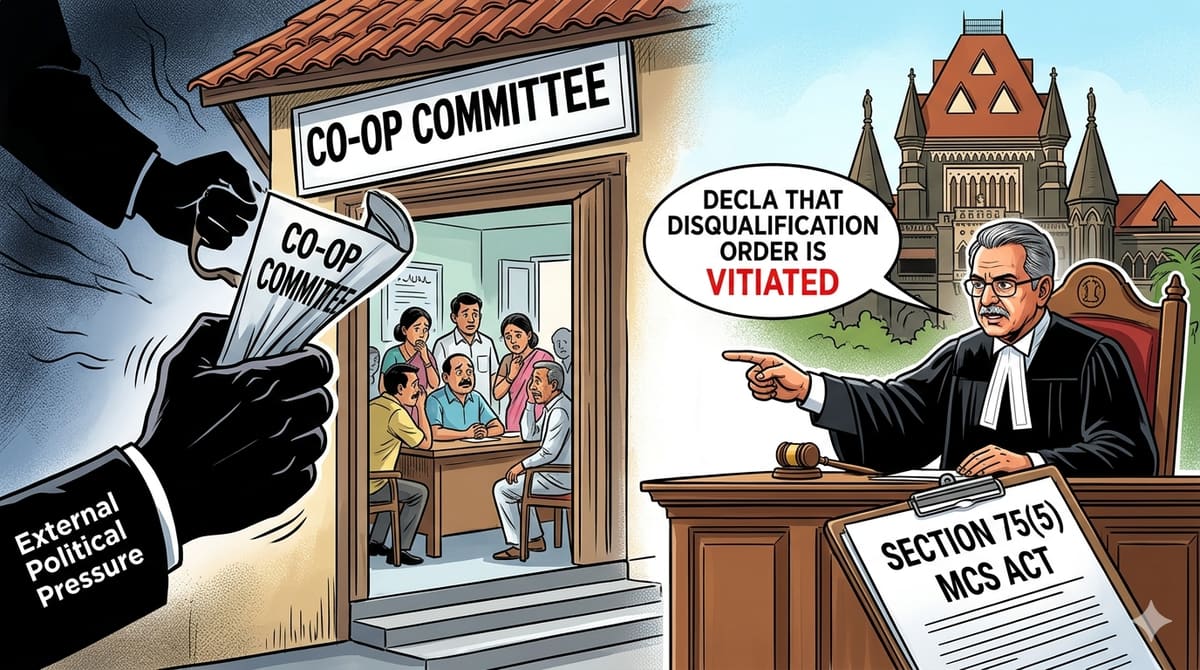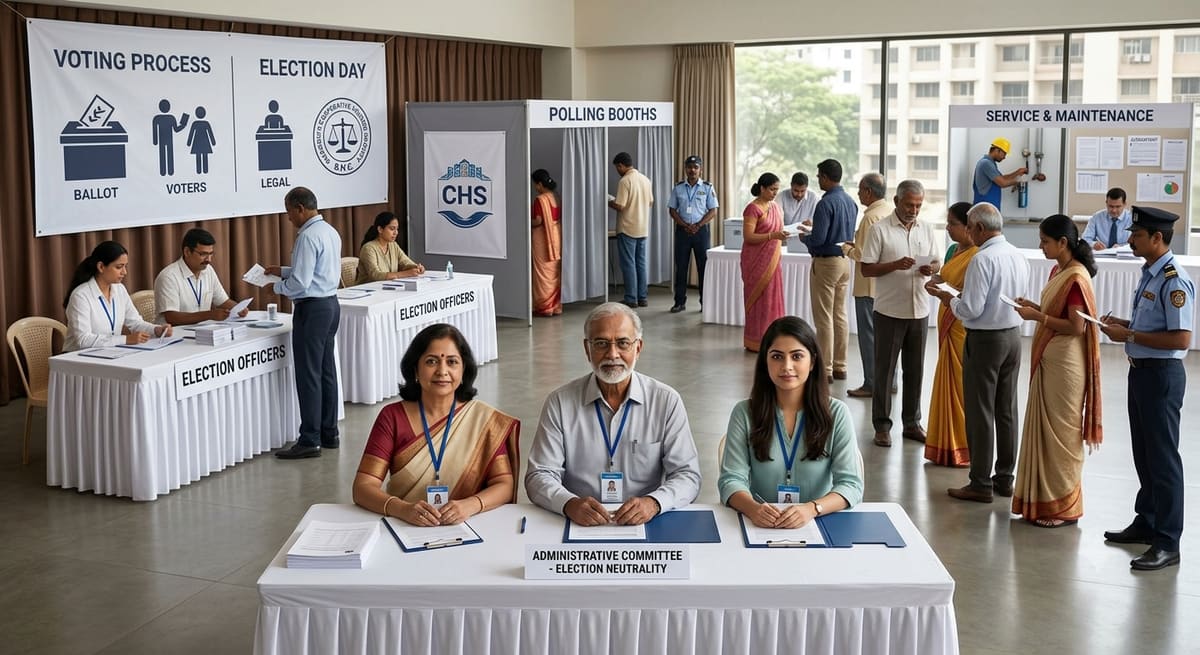
The Bombay High Court has clarified that the appointment of an administrative committee under the Maharashtra Co-operative Societies Act, 1960, must be strictly confined to facilitating free and fair elections, and cannot be used to perpetuate control by any faction. This ruling reinforces procedural neutrality in co-operative governance.
Background & Facts
The Dispute
The dispute arose over the management and upcoming elections of the Matunga Navjeevan CHSL, a housing co-operative society. The tenure of the Managing Committee elected in 2020 had expired, necessitating fresh elections. The Deputy Registrar, Co-operative Societies, G/N Division, Mumbai, appointed a three-member Administrative Committee on 28 December 2023 under Section 77A of the Maharashtra Co-operative Societies Act, 1960 (MCS Act), to oversee day-to-day affairs and conduct elections. The Petitioner challenged this order before the Divisional Joint Registrar, who set it aside on 25 June 2024, holding that the Registrar had failed to comply with the first proviso to Section 77A, which mandates public notice inviting objections. The Hon’ble Minister for Co-operation, however, reversed this order on 6 May 2026, relying on the second proviso to Section 77A, which permits dispensing with notice if immediate action is required or it is not reasonably practical to publish it.
Key Facts
The Managing Committee elected in 2020 completed its term and was no longer functional.
The Deputy Registrar appointed the Administrative Committee on 28 December 2023.
The Divisional Joint Registrar set aside the appointment on 25 June 2024 for non-compliance with the notice requirement under the first proviso to Section 77A.
The Minister for Co-operation restored the appointment on 6 May 2026, invoking the second proviso to Section 77A.
The Petitioner, a member of the society, objected specifically to the Chairman of the Administrative Committee, alleging bias.
Respondent No.4, who had initiated the appointment, did not oppose the replacement of the Chairman.
No dispute existed regarding the necessity of holding elections or the need for an impartial administrator.
Procedural History
28 December 2023: Deputy Registrar appoints three-member Administrative Committee under Section 77A of the MCS Act.
25 June 2024: Divisional Joint Registrar sets aside the appointment for failure to publish notice as required by the first proviso to Section 77A.
6 May 2026: Hon’ble Minister for Co-operation allows Revision Application No.475 of 2024, reversing the Divisional Joint Registrar’s order by invoking the second proviso to Section 77A.
7 June 2026: Writ Petition No.7864 of 2026 filed before the Bombay High Court challenging the Minister’s order.
1 July 2026: Hearing before Justice Sandeep V. Marne.
Relief Sought
The Petitioner sought quashing of the Minister’s order dated 6 May 2026 and the appointment of the Administrative Committee, particularly its Chairman. The Petitioner expressed willingness to accept an impartial administrator for conducting elections, provided the current Chairman was replaced.
The Legal Issue
The central question was whether the appointment of an administrative committee under Section 77A of the MCS Act can be sustained when the sole purpose is to conduct elections, and whether the Chairman of such a committee can be a member of a contested faction, thereby compromising neutrality.
Arguments Presented
For the Petitioner
The Petitioner’s counsel argued that the appointment of the Administrative Committee, particularly with the current Chairman, violated the spirit of Section 77A, which is meant to ensure impartial administration pending elections. He contended that even if the notice requirement under the first proviso was waived under the second proviso, the composition of the committee must remain neutral. He emphasized that the Chairman’s affiliation with one faction rendered the process inherently biased and undermined the legitimacy of the upcoming elections.
For the Respondent
The Respondent-State, through the AGP, defended the Minister’s order on the ground that the second proviso to Section 77A justified the waiver of notice due to the urgency of conducting elections. Respondent No.4, through counsel, did not oppose the replacement of the Chairman and acknowledged the need for an impartial administrator to ensure credible elections.
The Court's Analysis
The Court acknowledged that while the second proviso to Section 77A permits dispensing with notice in exceptional circumstances, the purpose of appointing an administrative committee is not to assume permanent control but to act as a neutral facilitator for elections. The Court observed that the appointment of an administrator is a temporary measure, intended to prevent deadlock and ensure orderly elections, not to entrench the authority of any faction.
"In my view appointment of Administrator is only for facilitating conduct of election. In view of bitter positions taken by the rival factions, it is better that the elections are held under the aegis of the Administrator rather than the Petitioner conducting the same."
The Court noted the consensus between the Petitioner and Respondent No.4 that the current Chairman should be replaced, and that no objection existed to the appointment of a neutral person. The Court emphasized that the integrity of the electoral process in co-operative societies depends on the perception of impartiality. Allowing a factional member to preside over elections, even under statutory authority, risks undermining public confidence and invites further litigation.
The Court further held that the Administrator must be strictly confined to administrative duties and must not make policy decisions, reinforcing the temporary and limited nature of the appointment.
The Verdict
The Petitioner succeeded. The Court modified the orders dated 28 December 2023 and 6 May 2026 to direct the Deputy Registrar to appoint a new, neutral Administrator for the sole purpose of conducting elections. The new Administrator must be appointed within one week, deposit election expenses with the State Co-operative Election Officer within one week of taking charge, and conduct elections within three months. The Administrator is prohibited from making any major policy decisions. Both factions are barred from interfering with the Administrator’s functioning. The order must be communicated to the Deputy Registrar immediately.
What This Means For Similar Cases
Neutrality Is Non-Negotiable in Co-operative Elections
Practitioners must challenge any administrative committee appointment where the Chairman or members are affiliated with a contested faction.
The mere invocation of the second proviso to Section 77A does not validate a biased appointment; neutrality is a substantive requirement.
Administrative Committees Are Temporary Facilitators, Not Governing Bodies
Co-operative societies must not allow administrative committees to assume decision-making powers beyond day-to-day maintenance.
Any policy action by an Administrator renders the appointment ultra vires and subject to judicial review.
Procedural Compliance Must Align with Substantive Fairness
Even if statutory notice requirements are waived, courts will scrutinize whether the appointment achieves the underlying purpose: fair elections.
Courts will prioritize the perception of fairness over technical compliance when the integrity of the electoral process is at stake.