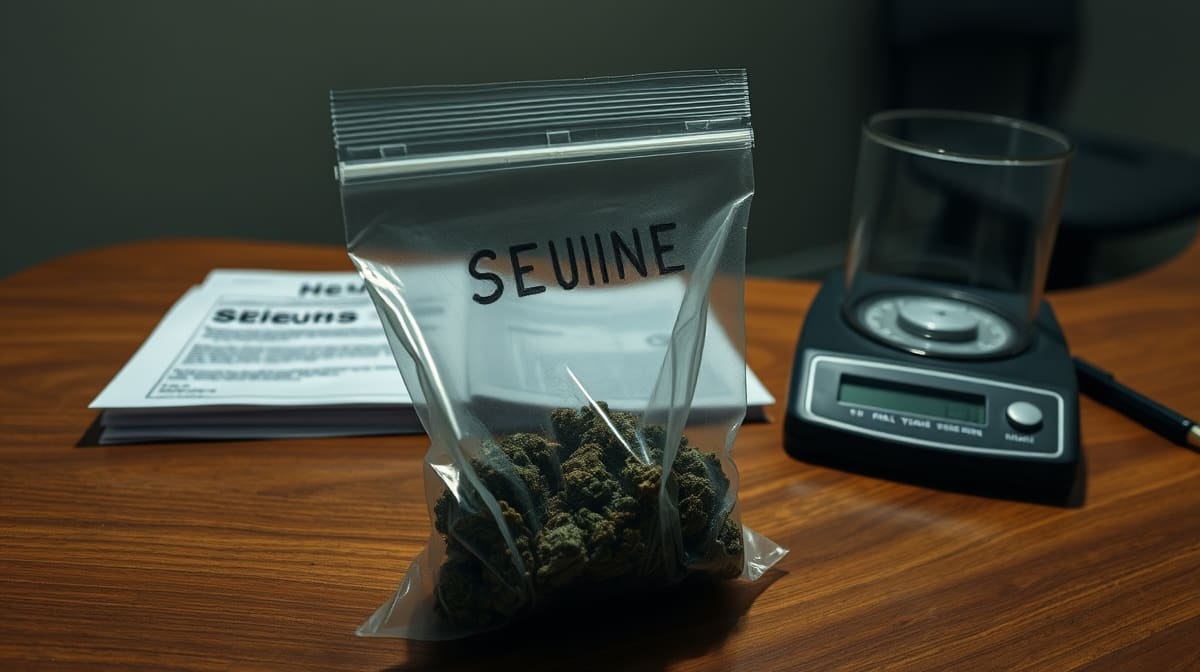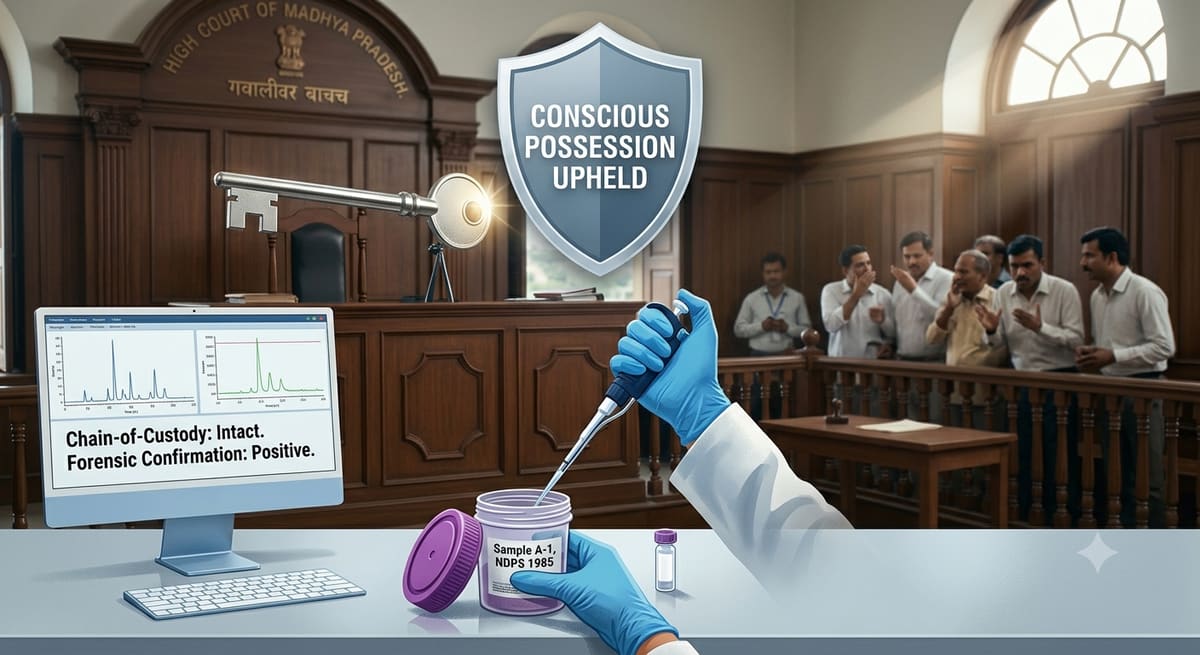
The Chhattisgarh High Court has affirmed that the testimony of police officials, when credible and consistent, can sustain a conviction under the NDPS Act even in the absence of corroboration by independent witnesses. The judgment clarifies that procedural deviations do not automatically vitiate proceedings if substantially explained, and emphasizes that the quantity of contraband and personal circumstances of the accused must inform sentencing.
Background & Facts
The Dispute
The appellant, Krishni Bai, a 52-year-old woman residing near the Bus Stand in Utai, District Durg, Chhattisgarh, was accused of possessing 1.100 kilograms of ganja without lawful authority. She operated a small paan stall at the location where the contraband was recovered. The prosecution alleged that she was engaged in illegal sale and possession of narcotics, leading to her arrest and prosecution under Section 20(b)(ii)(B) of the Narcotic Drugs and Psychotropic Substances Act, 1985.
Key Facts
- The appellant was found in possession of a plastic bag containing a green leafy substance on 03.09.2016 at approximately 15:10 hours near her paan stall.
- The substance was preliminarily identified as ganja by the Investigating Officer, Sub-Inspector Vishwajit Singh (P.W.-8), based on visual inspection, smell, and burning test.
- The contraband was weighed by weighman Naval Kishor (P.W.-4) in the presence of witnesses and found to be 1.100 kilograms.
- Two representative samples of 100 grams each were drawn and sealed in accordance with procedure.
- The appellant was not subjected to a personal search; the contraband was recovered from a bag kept at her stall.
- The appellant failed to produce any license or permit for possession of the substance.
- A notice under Section 91 CrPC was served, but no documents were produced.
- FIR No. 234/2016 was registered at Police Station Utai on 03.09.2016.
- The seized contraband was deposited in the police Malkhana with proper chain of custody maintained.
- The appellant was in custody for approximately 35 days during trial.
- The appellant has no prior criminal record.
Procedural History
- 03.09.2016: Recovery of ganja and registration of FIR.
- 24.03.2018: Judgment and sentence passed by Special Judge (NDPS Act), Durg, convicting the appellant under Section 20(b)(ii)(B) of the NDPS Act and sentencing her to one year rigorous imprisonment and a fine of ₹1,000.
- 2018: Appeal filed before the High Court (CRA No. 541 of 2018).
- 23.03.2026: Hearing conducted before the Division Bench of the Chhattisgarh High Court. No appearance was made by the appellant; legal aid counsel was appointed.
The Parties' Positions
For the Appellant
- Challenged the legality of the search and seizure under Sections 42, 50, 55, and 57 of the NDPS Act.
- Argued that independent witnesses turned hostile and failed to support the prosecution.
- Contended that the recovery was not proved beyond reasonable doubt.
- Highlighted contradictions in statements recorded under Sections 161 and 164 CrPC.
- Emphasized the appellant’s age, livelihood as a paan stall vendor, and 35 days of custody as mitigating factors.
For the Respondent/State
- Maintained that the prosecution proved conscious possession of ganja beyond reasonable doubt.
- Argued that police testimony is reliable and admissible, citing State (Govt. of NCT of Delhi) v. Sunil.
- Stated that minor discrepancies do not undermine the core of the case.
- Asserted that Section 50 does not apply as the search was not personal but of property at the stall.
Relief Sought
The appellant sought acquittal or, alternatively, reduction of sentence. The State sought dismissal of the appeal and upholding of the conviction and sentence.
The Legal Issue
The central questions were: (1) Whether the prosecution proved beyond reasonable doubt that the appellant was in conscious possession of contraband, despite lack of corroboration by independent witnesses? (2) Whether procedural irregularities under Sections 42 and 50 of the NDPS Act vitiated the trial? (3) Whether the sentence of one year rigorous imprisonment was proportionate given the quantity of contraband and personal circumstances of the accused?
Arguments Presented
For the Appellant
The appellant’s counsel relied on State of Punjab v. Baldev Singh to argue that non-compliance with Section 50 of the NDPS Act vitiates conviction. It was contended that the recovery was not properly witnessed and that the independent witnesses had turned hostile, rendering the prosecution case unreliable. Reliance was also placed on Karnail Singh v. State of Haryana to argue that delay in compliance with Section 42 requires strict scrutiny. It was further submitted that the appellant’s age, lack of criminal antecedents, and subsistence livelihood warranted leniency. The counsel cited Rafiq Qureshi v. Narcotic Control Bureau to argue for sentence reduction on humanitarian grounds.
For the Respondent/State
The State countered that the Investigating Officer’s testimony was consistent and credible. It was argued that Section 50 applies only to personal searches, and since the contraband was recovered from a bag at the stall, not from the appellant’s person, the provision was not triggered. The State relied on State (Govt. of NCT of Delhi) v. Sunil, which holds that police witnesses are not inherently unreliable. Minor inconsistencies in witness statements were dismissed as immaterial to the core of the case. The State maintained that the trial court’s findings were well-reasoned and entitled to deference.
The Court's Analysis
The Court undertook a detailed review of the evidence and legal principles governing NDPS prosecutions. It noted that while independent witnesses did not support the prosecution, the law does not require their corroboration for conviction if the testimony of official witnesses is credible.
"The law regarding Section 42 has been settled in Karnail Singh v. State of Haryana (2009) 8 SCC 539, wherein it has been held that 'Delayed compliance with satisfactory explanation would not vitiate the trial.'"
The Court found that the Investigating Officer had recorded the secret information in the Roznamcha, informed superiors, constituted a raiding party, and followed prescribed procedures for seizure and sealing. The recovery occurred from a bag at the paan stall, not from the appellant’s person. Therefore, Section 50 of the NDPS Act, which mandates informing the accused of their right to be searched before a gazetted officer or magistrate, was not attracted.
The Court rejected the argument that police testimony is inherently suspect, stating: "It is an archaic notion that actions of police officers should be approached with initial distrust."
The Court further held that the quantity of ganja (1.100 kg) was below the commercial quantity threshold under the NDPS Act, and the appellant’s personal circumstances - her age, lack of prior record, and subsistence livelihood - were significant mitigating factors. The trial court’s conviction was upheld as legally sound, but the sentence was found disproportionate.
The Verdict
The appeal was allowed in part. The conviction of the appellant under Section 20(b)(ii)(B) of the NDPS Act, 1985 is affirmed. The sentence of one year rigorous imprisonment is reduced to the period already undergone - approximately 35 days. The fine of ₹1,000 is maintained. The appellant is entitled to set off the period of custody under Section 428 of the BNSS Act, 2023. She need not surrender, subject to payment of the fine, if not already deposited.
What This Means For Similar Cases
Police Testimony Can Sustain Conviction Without Independent Witnesses
- Practitioners must argue that reliability, not corroboration, is the standard for police testimony under the NDPS Act.
- Courts will not automatically discard prosecution cases merely because independent witnesses are uncooperative or hostile.
- Focus should be on the consistency, plausibility, and procedural adherence of the investigating officer’s account.
Section 50 Does Not Apply to Property Searches
- Where contraband is recovered from a bag, vehicle, or premises - not from the person - Section 50 of the NDPS Act is inapplicable.
- Defense arguments invoking Section 50 must be carefully tailored to the nature of the search.
- Prosecution must document whether the search was personal or of property to pre-empt challenges.
Sentencing Must Reflect Quantity and Personal Circumstances
- For quantities below commercial thresholds, courts are expected to apply proportionality.
- Age, gender, livelihood, custody time, and lack of prior record are material for sentence reduction.
- Courts may reduce sentences to time already served where the punishment otherwise exceeds the gravity of the offense.