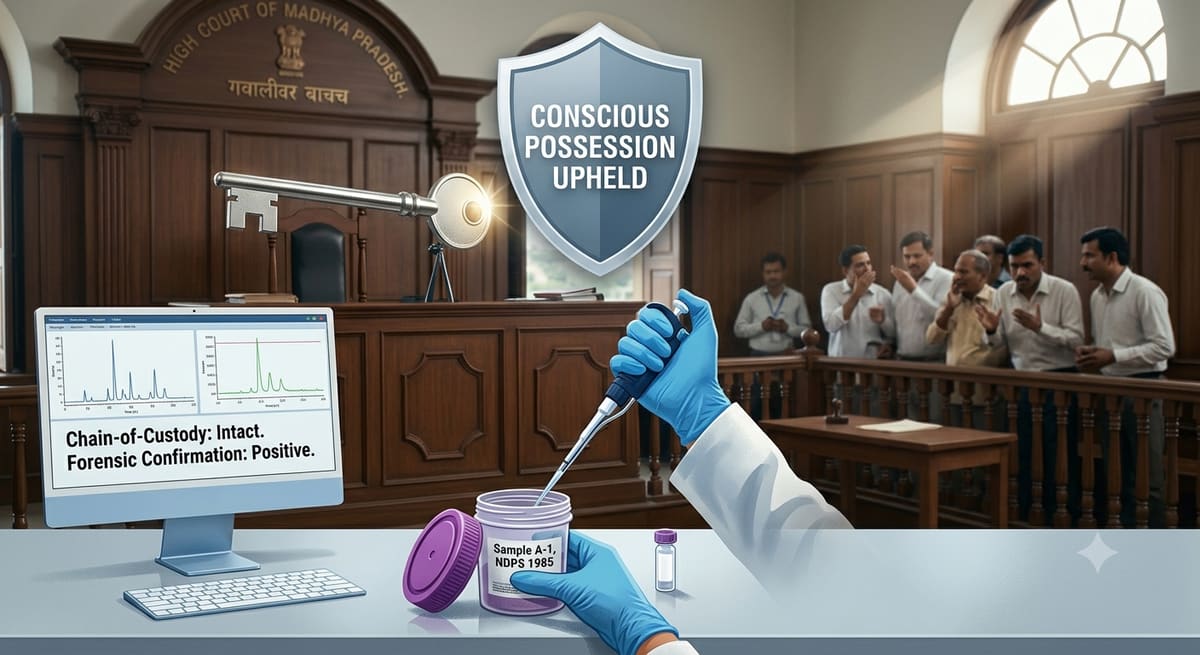
The Chhattisgarh High Court has reaffirmed that the hostility of seizure witnesses does not automatically nullify a conviction under the Narcotic Drugs and Psychotropic Substances Act, 1985, provided the Investigating Officer's testimony is credible, consistent, and supported by documentary evidence. This ruling clarifies the threshold for proving possession beyond reasonable doubt in drug cases where procedural irregularities or witness hostility are raised.
Background & Facts
The Dispute
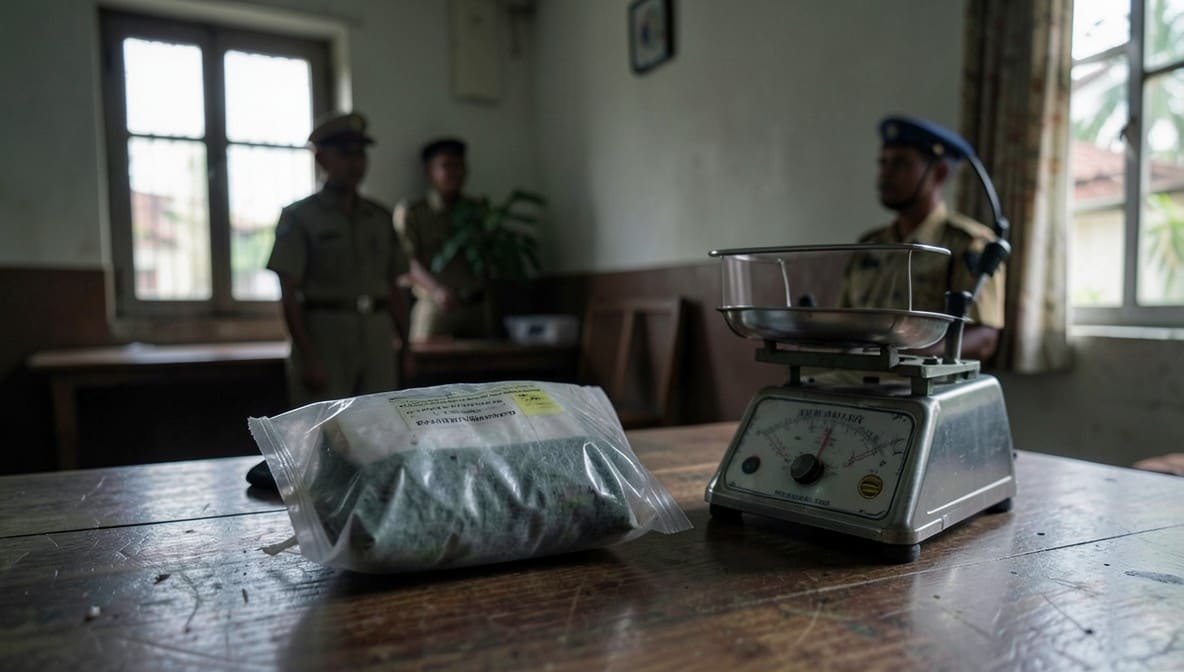
The appellant, Mahesh Jagat, was convicted under Section 20(B) of the NDPS Act for possessing 10 kg 500 g of contraband ganja, a quantity exceeding the small quantity threshold but falling short of commercial quantity. The prosecution alleged the contraband was recovered from his residence following a secret tip-off. The appellant contested the recovery, claiming the seizure occurred from one of two houses he owned, and that the panch witnesses had turned hostile.
Procedural History
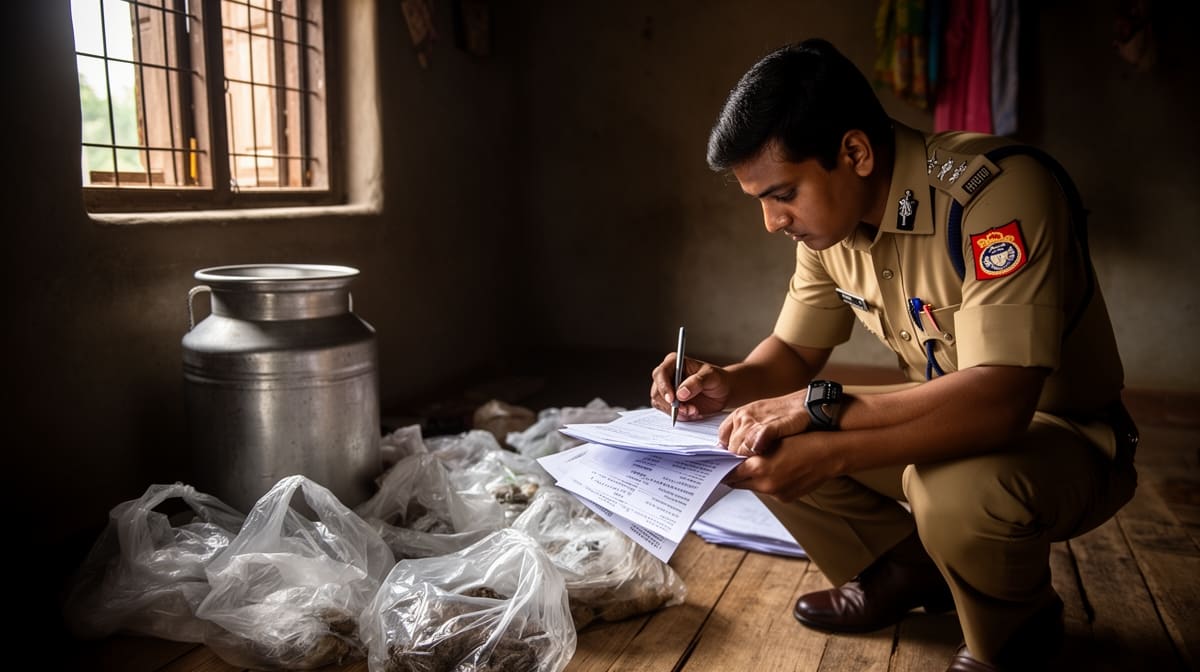
- 10.05.2004: Police conducted search based on secret information; seized ganja from plastic bags inside a steel drum, tin box, and separate packets.
- Seizure panchnamas (Ex.P-3 to Ex.P-13): Prepared with witnesses, including Sanjay Kumar Sahu (PW-2) and Pradeep Sanyal (PW-3).
- FSL Report: Confirmed the seized substance as ganja.
- 2009: Special Judge (NDPS) convicted appellant and sentenced him to 5 years RI and ₹50,000 fine.
- 2005: Appeal filed before Chhattisgarh High Court under Section 374(2) CrPC.
The Parties' Positions
- Appellant: Argued that hostile panch witnesses vitiated the entire case; questioned the accuracy of weight due to inclusion of leaves and seeds; claimed ambiguity in the house of seizure.
- State: Contended that despite witness hostility, the Investigating Officer’s testimony was unshaken on cross-examination and corroborated by seizure memos and FSL report.
Relief Sought
The appellant sought acquittal or reduction of sentence to time already served (9 months 6 days). The State sought dismissal of the appeal.
The Legal Issue
The central question was whether the hostility of seizure witnesses automatically vitiates a conviction under the NDPS Act when the Investigating Officer’s testimony is credible and supported by documentary evidence.
Arguments Presented
For the Appellant
Counsel argued that the panch witnesses (PW-2, PW-3, PW-4) had categorically denied witnessing the seizure, rendering the recovery unreliable. He cited Dilip Kaser v. State of Chhattisgarh to argue that procedural lapses in sampling and failure to segregate leaves/seeds from ganja rendered the weight measurement invalid. He further contended that the prosecution failed to prove exclusive possession of the house from which ganja was seized.
For the Respondent
The State countered that hostile witnesses do not invalidate a case if the IO’s testimony remains unimpeached. It emphasized that all witnesses had signed the panchnamas, confirming their participation. The IO’s detailed account of the recovery, cross-examined thoroughly, was consistent with the FSL report and seizure memos. The State relied on Bharat Aambale v. State of Chhattisgarh to argue that substantial compliance with Section 52A suffices, and hostility alone cannot override corroborative evidence.
The Court's Analysis
The Court examined the interplay between witness hostility and the reliability of the Investigating Officer’s testimony under the NDPS Act. It held that while hostile witnesses raise suspicion, they do not automatically destroy the prosecution’s case. The key lies in whether the remaining evidence inspires confidence.
"The prosecution by examining witnesses i.e. Investigating Officer has proved that the contraband Ganja was seized from the exclusive possession of the appellant and he is unable to discharge his burden to prove the same as the witness remained affirmed despite extensive cross-examination by the defense."
The Court noted that the IO had clearly identified the house from which the ganja was seized, despite the appellant’s claim of two residences. The appellant failed to provide any evidence to rebut this. The Court further held that the inclusion of leaves and seeds in the weight was not fatal, as Section 52A permits measurement of the entire seized substance unless the defense proves deliberate manipulation.
The Court applied the ten-point framework from Bharat Aambale, particularly 56.6 and 56.10, which state that procedural lapses under Section 52A are not fatal if the overall evidence inspires confidence. The IO’s testimony, supported by signed panchnamas and the FSL report, satisfied the standard of proof beyond reasonable doubt. The Court rejected the argument that sampling irregularities invalidated the case, noting that the samples were drawn in accordance with procedure and the substance was chemically confirmed.
The Court also emphasized that Section 54 of the NDPS Act - which creates a presumption of guilt upon possession - cannot be invoked unless the seizure is established by independent evidence. Here, the seizure was independently proven, making the presumption unnecessary but reinforcing the conviction.
The Verdict
The appeal was dismissed. The Court upheld the conviction and sentence under Section 20(B) of the NDPS Act, holding that the prosecution proved possession beyond reasonable doubt despite hostile witnesses. The appellant was directed to surrender within two months to serve the remainder of his sentence.
What This Means For Similar Cases
Hostile Witnesses Do Not Automatically Invalidate NDPS Convictions
- Practitioners must now focus on the credibility of the Investigating Officer’s testimony, not just the panch witnesses.
- Signed panchnamas and consistent IO testimony can sustain a conviction even if witnesses deny witnessing the seizure.
- Defense arguments based solely on witness hostility will fail unless they demonstrate material contradictions in the documentary chain.
Procedural Lapses Are Not Fatal Without Material Doubt
- Minor deviations in sampling or inventory under Section 52A will not lead to acquittal if the substance is chemically verified and possession is established.
- Courts will adopt a holistic view: procedural lapses may invite adverse inference, but will not override corroborative evidence.
- Prosecutors must ensure panchnamas are signed and samples preserved, but need not achieve perfection to secure conviction.
Burden of Rebuttal Lies with the Accused on Possession
- When the prosecution establishes recovery from a specific location, the accused bears the burden to prove lack of exclusive possession.
- Mere assertion of multiple residences is insufficient; the accused must produce evidence (e.g., occupancy records, third-party testimony) to rebut the IO’s account.
- Failure to discharge this burden strengthens the prosecution’s case under Section 54 even without invoking the presumption.