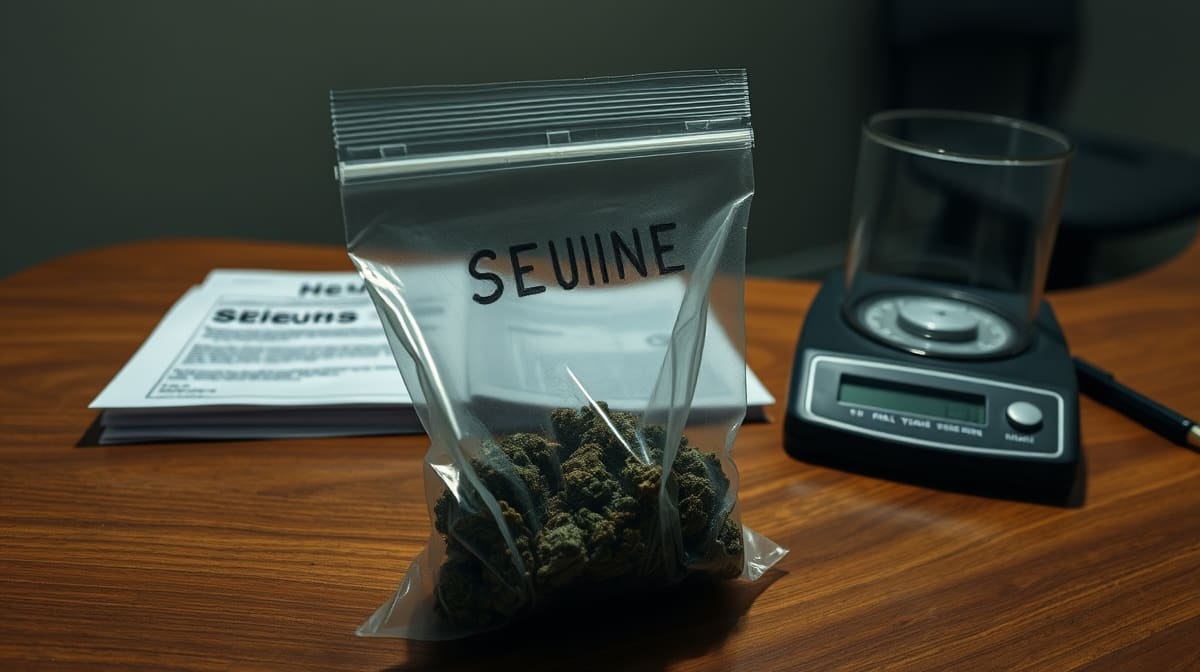
The Chhattisgarh High Court has affirmed that procedural deviations under the NDPS Act do not automatically invalidate a conviction if the core evidence of possession remains unchallenged, but may warrant sentence modification where the accused has endured prolonged incarceration. This judgment reinforces the principle that substantial compliance, not technical perfection, governs statutory safeguards in drug cases, while emphasizing judicial discretion in sentencing based on equity and delay.
Background & Facts
The Dispute
The appellants, Vijendra Lodhi and Kanshi Prasad Lodhi, were convicted under Section 20(b)(ii)(B) of the Narcotic Drugs and Psychotropic Substances (NDPS) Act, 1985 for possession of ganja. The prosecution alleged that on 28.07.2017, the appellants, disguised as sadhus, were found carrying illicit contraband near the Charama Bus Stand in Kanker District, Chhattisgarh. The case arose from a secret intelligence tip-off received by Sub-Inspector Baleshwar Lahre of Police Station Charama.
Key Facts
- On 28.07.2017, secret information was received by SI Baleshwar Lahre regarding two individuals carrying ganja near Charama Bus Stand
- A memorandum under Section 42 of the NDPS Act was prepared on the same day
- A raiding party was constituted, and independent panch witnesses were secured
- The appellants were intercepted and identified as Vijendra Lodhi and Kanshi Prasad Lodhi
- From Vijendra Lodhi, the following contraband was recovered:
- 3 kg 230 grams from a steel container
- 2 kg 950 grams from a plastic sack
- 3 kg 420 grams from another sack
- Total: 9 kg 600 grams
- From Kanshi Prasad Lodhi, the following contraband was recovered:
- 3 kg 210 grams from a steel container
- 5 kg 350 grams from a sack
- Total: 8 kg 560 grams
- Total ganja recovered: 18 kg 160 grams
- Samples of 50 grams each were drawn from each packet and sealed
- A seizure memo (panchnama) was prepared in presence of witnesses
- The contraband was transported to the police station and later sent to the Forensic Science Laboratory (FSL)
- FSL report dated 15.08.2017 confirmed the substance as ganja (cannabis)
- Charge-sheet was filed on 10.10.2017 in Special Case No. 43/2017
- Trial commenced before the Special Judge (NDPS Act), North Bastar, Kanker
- Prosecution examined 12 witnesses, including the Investigating Officer and panch witnesses
- Appellants denied charges under Section 313 Cr.P.C. and did not lead any defence evidence
Procedural History
- 28.07.2017: Recovery of contraband and arrest of appellants
- 10.10.2017: Charge-sheet filed
- 28.07.2018: Trial Court convicted appellants under Section 20(b)(ii)(B) of NDPS Act and sentenced them to 5 years rigorous imprisonment with ₹10,000 fine each
- 15.08.2018: Appellants filed Criminal Appeal No. 1208 of 2018 before the High Court of Chhattisgarh
- 23.03.2026: Judgment delivered by the Division Bench of the Chhattisgarh High Court
The Parties' Positions
For the Appellants
- Contended that Sections 42 and 50 of the NDPS Act were not strictly complied with
- Argued that the panch witnesses turned hostile and their testimony was unreliable
- Claimed that the search was not conducted before a Gazetted Officer or Magistrate as mandated under Section 50
- Asserted that weighing of contraband occurred at the police station, not at the recovery site, raising doubts about authenticity
- Alleged violation of Section 55 of the NDPS Act regarding safe custody of seized articles
For the Respondent/State
- Maintained that the prosecution case was proved beyond reasonable doubt
- Argued that the testimonies of police witnesses were consistent and credible
- Submitted that hostility of independent witnesses does not automatically destroy the prosecution case
- Emphasized that the FSL report conclusively established the substance as ganja
- Contended that minor procedural lapses, without prejudice to the accused, do not vitiate conviction
Relief Sought
The appellants sought: (1) quashing of the conviction, (2) acquittal on grounds of procedural non-compliance, and (3) release from custody. Alternatively, they sought reduction of sentence to time already served.
The Legal Issue
The central questions were: (1) Whether the prosecution proved beyond reasonable doubt that the appellants were in conscious possession of ganja? (2) Whether non-compliance with Sections 42 and 50 of the NDPS Act vitiated the conviction? (3) Whether the sentence of five years rigorous imprisonment warranted modification in light of the appellants’ prolonged incarceration?
Arguments Presented
For the Appellant
Counsel for the appellants relied on State of Punjab v. Baldev Singh (1999) 6 SCC 172 and Karnail Singh v. State of Haryana (2009) 8 SCC 539 to argue that Sections 42 and 50 of the NDPS Act are mandatory and their non-compliance renders the entire prosecution case invalid. It was submitted that the failure to conduct the search before a Gazetted Officer or Magistrate, the absence of contemporaneous documentation of the secret information, and the delay in weighing the contraband at the police station created reasonable doubt. The hostility of the panch witnesses, it was argued, further undermined the credibility of the recovery. The counsel contended that the trial court’s reliance on police testimony alone, without corroboration from independent witnesses, was legally unsustainable.
For the Respondent/State
The State counsel countered that the prosecution witnesses, particularly the Investigating Officer, provided consistent and detailed testimony corroborated by the seizure memo, FSL report, and case diary entries. It was submitted that the Supreme Court has held that substantial compliance suffices if no prejudice is caused to the accused. The FSL report, it was argued, provided scientific validation of the seized substance as ganja. The State further emphasized that hostility of independent witnesses does not automatically discredit the prosecution case, especially when official witnesses are reliable and their testimony is internally consistent.
The Court's Analysis
The High Court undertook a meticulous review of the evidence and procedural compliance. It acknowledged that Sections 42 and 50 of the NDPS Act are mandatory, as affirmed in Baldev Singh and Karnail Singh. However, the Court emphasized that the Supreme Court has consistently held that strict compliance must be balanced against the absence of prejudice to the accused.
"The evidence of official witnesses cannot be discarded merely on the ground of their official status, unless any material is brought on record to show animosity or motive for false implication."
The Court found no evidence of malice or fabrication in the conduct of the Investigating Officer. The testimonies of the police personnel were consistent across multiple points: the receipt of secret information, the constitution of the raiding party, the interception of the appellants, the recovery of contraband, and the preparation of the seizure memo. The FSL report, which confirmed the substance as ganja, provided critical scientific corroboration.
Regarding the panch witnesses, the Court noted that their hostility does not ipso facto invalidate the prosecution case. The seizure memo and other contemporaneous documents, prepared at the time of recovery, served as reliable corroborative evidence. The Court also observed that the chain of custody, though questioned, was not so broken as to cast doubt on the authenticity of the seized material.
The Court further held that the weighing of contraband at the police station, while not ideal, did not amount to a fatal irregularity in the absence of any allegation of tampering or substitution. The sealing and sampling procedures were followed, and the FSL report confirmed the identity of the substance.
The Court concluded that the prosecution had established the appellants’ conscious possession of ganja beyond reasonable doubt. The conviction, therefore, was legally sound.
However, the Court noted that the appellants had been in custody since their arrest on 28.07.2017 and had endured over one year and one month of incarceration by the time of judgment. The Court observed that the appellants were not habitual offenders and had no prior criminal record. The quantity of ganja, while substantial, fell within the intermediate category under the NDPS Act.
"Taking into consideration the totality of circumstances, including the nature of offence, quantity involved, antecedents of the appellants, and the period of incarceration already undergone, this Court is of the considered view that ends of justice would be adequately met by reducing the substantive sentence to the period already undergone."
The Verdict
The appeal was partly allowed. The conviction of the appellants under Section 20(b)(ii)(B) of the NDPS Act, 1985, was affirmed. However, the sentence of rigorous imprisonment for five years was reduced to the period already undergone by the appellants, which amounted to approximately one year and one month. The fine of ₹10,000 each imposed by the trial court was upheld. In default of payment, the default sentence as originally directed would apply. The appellants, who were on bail, were not required to surrender, subject to payment of the fine, if not already deposited.
What This Means For Similar Cases
Procedural Lapses Do Not Automatically Nullify Conviction
- Practitioners must argue that non-compliance with Sections 42 and 50 of the NDPS Act must be shown to have caused actual prejudice to the accused
- Mere technical deviations, such as delay in weighing or absence of a Gazetted Officer, will not vitiate conviction if the recovery is corroborated by FSL reports and consistent police testimony
- The burden is on the defence to demonstrate how the lapse affected the fairness of the trial
Sentencing Must Reflect Time Served and Individual Circumstances
- Courts are increasingly inclined to reduce sentences to time already served where the accused has undergone prolonged incarceration without conviction being overturned
- Factors such as lack of prior record, intermediate quantity of contraband, and absence of trafficking intent are critical in sentencing discretion
- This judgment provides a clear precedent for seeking sentence reduction on humanitarian and equitable grounds, even when conviction stands
Independent Witness Hostility Is Not Fatal to Prosecution
- Hostility of panch witnesses does not automatically destroy the prosecution case
- Official witness testimony, if consistent and corroborated by documentary evidence, can sustain conviction
- Practitioners should focus on challenging the credibility of police testimony through cross-examination rather than relying solely on panch witness hostility