Topic

conscious possession

Conscious possession under the NDPS Act requires proof that the accused knowingly had control over narcotics, not merely proximity to them. This page provides latest judgments, case analyses, and updates from Indian courts on how courts interpret knowledge, control.

19 articlesLatest July 2026
Conscious Possession Under NDPS Act | Bail Granted When Contraband Recovered Solely from Co-Accused Without Knowledge or Control: Bombay HC
Case Law Analysis
|Bombay High Court

Conscious Possession Under NDPS Act | Bail Granted When Contraband Recovered Solely from Co-Accused Without Knowledge or Control: Bombay HC

The Bombay High Court held that mere proximity to a co-accused and call detail records cannot establish conscious possession under the NDPS Act when contraband is recovered exclusively from another person. This ruling reinforces that knowledge and control are indispensable elements for conviction and bail denial in drug cases, protecting individuals from guilt by association.


Sections 25-1B(a) & 26 Arms Act | 'Conscious Possession' Requires Proof of Dominion & Knowledge: SC Acquits for Mere Recovery
Case Law Analysis
|Supreme Court of India

Sections 25-1B(a) & 26 Arms Act | 'Conscious Possession' Requires Proof of Dominion & Knowledge: SC Acquits for Mere Recovery

The Supreme Court reiterated that conviction under the Arms Act demands proof of 'conscious possession'-mere recovery of weapons without evidence of dominion or knowledge is insufficient. The ruling sets a critical precedent for extremist-related prosecutions, emphasizing the prosecution's burden to establish active control over seized arms.

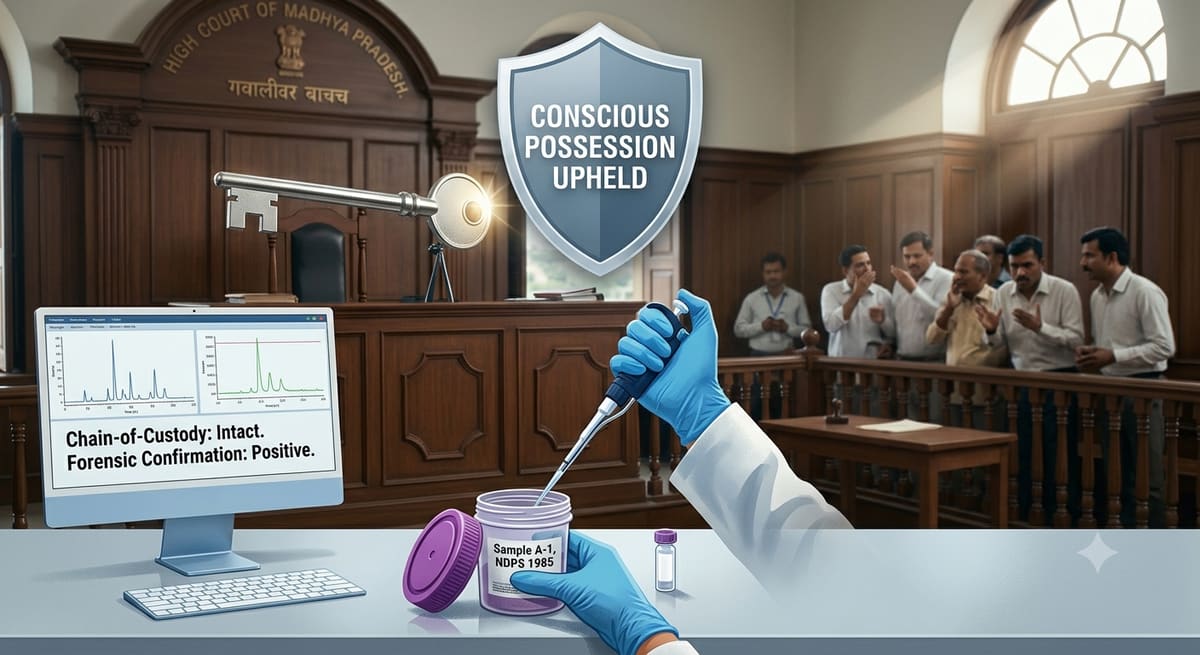
Conscious Possession Under NDPS Act Upheld Despite Witness Contradictions When Forensic and Chain-of-Custody Evidence Is Unbroken : Gauhati HC
Case Law Analysis
|Gauhati High Court

Conscious Possession Under NDPS Act Upheld Despite Witness Contradictions When Forensic and Chain-of-Custody Evidence Is Unbroken : Gauhati HC

The Gauhati High Court affirmed that minor inconsistencies in witness testimony do not invalidate a conviction under the NDPS Act when forensic analysis and unbroken chain of custody establish deliberate possession. This reinforces that procedural hiccups cannot override substantive evidence in drug trafficking cases, setting a clear standard for trial courts handling similar evidentiary challenges.

Probation of Offenders Act Section 4 | Elderly First-Time Offenders Entitled to Probation Despite Minimum Sentence Under EC Act : Allahabad HC
Case Law Analysis
|Allahabad High Court

Probation of Offenders Act Section 4 | Elderly First-Time Offenders Entitled to Probation Despite Minimum Sentence Under EC Act : Allahabad HC

Allahabad HC sets aside a 6-month RI sentence under the Essential Commodities Act, ruling that probation under Section 4 of the Probation of Offenders Act must be granted to elderly first-time offenders, prioritizing reformation over punishment. The judgment reinforces judicial discretion in sentencing, even for offences carrying mandatory minimum penalties.

NDPS Act Section 37 | Twin Bail Conditions Mandatory for Commercial Quantity Offences : HP HC
Case Law Analysis
|Himachal Pradesh High Court

NDPS Act Section 37 | Twin Bail Conditions Mandatory for Commercial Quantity Offences : HP HC

Himachal Pradesh High Court reinforces that bail under Section 37 of the NDPS Act for commercial quantity offences requires satisfaction of twin conditions: reasonable belief of innocence and no likelihood of reoffending. The ruling dismisses bail for an accused found in joint possession of 1.852 kg charas, setting a strict precedent for NDPS bail jurisprudence.

Bihar Prohibition Act | Anticipatory Bail Granted Despite Boat Ownership Where 'Conscious Possession' and Criminal Antecedents Absent : Patna HC
Case Law Analysis
|Patna High Court

Bihar Prohibition Act | Anticipatory Bail Granted Despite Boat Ownership Where 'Conscious Possession' and Criminal Antecedents Absent : Patna HC

Patna High Court rules that mere ownership of a boat-without proof of conscious possession of contraband or prior criminal record-does not constitute an offence under Section 30(a) of the Bihar Prohibition and Excise Act. The judgment reinforces that anticipatory bail can be granted where allegations fail to establish culpability beyond nominal association.

Section 21 NDPS Act | Pillion Rider Not Liable Without Proof of Conscious Possession: Punjab & Haryana HC Grants Bail
Case Law Analysis
|Punjab and Haryana High Court

Section 21 NDPS Act | Pillion Rider Not Liable Without Proof of Conscious Possession: Punjab & Haryana HC Grants Bail

The Punjab & Haryana High Court ruled that a pillion rider cannot be held guilty under Section 21 of the NDPS Act merely for being present on a motorcycle where contraband was recovered from the driver. The court emphasized that conscious possession must be proven, not presumed, setting a precedent for bail jurisprudence in drug trafficking cases involving co-accused.

NDPS Act Section 37 | Mere Presence Without Conscious Possession Insufficient for Bail Denial: Bombay HC
Case Law Analysis
|Bombay High Court

NDPS Act Section 37 | Mere Presence Without Conscious Possession Insufficient for Bail Denial: Bombay HC

Bombay High Court rules that bail under Section 37(1)(b)(ii) of the NDPS Act cannot be denied based solely on the accused's presence at the crime scene unless 'conscious possession' of contraband is proven. The judgment clarifies that accidental presence or lack of knowledge about illegal activity negates bail denial grounds, reinforcing personal liberty protections in drug offences.

Section 37 NDPS Act | Mere Presence Without Conscious Possession Insufficient for Bail Denial : Punjab & Haryana HC
Case Law Analysis
|Punjab and Haryana High Court

Section 37 NDPS Act | Mere Presence Without Conscious Possession Insufficient for Bail Denial : Punjab & Haryana HC

The Punjab & Haryana High Court ruled that bail cannot be denied under the NDPS Act based solely on a co-accused's possession of contraband unless there is evidence of the accused's knowledge or control. This sets a critical precedent for bail jurisprudence in drug offenses, emphasizing the need for proof of conscious possession.

Section 42 & 50 NDPS Act | Procedural Lapses Do Not Vitiate Conviction but Justify Sentence Reduction : CGHC
Case Law Analysis
|Chhattisgarh High Court

Section 42 & 50 NDPS Act | Procedural Lapses Do Not Vitiate Conviction but Justify Sentence Reduction : CGHC

Chhattisgarh High Court rules that while procedural non-compliance under Sections 42 and 50 of the NDPS Act does not invalidate a conviction if evidence is reliable, it may warrant sentence reduction. The court reduced the sentence to time already served for possession of 18 kg ganja, emphasizing that prejudice must be demonstrated for procedural lapses to affect conviction.

NDPS Act Section 20(b)(ii)(B) | Police Testimony Alone Sufficient for Conscious Possession Without Independent Witness Corroboration : Chhattisgarh HC
Case Law Analysis
|Chhattisgarh High Court

NDPS Act Section 20(b)(ii)(B) | Police Testimony Alone Sufficient for Conscious Possession Without Independent Witness Corroboration : Chhattisgarh HC

The Chhattisgarh High Court affirmed that in NDPS cases, the uncorroborated testimony of the investigating officer can establish conscious possession of contraband, reinforcing prosecutorial credibility in absence of eyewitnesses. This ruling strengthens the evidentiary standard for drug possession convictions while the sentence reduction to time served underscores judicial recognition of mitigating personal circumstances.

NDPS Act Section 21 | Pillion Rider Not Guilty of Conscious Possession Without Knowledge or Control of Contraband : Punjab & Haryana HC
Case Law Analysis
|Punjab and Haryana High Court

NDPS Act Section 21 | Pillion Rider Not Guilty of Conscious Possession Without Knowledge or Control of Contraband : Punjab & Haryana HC

The Punjab & Haryana High Court ruled that mere presence as a pillion rider on a motorcycle where contraband is found with the driver does not establish conscious possession under the NDPS Act. The judgment reinforces that guilt requires proof of actual knowledge and dominion over the drugs, protecting innocent passengers from automatic liability in drug cases.