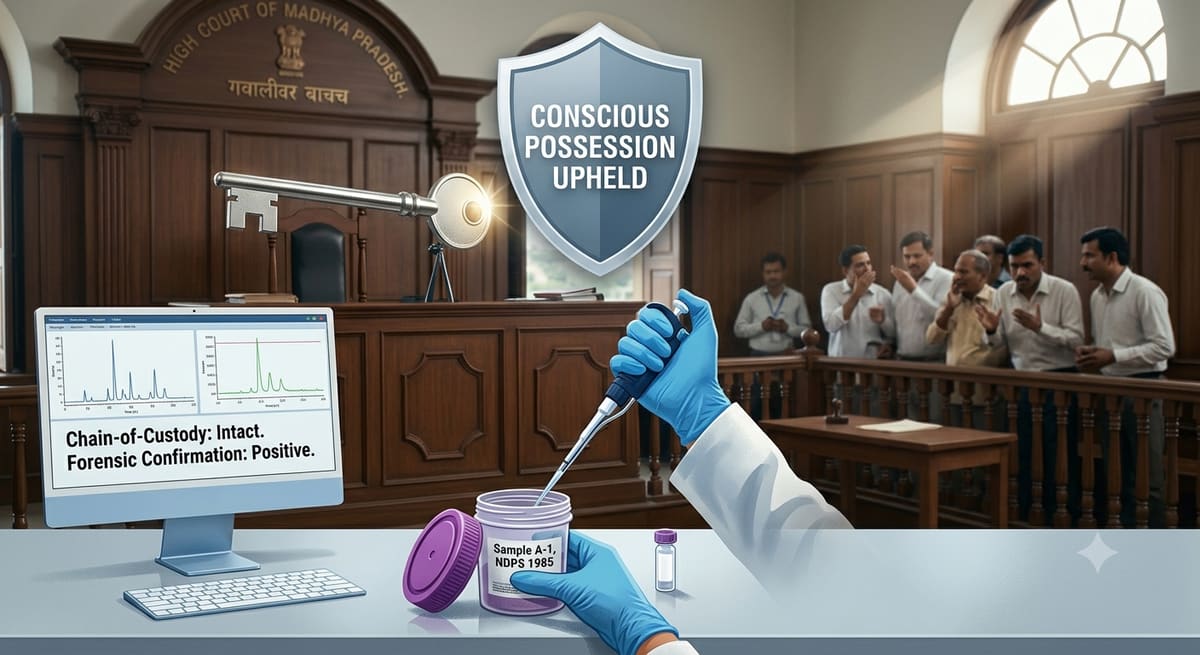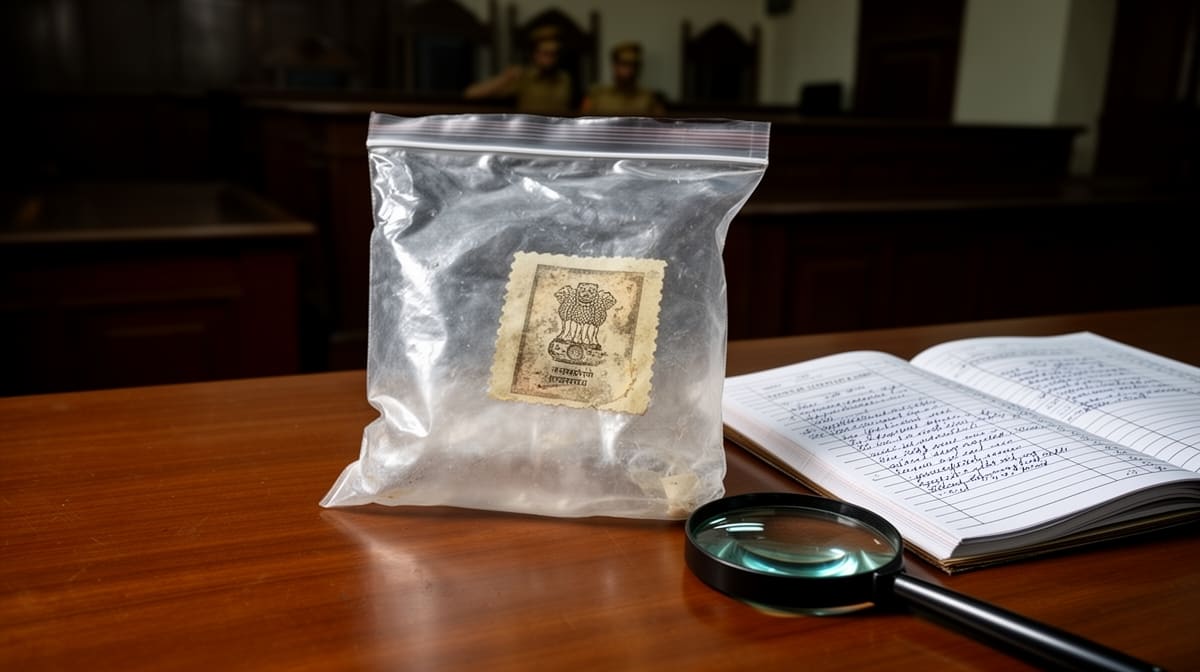
The Punjab and Haryana High Court has dismissed a state appeal against the acquittal of an accused under the NDPS Act, holding that fatal irregularities in the chain of custody and failure to comply with Section 313 CrPC rendered the prosecution’s case unprovable. The judgment underscores that procedural integrity in handling contraband is not a technicality but a constitutional safeguard against wrongful conviction.
Background & Facts
The Dispute
The State of Haryana appealed against the acquittal of Malha Ram and Matu Ram under Section 20 of the Narcotic Drugs and Psychotropic Substances Act, 1985, for possession of 950 grams of opium. The trial court had acquitted both accused on grounds of defective evidence and lack of link between seized contraband and laboratory testing. The State sought to overturn this acquittal, but the appeal, filed in 2005, remained pending for over two decades due to the death of one accused and the untraceability of the other.
Key Facts
- On 26.12.2001, a police party headed by ASI Ramesh Kumar (PW4) stopped a scooter near Fatehabad
- Three persons were on the scooter: Malha Ram (driver), Matu Ram (middle passenger carrying a bag), and Mahabir (rear passenger)
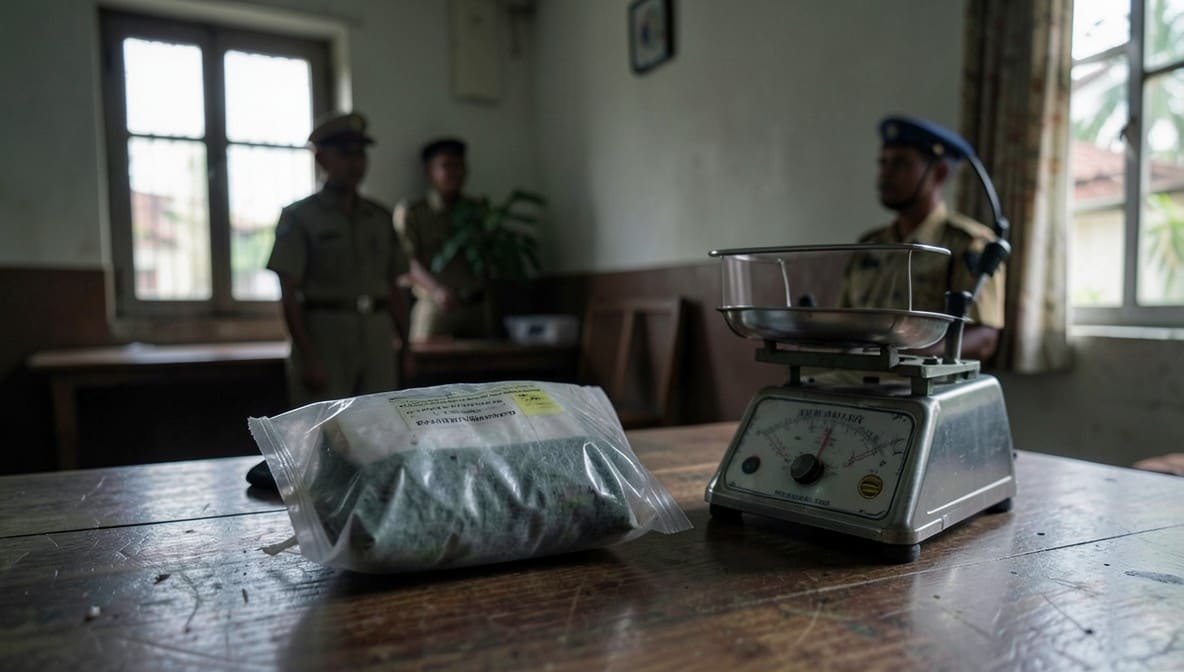
- A packet slipped from Matu Ram’s bag during the stoppage; police recovered six packets of opium totaling 950 grams
- Two 25-gram samples were taken from each of the six packets (12 samples total); remaining contraband was re-sealed
- Seizure memo prepared; accused arrested and produced before officiating SHO Surat Singh (PW1)
- PW1 re-sealed the contraband using his seal "SS" (for Surat Singh)
- Samples were sent for testing by Constable Dharampal Pal (PW2)
- FSL report (Exhibit P13) confirmed the presence of opium in samples
- Mahabir was discharged; only Malha Ram and Matu Ram were prosecuted
- Matu Ram died during pendency of appeal; appeal against him abated on 13.11.2025
- Malha Ram remained untraceable; legal aid counsel appointed to represent him
Procedural History
- 26.12.2001: Incident and seizure
- 23.04.2002: Filing of FIR No. 791/2001, Police Station Sadar, Fatehabad
- 17.01.2003: Commencement of trial in Sessions Case No. 42 of 2002
- 26.05.2004: Trial Court acquits both accused
- 2005: State files appeal before Punjab and Haryana High Court (CRA-D-44-DBA-2005)
- 13.11.2025: Appeal against Matu Ram abated due to death
- 17.03.2026: Judgment pronounced on appeal against Malha Ram
The Parties' Positions
For the State: Argued that the FSL report confirmed the presence of opium and that procedural lapses were minor and inconsequential. Contended that the trial court erred in acquitting despite scientific confirmation.
For the Accused (Legal Aid): Argued that the chain of custody was irreparably broken due to conflicting seal impressions and failure to establish unbroken custody from seizure to testing. Highlighted non-compliance with Section 313 CrPC.
Relief Sought
The State sought reversal of the acquittal, conviction of Malha Ram under Section 20 of the NDPS Act, and imposition of appropriate punishment.
The Legal Issue
The central question was whether the prosecution’s failure to establish an unbroken chain of custody for the seized contraband, coupled with material contradictions in seal documentation and non-compliance with Section 313 CrPC, renders the conviction unsustainable under the NDPS Act.
Arguments Presented
For the Appellant
The State contended that the FSL report was conclusive proof of opium possession and that minor discrepancies in seal documentation were procedural irregularities, not fatal defects. It relied on State of Punjab v. Baldev Singh to argue that technicalities should not override scientific evidence. It further submitted that the accused had not raised objections during trial and that the recovery was witnessed by multiple officers.
For the Respondent
The legal aid counsel emphasized that the prosecution’s own witnesses contradicted each other on the seal used during re-sealing. PW1 (Surat Singh) claimed seal "SS" was affixed, while PW7 (Vijay Kumar, actual SHO) admitted seal "VK" was initially recorded but later altered to "SS" without explanation. The counsel argued that this created reasonable doubt about whether the sample tested was the same as seized. Further, the prosecution failed to put critical questions to the accused under Section 313 CrPC regarding custody and transfer of samples, violating the accused’s right to fair trial.
The Court's Analysis
The Court conducted a meticulous review of the evidence and found that the prosecution’s case was fatally undermined by two interlinked defects: tampering in the chain of custody and non-compliance with Section 313 CrPC.
"The material contradiction in the prosecution case is that the re-seal of the case property had to be by SS i.e. PW1, who was officiating SHO, and he had stated an oath that he had re-sealed the case property and since his name is Surat Singh, his seal was SS. But PW7 Vijay Kumar who was actual SHO, had not sealed, then there was no question of the seal's impressions bearing seal VK, which again represents his name."
The Court noted that the seal "VK" - representing the actual SHO Vijay Kumar - appeared on the samples despite his absence during re-sealing. The substitution of "VK" with "SS" was unexplained and unauthenticated. The FSL report (Exhibit P13) recorded both seals, creating irreconcilable doubt about whether the contraband tested was the same as seized. The Court held that such discrepancies are not mere technicalities but go to the root of the prosecution’s ability to prove the corpus delicti.
Further, the Court examined the failure to put relevant questions under Section 313 CrPC to the accused. The prosecution failed to ask Malha Ram about how the samples were transferred from the Malkhana (PW3) to the lab (PW2), or how custody was maintained during transit. The Court observed:
"The questions that were raised regarding link evidence in Section 313 CrPC are also cryptic, and it is not possible for an accused to have answered the same."
Since Matu Ram, the primary accused carrying the bag, had died, the Court held that remand for fresh Section 313 examination was impossible. The non-putting of these questions created an illegality that could not be cured, further weakening the prosecution’s case.
The Court concluded that the prosecution had failed to prove the identity and integrity of the seized contraband beyond reasonable doubt, a mandatory requirement under State of Punjab v. Baldev Singh and State of Haryana v. Bhagwan Das.
The Verdict
The appeal was dismissed. The acquittal of Malha Ram under Section 20 of the NDPS Act was upheld. All bail bonds and surety bonds were discharged. All pending miscellaneous applications were disposed of. No monetary relief or penalty was imposed, as the accused was acquitted.
What This Means For Similar Cases
Chain of Custody Must Be Unbroken and Documented
- Prosecutors must ensure that every transfer of contraband is recorded with a unique, verifiable seal and signed receipt
- Seal discrepancies between witnesses cannot be glossed over; they create reasonable doubt under Section 101 of the Evidence Act
- If the actual custodian (e.g., SHO) is absent during re-sealing, the chain is broken unless a formal handover is documented
Section 313 CrPC Is Not a Formality
- The court must ensure that all material contradictions in evidence are put to the accused
- In NDPS cases, questions on custody, transfer, and sealing must be specifically framed
- Failure to do so, especially when key accused are deceased or unavailable, renders the trial fundamentally flawed
Scientific Evidence Alone Is Not Sufficient
- FSL reports are only as reliable as the chain that delivered the sample
- Courts will not accept scientific proof if the provenance of the sample is in doubt
- The burden remains on the prosecution to prove the integrity of the evidence from seizure to test