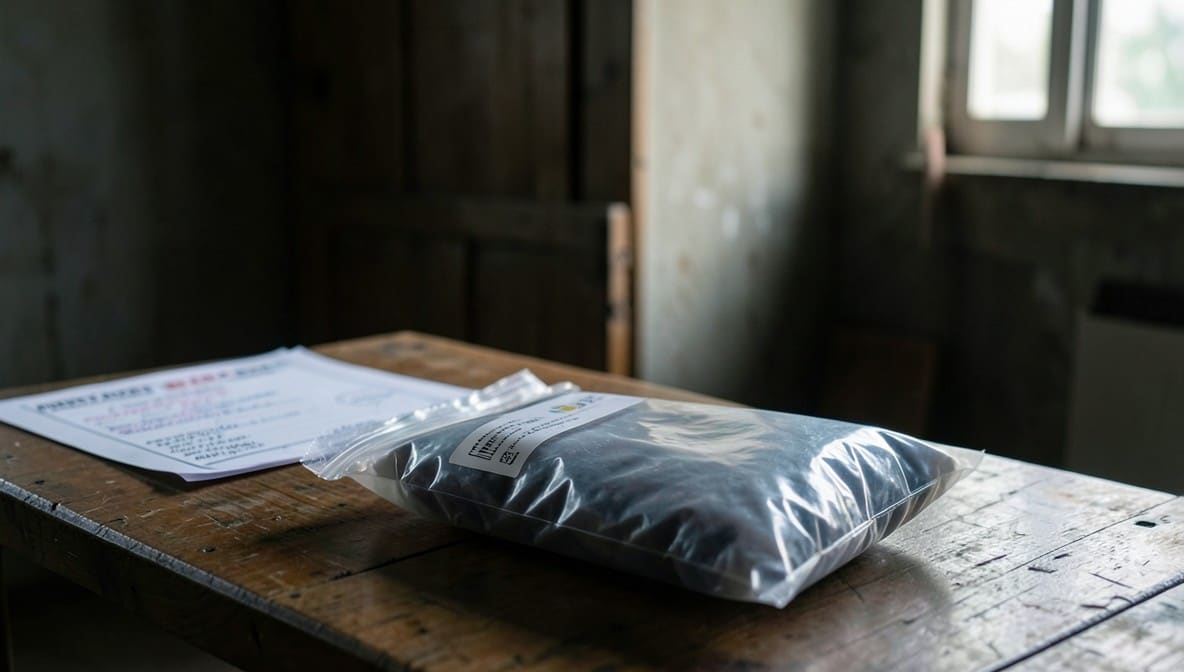
The Patna High Court has reaffirmed that the non-production of seized narcotics as a material exhibit, coupled with unreliable official testimony and absence of independent corroboration, renders a conviction under the NDPS Act unsustainable. This judgment underscores the non-negotiable requirement for strict compliance with procedural safeguards in drug cases.
Background & Facts
The Dispute
The appellant, Yogendra Sah, was charged under Section 20(b)(ii)(B) of the Narcotic Drugs and Psychotropic Substances Act, 1985, for possessing 8.5 kilograms of ganja near the Indo-Nepal border. The prosecution alleged that on 30.11.1998, while on patrolling duty near Pillar Nos. 325 to 326/11 at Mangwa Bazar, S.S.B. personnel apprehended the appellant after he attempted to flee. A black bag carried by him was searched in the presence of two witnesses, yielding 8.5 kg of ganja. The substance was examined on-site by a camp doctor using a narcotics testing kit, and a seizure list was prepared. The appellant was taken to the S.S.B. camp and later handed over to Sonbarsa Police Station, where an F.I.R. was registered on 25.12.2009.
Key Facts
- The alleged contraband weighed 8 kilograms and 500 grams.
- The recovery was allegedly conducted in the presence of two independent witnesses: PW-8 (Ahiraj Shailendra Bhushan) and PW-10 (Ram Nagina Mahto).
- The seized ganja was sealed and sent to the Forensic Science Laboratory (F.S.L.) for chemical analysis.
- The F.S.L. report (Exhibit-8) was produced in court, but the actual seized ganja was never marked as an exhibit.
- The Malkhana in-charge (PW-11) testified that the seized ganja had been destroyed.
- PW-8 and PW-10 both deposed in cross-examination that their signatures were obtained on blank papers and that they had no knowledge of the contents of the seizure or apprehension memos.
- The Investigating Officer admitted that the seized ganja was initially kept in open condition and sealed only after production before the court.
- The appellant was examined under Section 313 Cr.P.C. and denied all allegations.
Procedural History
- 30.11.1998: Alleged seizure of ganja near Indo-Nepal border.
- 25.12.2009: F.I.R. registered as Sonbarsa P.S. Case No. 136 of 2009.
- 12.09.2013: Conviction by the 1st Additional Sessions Judge, Sitamarhi under Section 20(b)(ii)(B) NDPS Act.
- 16.09.2013: Sentencing to 4 years rigorous imprisonment and a fine of Rs. 20,000, with an additional year in default.
- 02.01.2014: Criminal Appeal (SJ) No. 2 of 2014 filed before the Patna High Court.
- 20.04.2026: Judgment delivered by the Patna High Court.
The Parties' Positions
For the Appellant
The appellant contended that the prosecution failed to establish the chain of custody, as the seized ganja was not produced in court. He highlighted contradictions between PW-1 (informant) and PW-6 (S.S.B. Commander) regarding the location of weighing and sealing. He further emphasized that the two seizure witnesses (PW-8 and PW-10) repudiated the prosecution’s version, stating their signatures were obtained on blank papers. The absence of the physical contraband, combined with the destruction of the seized material, deprived the defence of any opportunity to verify the nature of the substance.
For the Respondent
The State contended that the trial court had correctly appreciated the evidence, relying on the F.S.L. report and the testimonies of S.S.B. personnel. It argued that the procedural lapses were minor and did not affect the substance of the case.
Relief Sought
The appellant sought acquittal on the grounds that the prosecution failed to prove the charge beyond reasonable doubt due to material contradictions, non-compliance with mandatory NDPS Act procedures, and non-production of the seized contraband.
The Legal Issue
The central question was whether the prosecution’s failure to produce the seized ganja as a material exhibit, coupled with the repudiation of seizure witnesses and absence of independent corroboration, vitiates the conviction under Section 20(b)(ii)(B) of the NDPS Act, even in the presence of a forensic report.
Arguments Presented
For the Appellant
Learned counsel relied on Gorakh Nath Prasad v. State of Bihar (2018) 2 SCC 305 and Jitendra v. State of M.P. (2004) 10 SCC 562 to argue that the non-production of the seized contraband is fatal to the prosecution case. He emphasized that the testimony of S.S.B. personnel, being official witnesses, cannot be relied upon in isolation, especially when independent witnesses disavow the recovery. He further contended that the destruction of the seized material by the Malkhana in-charge violated Section 52A of the NDPS Act and denied the accused his right to a fair trial.
For the Respondent
The State argued that the F.S.L. report (Exhibit-8) was sufficient to establish the nature of the substance and that the testimonies of the patrolling officers were consistent. It maintained that minor procedural irregularities did not invalidate the conviction, particularly where the accused was apprehended red-handed near the border.
The Court's Analysis
The Court undertook a meticulous review of the evidence and found that the prosecution’s case rested entirely on the testimonies of S.S.B. personnel, all of whom were official witnesses with a vested interest in the outcome. Crucially, the two independent witnesses cited in the seizure list - PW-8 and PW-10 - both testified that their signatures were obtained on blank papers and that they had no knowledge of the contents of the documents they signed. This directly undermined the credibility of the seizure process.
"The non-production of the seized material is therefore considered fatal to the prosecution case."
The Court cited Gorakh Nath Prasad to emphasize that the F.S.L. report alone cannot substitute for the physical production of the seized substance. Without the actual ganja being marked as an exhibit, there was no way to verify whether the sample tested was the same as that seized from the appellant. The Court noted that the Investigating Officer admitted the seized material was kept in open condition and sealed only after court production, further breaking the chain of custody.
The Court also observed that the Malkhana in-charge’s testimony that the ganja had been destroyed rendered any possibility of independent verification impossible. This, combined with the hostile or uncooperative stance of the seizure witnesses, created a reasonable doubt that could not be resolved in favour of the prosecution.
The Court held that while the NDPS Act imposes a reverse burden on the accused, the initial burden on the prosecution to establish the foundational facts - recovery, seizure, and identity of the substance - remains absolute and must be discharged with strict compliance. The failure to meet this threshold, particularly in a case carrying a potential sentence of up to ten years, rendered the conviction unsustainable.
The Verdict
The appeal was allowed. The impugned judgment of conviction dated 12-09-2013 and order of sentence dated 16-09-2013 were set aside. The appellant, Yogendra Sah, was acquitted of all charges under Section 20(b)(ii)(B) of the NDPS Act. He was discharged from the liability of his bail bond. Any fine deposited by him shall be refunded. The lower court records were directed to be returned to the District Court with a copy of the judgment.
What This Means For Similar Cases
Non-Production of Seized Narcotics Is Fatal
- Practitioners must insist on the production of seized contraband as a material exhibit in all NDPS cases.
- Absence of the physical substance, even with a forensic report, creates an irreparable evidentiary gap.
- Courts will not accept oral testimony alone to establish the identity of the seized material.
Independent Witnesses Cannot Be Disregarded
- If seizure witnesses turn hostile or claim signatures were obtained on blank papers, the prosecution’s case collapses.
- Relying solely on police or paramilitary testimony without independent corroboration is legally untenable.
- Defence counsel should aggressively cross-examine witnesses on the circumstances of signature collection.
Destruction of Seized Material Violates Procedural Fairness
- Destruction of seized narcotics before trial, without court permission, violates Section 52A of the NDPS Act.
- Such destruction deprives the accused of the right to challenge the forensic sample and constitutes a denial of natural justice.
- Courts must treat such acts as serious procedural violations warranting acquittal.
Chain of Custody Must Be Unbroken
- Any gap in the chain - from seizure to sealing to storage to testing - must be explained.
- Open storage of contraband before sealing, as admitted here, is a fatal flaw.
- Prosecution must maintain a documented, unbroken chain with timestamps and signatures at every stage.
Burden of Proof Remains With Prosecution
- The reverse burden under the NDPS Act applies only after the prosecution establishes the foundational facts.
- Mere registration of an FIR or production of a forensic report does not discharge the initial burden.
- Courts must apply heightened scrutiny in NDPS cases due to the severity of punishment.