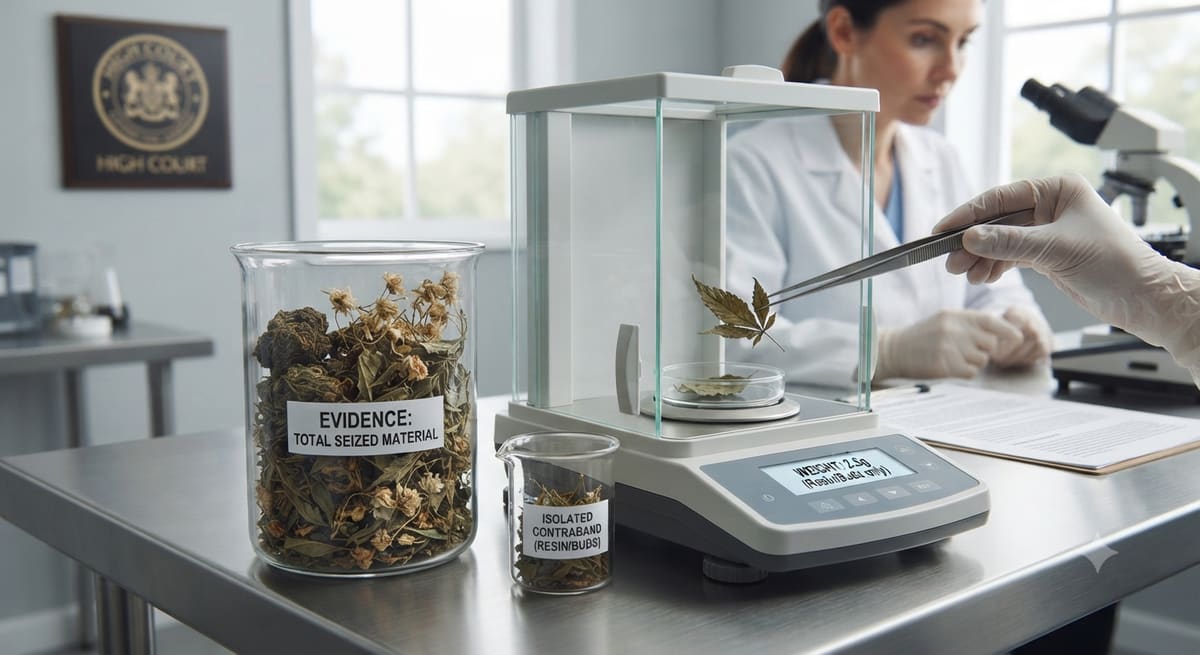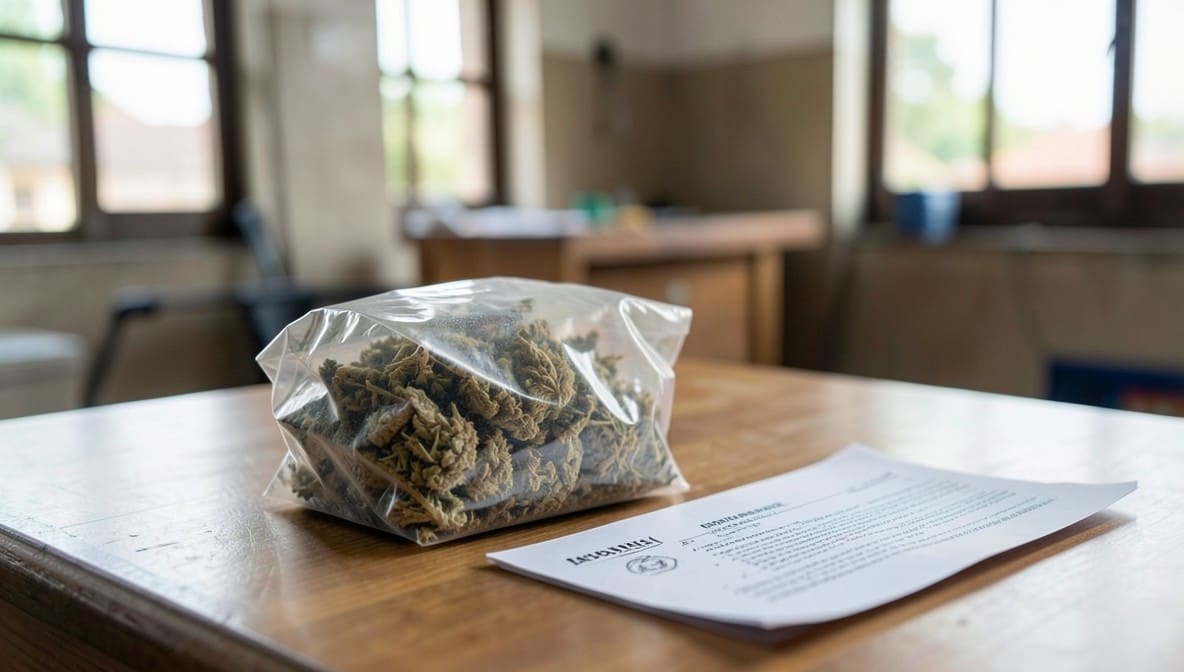
The Bombay High Court has held that even in cases involving commercial quantities of narcotics, bail may be granted if there is a material discrepancy in the chain of custody that casts reasonable doubt on the identity of the seized contraband. This ruling underscores that procedural integrity in evidence handling can override the strict bail restrictions under Section 37 of the NDPS Act.
Background & Facts
The Dispute
The applicant, Mohan Yashwant Kowachi, was arrested in connection with Crime No. 59 of 2025 registered at the Purada Police Station, Taluka Kurkheda, District Gadchiroli. He is accused of offences under Sections 8(b) and 20(b)(ii)(c) of the Narcotic Drugs and Psychotropic Substances Act, 1985, following the seizure of 28.050 kg of cannabis (ganja) from his residence.
Key Facts
- The FIR, dated 20.05.2025, alleged that secret intelligence led police to the applicant’s house, where four gunny bags containing moist, dark green cannabis leaves with flowering tops and seeds were seized.
- The seizure was documented in a spot panchanama, which described the contraband identically to the FIR: "wet dark green leaves, flowering tops, buds and seeds."
- On 27.05.2025, seven days after seizure, the contraband was produced before the Magistrate. An inventory certificate was prepared, describing the substance as: "dry leaves are dark greenish and the seeds are brown in colour."
- One sample was drawn from each of the four gunny bags, sealed in the presence of panch witnesses, the Investigating Officer, and the Magistrate, and marked as S-1 and S-2.
- A requisition letter sent to the Regional Forensic Science Laboratory stated that these sealed samples (S-1 and S-2) from the inventory were forwarded for chemical analysis.
- The Chemical Analysis (CA) report, however, described the tested material as: "Greenish, brownish coloured leaves, flowering tops, seeds and stalks" - a description inconsistent with the inventory’s characterization of dry, brown-seeded material.
- The CA report identified the substance as ganja and marked the samples as Exhibit Nos. (1) and (2).
- The applicant has no prior criminal record.
- The charge sheet was filed on 15.10.2025. The applicant has been in custody since 20.05.2025.
Procedural History
- 20.05.2025: Arrest of applicant following seizure of 28.050 kg ganja.
- 27.05.2025: Contraband produced before Magistrate; inventory prepared with conflicting description.
- 15.10.2025: Charge sheet filed.
- 30.04.2026: Criminal Application No. 407 of 2026 filed before Bombay High Court, Nagpur Bench, seeking bail.
Relief Sought
The applicant sought bail on the grounds that the discrepancy between the inventory description and the CA report undermines the integrity of the prosecution’s evidence, thereby creating reasonable doubt about whether the seized contraband was the same as that analyzed.
The Legal Issue
The central question was whether the existence of a material discrepancy in the description of seized contraband between the inventory and the forensic report, despite the recovery of a commercial quantity, can constitute a reasonable ground for believing the accused is not guilty, thereby permitting bail under Section 37 of the NDPS Act.
Arguments Presented
For the Applicant
The applicant’s counsel argued that the inventory certificate and the CA report present irreconcilable descriptions of the seized substance. The inventory described dry, dark greenish leaves with brown seeds, while the CA report described greenish-brown leaves with stalks - a description more consistent with fresh, moist ganja. This discrepancy, he submitted, raises a fundamental doubt as to whether the samples sent for analysis were the same as those seized and sealed before the Magistrate. He relied on the principle that the chain of custody must be unbroken and accurately documented, and any failure to establish identity of evidence vitiates the prosecution’s case. He further emphasized the absence of criminal antecedents and the completion of investigation.
For the Respondent
The State opposed bail, contending that the recovery of 28.050 kg of ganja clearly constitutes a commercial quantity under Section 20(b)(ii)(c) of the NDPS Act, triggering the mandatory restrictions under Section 37. The prosecution argued that minor inconsistencies in descriptive terminology do not negate the identity of the substance, especially since the CA report conclusively identified it as ganja. The APP submitted that the inventory error, if any, is a matter for trial and cannot be grounds for bail at the pre-trial stage.
The Court's Analysis
The Court acknowledged that the recovery of 28.050 kg of ganja falls squarely within the definition of commercial quantity under the NDPS Act, which ordinarily makes bail extremely difficult under Section 37. However, the Court emphasized that Section 37 permits bail if the Court is satisfied that there is a reasonable ground for believing the accused is not guilty. The key issue, therefore, was not the quantity recovered, but whether the evidence linking the applicant to the contraband was reliable.
"It is important to note that as there is contradiction in the description of the contraband in the inventory and CA report, it creates a doubt as to whether the samples which were drawn before the Magistrate are same that were sent to the Regional Forensic Science Laboratory."
The Court observed that the requisition letter explicitly stated that the samples sealed before the Magistrate were sent for analysis. Yet the forensic report’s description did not match the inventory’s description - a critical divergence. The Court held that this discrepancy goes to the root of the matter: if the sample analyzed was not the sample seized and sealed, then the entire prosecution case rests on unverified evidence. While the Court noted that challenges to the inventory are typically for trial, it distinguished this case by highlighting that the forensic analysis was explicitly tied to the sealed inventory samples. The failure to establish identity at this stage, the Court held, creates a reasonable doubt sufficient to satisfy the threshold under Section 37.
The Court further noted the applicant’s clean record and the fact that the investigation was complete, reducing the risk of evidence tampering or witness intimidation. The Court concluded that the procedural lapse, though not fatal to conviction, was sufficient to warrant bail pending trial.
The Verdict
The applicant succeeded. The Court allowed the bail application and directed the release of Mohan Yashwant Kowachi on a personal bond of Rs. 50,000 with one surety of like amount. The applicant is prohibited from intimidating witnesses or tampering with evidence, must provide his residential address and mobile number to the investigating agency, must not change residence without prior notice, and must attend every trial date. Failure to attend two consecutive dates or breach of conditions shall render bail liable for cancellation. The Court clarified that its observations are prima facie and shall not influence the trial court.
What This Means For Similar Cases
Chain of Custody Defects Can Override Commercial Quantity
- Practitioners must now argue that even in NDPS cases involving commercial quantities, bail is not automatically barred if the chain of custody is demonstrably broken.
- A mismatch between the inventory description and forensic report - especially when the latter is explicitly tied to the sealed samples - can create reasonable doubt under Section 37.
- The burden shifts to the prosecution to prove identity of evidence; mere assertion that the substance is ganja is insufficient if the chain is compromised.
Pre-Trial Bail Is Not Prejudicial to Trial
- Courts may grant bail on procedural grounds without prejudging the merits, provided the accused has no criminal history and investigation is complete.
- Conditions such as reporting to police, no contact with witnesses, and mandatory court attendance are sufficient safeguards.
- This judgment reinforces that bail under Section 37 is not a binary choice between guilt and innocence, but a reasoned assessment of whether the accused can reasonably be deemed not guilty due to evidentiary defects.
Documentation Must Be Precise and Consistent
- Investigating officers must ensure that seizure, inventory, and requisition documents use identical, unambiguous terminology.
- Any deviation in description - even if seemingly minor - must be explained in writing and corroborated.
- Prosecutors should anticipate challenges to forensic linkage and maintain airtight documentation from seizure to lab submission.