The Rajasthan High Court has clarified a critical threshold in narcotics prosecutions: the weight of contraband must be assessed in its natural, dry state to determine whether it crosses the statutory limit for commercial quantity. This ruling directly impacts bail eligibility under Section 37 of the NDPS Act, where the burden of proof shifts once the quantity is below the prescribed limit.
Background & Facts
The Dispute
The petitioners, Sachin and Pravesh, were arrested in connection with FIR No. 94/2025 at Police Station Rathanjana, District Pratapgarh, for offences under Section 8/15 of the NDPS Act. The prosecution alleged recovery of 180.360 kilograms of poppy husk from three plastic bags floating in a well belonging to Kishore Patidar. The contraband was recovered in a wet condition, and an inventory was prepared before the Magistrate.
Procedural History
- 24 September 2025: Petitioner Sachin taken into judicial custody
- 26 September 2025: Petitioner Pravesh taken into judicial custody
- October - December 2025: Investigation completed; chargesheet filed
- January 2026: Bail applications filed under Section 483 of BNSS
- 19 February 2026: Hearing before the High Court
Relief Sought
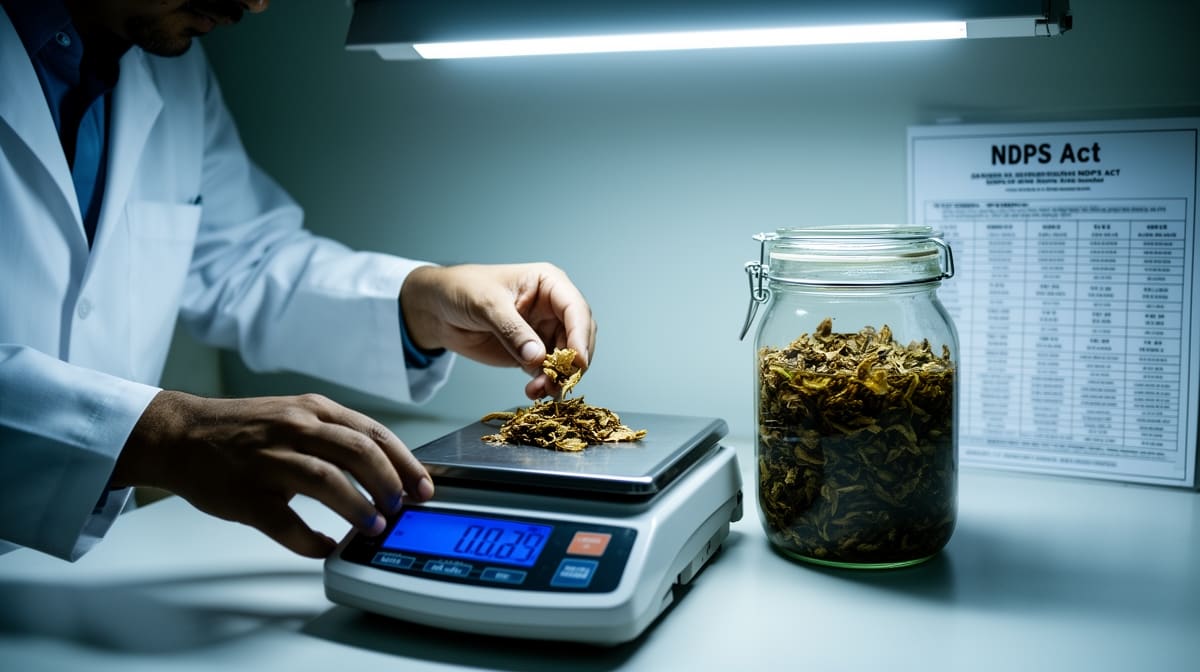
The petitioners sought regular bail, arguing that the recovered poppy husk, once dried, weighed only 38.99 kilograms - below the commercial quantity threshold under the NDPS Act. They contended that the initial inflated weight was due to water absorption and that no nexus existed between them and the recovered contraband.
The Legal Issue
The central question was whether the weight of poppy husk for determining commercial quantity under Section 2(v) of the NDPS Act must be calculated in its wet condition as recovered, or whether it must be assessed in its natural, dry state.
Arguments Presented
For the Petitioner
Learned counsel argued that the weight of contraband must reflect its true, dry mass, as water content is extraneous and transient. They relied on the Superintendent of Police’s inquiry report, which confirmed that the weight reduction from 180.360 kg to 38.99 kg occurred naturally due to drying, with no tampering. Counsel cited State of Punjab v. Baldev Singh to assert that only the intrinsic weight of the substance matters for statutory thresholds. They emphasized that Section 37 of the NDPS Act does not apply when the quantity is below commercial limit, making bail a matter of right.
For the Respondent
The Public Prosecutor conceded the authenticity of the Superintendent’s report but argued that the initial recovery weight should govern prosecution, as it reflects the scale of the offence at the time of seizure. He contended that the drying process could be manipulated and that the court should not second-guess the investigative findings.
The Court's Analysis
The Court examined the statutory definition of "commercial quantity" under Section 2(v) of the NDPS Act, which refers to the quantity of narcotic drugs or psychotropic substances, without reference to moisture content. The Court noted that the purpose of the threshold is to distinguish between personal use and trafficking, and that water is not a controlled substance. The Court observed:
"The weight of the contraband must be determined in its natural state, free from extraneous elements such as water, which are neither part of the drug nor indicative of its illicit nature. To hold otherwise would penalize the accused based on environmental conditions beyond their control."
The Court further held that the Superintendent’s inquiry, conducted independently and without bias, provided credible evidence that the weight reduction was natural. The absence of any link between the petitioners and the well, coupled with no recovery from their person or premises, rendered the prosecution’s case weak. The Court rejected the notion that initial seizure weight overrides scientific reality.
The Verdict
The petitioners won. The Court held that commercial quantity under the NDPS Act must be determined based on the dry weight of the contraband, and since the dried weight was below the statutory limit, Section 37 of the NDPS Act was not attracted. The petitioners were granted bail on personal bond with sureties.
What This Means For Similar Cases
Dry Weight Is the Legal Standard
- Practitioners must now insist on forensic reports confirming the dry weight of seized contraband before invoking Section 37 NDPS
- Prosecutors cannot rely on wet weight alone to argue that the threshold for commercial quantity has been crossed
- Defence counsel should request independent lab analysis of moisture content in all NDPS cases involving organic substances like poppy husk, ganja, or opium
Bail Becomes Presumptive When Below Threshold
- If the dried weight is below commercial quantity, Section 37 does not apply, and bail must be granted unless exceptional circumstances exist
- Courts must treat such cases as non-bailable only if the dry weight exceeds the limit
- This aligns with the principle in Arnesh Kumar v. State of Bihar that custody should not be automatic in non-serious offences
Investigative Rigor Required
- Police must document the condition of recovered contraband at seizure, including moisture levels
- Failure to preserve samples for re-weighing may lead to dismissal of charges if the dry weight falls below threshold
- Prosecution must now proactively establish that the substance was intentionally adulterated or that the drying process was manipulated