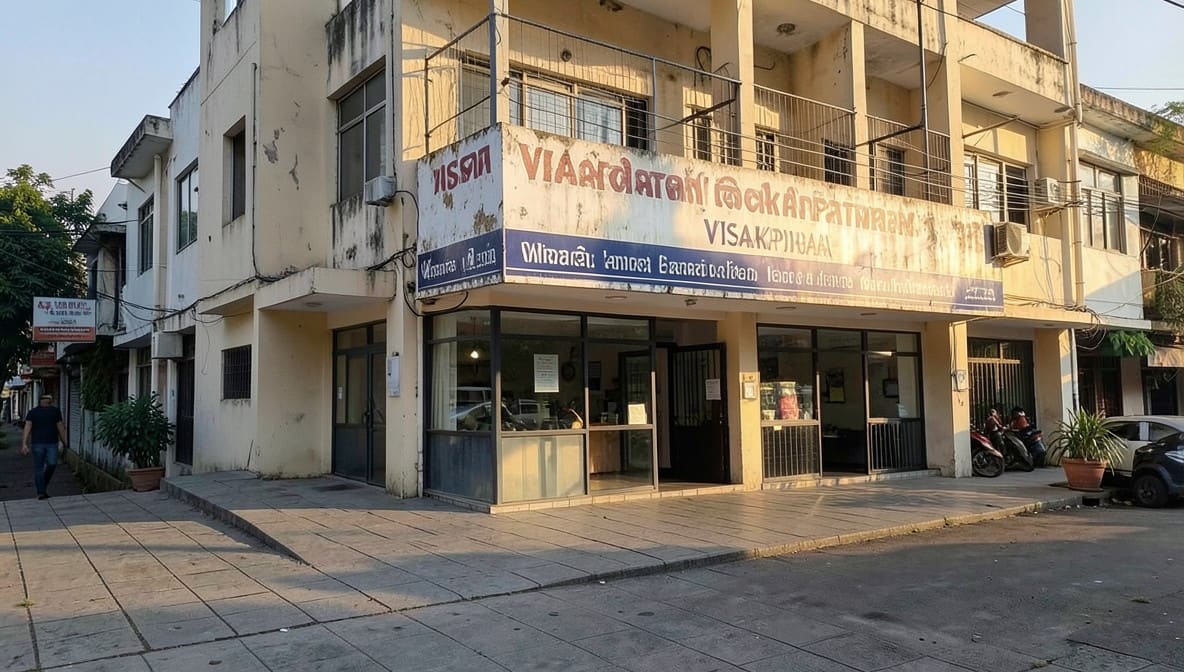
The Andhra Pradesh High Court has reaffirmed that procedural fairness under Article 226 of the Constitution is non-negotiable, even in municipal enforcement actions. Where a notice essential to the right of hearing is not received, any subsequent order is inherently flawed and must be set aside, regardless of the merits of the underlying allegation.
Background & Facts
The Dispute
The petitioner, Smt. K. Swati (Vasamsetti), a resident of Visakhapatnam, was served with a provisional notice dated 19.01.2026 by the Greater Visakhapatnam Municipal Corporation (GVMC) alleging unauthorized construction or land use violations. A final order dated 13.03.2026 (Ex.P.1) was subsequently passed by the Assistant City Planner, Zone-VI, confirming the alleged violations and imposing penalties. The petitioner challenged this order as violative of natural justice, contending she never received the provisional notice.
Key Facts
- The provisional notice dated 19.01.2026 was issued by the GVMC under its urban planning enforcement powers.
- The petitioner filed an explanation dated 20.04.2026 (Ex.P.2) in response to the final order, explicitly stating she had not received the provisional notice dated 19.01.2026.
- The affidavit filed in support of the writ petition (Para 6) reiterated that the provisional notice was never received.
- The GVMC did not provide any evidence of service, such as postal receipts, acknowledgment slips, or witness testimony confirming delivery.
- The final order dated 13.03.2026 was passed without considering the petitioner’s explanation, which was submitted after the order was issued.
Procedural History
- 19.01.2026: Provisional notice issued by Assistant City Planner, GVMC.
- 13.03.2026: Final order passed by Assistant City Planner, confirming violations and imposing penalties.
- 20.04.2026: Petitioner submitted written explanation (Ex.P.2) to the GVMC, asserting non-receipt of provisional notice.
- 15.04.2026: Writ Petition No. 13948 of 2026 filed before the Andhra Pradesh High Court.
- 07.05.2026: Hearing before Justice Gannamaneni Ramakrishna Prasad; interim relief sought under Section 151 CPC.
Relief Sought
The petitioner sought:
- Declaration that the orders dated 19.01.2026 and 13.03.2026 were illegal, arbitrary, and violative of natural justice.
- Setting aside of the final order dated 13.03.2026.
- Stay of all further proceedings pending disposal of the writ petition.
- Direction to the GVMC to issue a fresh, speaking order after providing a fair opportunity of hearing.
The Legal Issue
The central question was whether a final administrative order passed under municipal enforcement powers can be sustained when the recipient has not received the mandatory provisional notice, thereby being denied the opportunity to be heard in violation of the principles of natural justice.
Arguments Presented
For the Petitioner
Counsel for the petitioner, G. Rama Gopal, argued that the issuance of a provisional notice is a statutory precondition to the imposition of penalties under municipal by-laws. The petitioner’s unchallenged assertion that she never received the notice dated 19.01.2026, supported by her affidavit and explanation dated 20.04.2026, rendered the final order void ab initio. Reliance was placed on State of U.P. v. Mohd. Noor and A.K. Krause v. Union of India to emphasize that the right to be heard is a fundamental component of natural justice, and non-service of notice is fatal to the validity of any adjudicatory order.
For the Respondent
Counsel for the respondents, representing the GVMC and the State of Andhra Pradesh, did not dispute the petitioner’s claim of non-receipt. No evidence of service was produced. The respondents’ submission was limited to the procedural posture, without contesting the legal principle that notice must be effectively communicated.
The Court's Analysis
The Court did not delve into the merits of the alleged violations. Instead, it focused squarely on the procedural defect. The Court observed that the petitioner’s explanation dated 20.04.2026, submitted after the final order, clearly stated non-receipt of the provisional notice. This assertion was corroborated by the affidavit filed in support of the writ petition.
"It therefore transpires that the Provisional Notice issued by the Respondents on 19.01.2026 was not received by the Writ Petitioner and therefore, the Writ Petitioner could not respond to the Provisional Notice."
The Court held that the failure to establish service of the provisional notice rendered the entire adjudicatory process defective. The final order dated 13.03.2026 was passed without affording the petitioner a meaningful opportunity to present her case, violating the cardinal principle of audi alteram partem. The Court emphasized that administrative bodies cannot rely on presumed or constructive service where actual delivery is in doubt, particularly when the consequences include penalties or restrictions on property rights.
The Court further noted that the petitioner had acted promptly by filing an explanation and a writ petition within weeks of becoming aware of the order. The absence of any prejudice to the respondents in granting relief was also considered.
The Verdict
The writ petition was allowed. The Court set aside the final order dated 13.03.2026. The respondents were directed to consider the petitioner’s explanation dated 20.04.2026 and pass a speaking order within four weeks from the date of uploading of this order on the Court’s website. The petitioner was granted liberty to produce additional documents within two weeks of the order’s upload. The respondents were directed to provide a personal hearing before passing the fresh order, and a copy of the speaking order must be supplied to the petitioner immediately upon issuance. No costs were awarded.
What This Means For Similar Cases
Notice Must Be Proven, Not Presumed
- Municipal authorities must maintain and produce verifiable proof of service (registered post, acknowledgment receipt, witness affidavit) for all provisional notices.
- Mere issuance of notice without proof of delivery is insufficient to satisfy natural justice.
- Courts will not uphold final orders where service is unproven, even if the underlying violation appears serious.
Speaking Orders Are Mandatory
- Any order imposing penalties or restrictions must be a "speaking order" - clearly explaining reasons, addressing submissions, and demonstrating application of mind.
- Post-facto explanations submitted by affected parties must be considered before final orders are passed.
- Failure to do so invites judicial intervention under Article 226.
Procedural Compliance Is Non-Negotiable
- Administrative agencies cannot bypass procedural safeguards in the name of efficiency.
- The burden of proving service lies squarely on the authority issuing the notice.
- Practitioners should routinely challenge municipal orders on grounds of non-service, even if the client is unaware of the notice until after the final order.