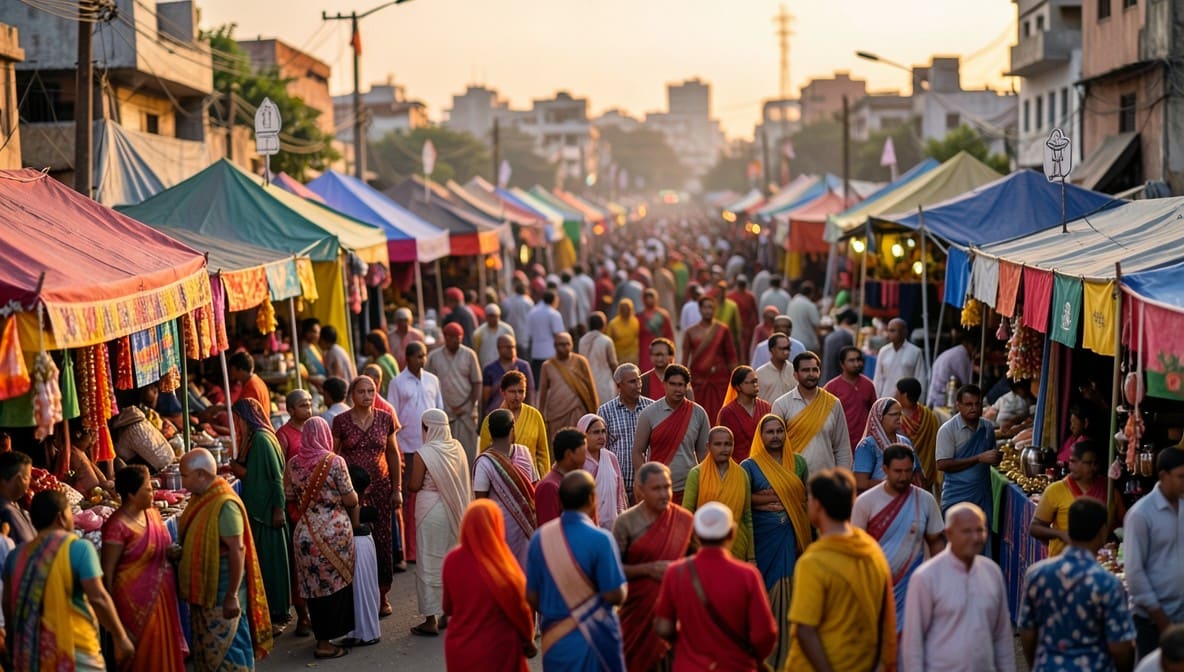
The Madhya Pradesh High Court has underscored the importance of natural justice in administrative decision-making, quashing a Municipal Corporation's midnight withdrawal of permission for a religious fair. The judgment reinforces that legitimate expectations created by prior administrative actions cannot be arbitrarily nullified without affording an opportunity of hearing, particularly when stakeholders have already acted upon the granted permission.
Background & Facts
The Dispute
The petitioner, Waqf Karbala Intejamia Committee through its President Abdul Hamid Niyargar, has traditionally organized an annual religious procession and fair (Mela) at Dhobhi Ghat, Indore. For the year 2026, the Municipal Corporation, Indore (respondent No. 2) granted permission vide order dated 25.06.2026 to hold the fair for three days (26.06.2026 to 28.06.2026) subject to deposit of Rs. 1,36,007 as fees. However, on the same night (25.06.2026 at 08:15 P.M.), the Mayor-in-Council (MIC) of the Municipal Corporation passed a resolution withdrawing the permission, alleging non-compliance with conditions from the previous year and non-deposit of prescribed fees.
Key Facts
- The petitioner has organized the Taazia procession and fair annually for decades, with prior permissions granted by the Municipal Corporation.
- For 2026, the petitioner applied for permission on 03.06.2026, which was granted on 25.06.2026 (Annexure P/6) for a three-day event starting 26.06.2026.
- The permission order explicitly described the event as a "Paramparaagat Mele Ka Aayojan" (traditional fair organization).
- The MIC resolution (Annexure P/7) alleged non-compliance with last year’s conditions and non-deposit of fees, but no documentary evidence or prior notice of violation was produced.
- The petitioner deposited the required fee of Rs. 1,36,007 and made arrangements for the fair, which commenced on 26.06.2026.
- The MIC withdrew the permission on 25.06.2026, without affording the petitioner an opportunity of hearing.
Procedural History
- 03.06.2026: Petitioner filed application for permission.
- 25.06.2026: Municipal Corporation granted permission (Annexure P/6).
- 25.06.2026 (08:15 P.M.): MIC passed resolution withdrawing permission (Annexure P/7).
- 26.06.2026: Petitioner filed Writ Petition No. 24236 of 2026 before the Madhya Pradesh High Court.
- 26.06.2026: High Court heard and disposed of the petition, quashing the MIC resolution.
The Parties' Positions
For the Petitioner
- The fair and procession are traditional, held annually without legal violations.
- The Municipal Corporation’s withdrawal of permission without hearing violates natural justice and the petitioner’s right to religious freedom under Article 25 of the Constitution.
- No outstanding dues or violations were communicated to the petitioner for the previous year.
- The petitioner and stakeholders had already incurred expenses and commenced the fair, causing irreparable loss.
For the Respondent (Municipal Corporation)
- The fair is not traditional; the petitioner used only 0.02 acres of land for Taazia immersion, not for the fair (relying on judgment in RCA No. 87/2019).
- The petitioner failed to deposit the full fee for the previous year and violated conditions, justifying withdrawal of permission.
- The MIC’s decision was in larger public interest, as other communities and stakeholders opposed the fair.
- The petitioner has no indefeasible right to hold the fair.
Relief Sought
The petitioner sought quashing of the MIC resolution dated 25.06.2026 (Annexure P/7) and revival of the permission granted under Annexure P/6.
The Legal Issue
The central question was whether the Municipal Corporation could withdraw permission for a religious fair without affording an opportunity of hearing, particularly when the petitioner had legitimate expectations based on prior administrative actions and had already acted upon the granted permission.
Arguments Presented
For the Petitioner
- Relied on the principles of natural justice, arguing that withdrawal of permission without hearing violates Article 14 and Article 21 of the Constitution.
- Emphasized legitimate expectation, as the petitioner had relied on the permission and incurred expenses.
- Contended that the Municipal Corporation failed to produce evidence of non-compliance or outstanding dues from the previous year.
For the Respondent (Municipal Corporation)
- Argued that the fair is not traditional, citing a 2024 judgment (RCA No. 87/2019) which held that only 0.02 acres were used for Taazia immersion, not the fair.
- Claimed the petitioner violated conditions and failed to deposit fees for the previous year.
- Submitted that the MIC’s decision was in public interest, as other stakeholders opposed the fair.
The Court's Analysis
The Court examined the administrative decision-making process and the principles of natural justice, holding that the Municipal Corporation’s actions were arbitrary and procedurally flawed.
"The manner in which the entire issue has been handled by the Municipal Corporation is not in accordance with the proper administrative decision-making process. In all fairness, if the request was for granting permission to hold Mela from 26.06.2026 then the decisions on the same, after considering each and every aspect, should have been made well before the said date, so that if any issue crops up then the same could have been held in timely manner."
The Court noted that the permission order (Annexure P/6) did not mention any violations from the previous year, and the respondent failed to produce evidence of non-compliance. The withdrawal of permission on the night of 25.06.2026, without notice or hearing, was held to violate natural justice and legitimate expectation.
"Looking to the fact that without giving an opportunity, the order passed by the competent authority has been cancelled to the prejudice of the petitioner, the petition deserves to be allowed."
The Court also distinguished the 2024 judgment (RCA No. 87/2019) relied upon by the respondent, holding that the title of the land was irrelevant to the present dispute, which centered on the validity of the permission withdrawal.
The Verdict
The Court allowed the writ petition, quashing the MIC resolution dated 25.06.2026 (Annexure P/7). The permission granted under Annexure P/6 was revived with all its conditions. The Court further directed:
- From next year onwards, the petitioner must submit its application for permission at least two and a half months in advance.
- The Municipal Corporation must decide the application at least 30 days before the start of the fair.
- The Court clarified that its decision pertained only to the 2026 fair, and the parties were free to raise the issue of the petitioner’s right to hold the fair annually in separate proceedings.
What This Means For Similar Cases
Natural Justice Is Non-Negotiable in Administrative Decisions
- Administrative bodies cannot withdraw permissions or licenses without affording an opportunity of hearing, even if the decision is in public interest.
- Legitimate expectation arises when a party relies on prior administrative actions, and withdrawal without notice causes irreparable prejudice.
- Practitioners should argue that arbitrary administrative actions violate Article 14 (equality before law) and Article 21 (right to life and personal liberty) of the Constitution.
Timely Decision-Making Is Critical
- Authorities must decide applications well in advance of the event date to avoid last-minute disruptions.
- Delay in decision-making can lead to legitimate expectation claims, particularly when stakeholders have already acted upon the permission.
- Courts may revive withdrawn permissions if the withdrawal is procedurally flawed, even if the underlying dispute remains unresolved.
Distinguishing Title Disputes from Permission Validity
- Title disputes (e.g., ownership of land) are separate from permission validity issues.
- Even if the land belongs to the Municipal Corporation, withdrawal of permission without hearing remains unlawful.
- Practitioners should frame arguments narrowly, focusing on the specific administrative action (e.g., permission withdrawal) rather than broader disputes (e.g., land title).