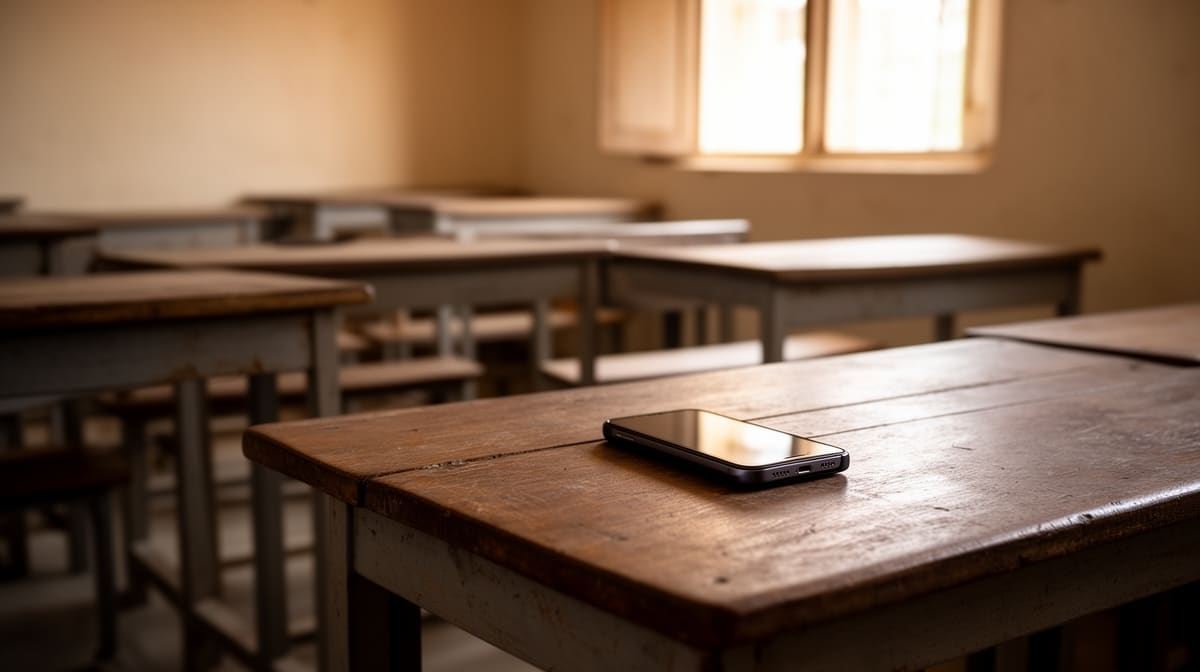
The Karnataka High Court has affirmed that the mere possession of a mobile phone in an examination hall, even without evidence of use, constitutes an unfair means under CBSE’s revised guidelines. This ruling reinforces the authority of expert administrative bodies to set disciplinary standards for national examinations, prioritizing institutional integrity over individual mitigating circumstances.
Background & Facts
The Dispute
The case arose when Donthi Saathvik Reddy, a Class XII student, was found with a mobile phone in his pocket 25 minutes into his Physical Education exam at Shri Ram Global School, Bengaluru. The invigilator seized the device, reported the incident, and provided the student with a fresh question paper and answer script. The student was permitted to continue with the remaining exams. A subsequent inquiry by CBSE’s Unfair Means Committee confirmed the phone was not used for copying, contained no exam-related material, and the student claimed he had inadvertently carried it due to rushing into the exam hall.
Procedural History
- 17 February 2025: Mobile phone discovered during Physical Education exam.
- 9 April 2025: Student appeared before CBSE’s Unfair Means Committee.
- 28 May 2025: CBSE issued communication imposing Category-3 penalty: cancellation of current and next year’s exams in all subjects.
- 23 August 2025: Learned Single Judge allowed writ petition, quashing the penalty and directing result declaration, relying on Shuchi Mishra v. Joint Secretary.
- 5 March 2026: Karnataka High Court allowed CBSE’s writ appeal, setting aside the Single Judge’s order.
Relief Sought
The petitioner sought: (a) striking down or reading down Category-3 of CBSE’s 20 January 2025 guidelines; (b) quashing the penalty order; (c) directing CBSE to declare results; and (d) equitable relief based on parity with Shuchi Mishra.
The Legal Issue
The central question was whether mere possession of a mobile phone in the examination hall, without proof of use or intent to cheat, can lawfully attract the severe penalty of cancellation of current and next year’s examinations under CBSE’s Category-3 guidelines, particularly after the Governing Body’s explicit ratification of such a classification.
Arguments Presented
For the Appellant (CBSE)
CBSE contended that the 139th Governing Body Meeting on 24 June 2024 explicitly reclassified mobile phone possession under Category-3, equating it with other electronic devices due to the high risk of question paper leakage. The guidelines were duly communicated to students via admit cards and institutional notices. CBSE argued that the Single Judge erred in applying Shuchi Mishra, which predated the revised guidelines and involved a different factual matrix. The Court, it was submitted, cannot substitute its opinion for that of an expert administrative body that has deliberated and ratified the policy.
For the Respondent (Student)
The student’s counsel argued that the absence of any evidence of copying or use rendered the penalty disproportionate. They relied on Category-1’s provision of benefit of doubt for possession without use, and contended that treating mobile phones (a common personal item) more harshly than physical chits was irrational. The student’s academic record and IIT-JEE Advanced qualification were cited as mitigating factors. The counsel urged the Court to read down Category-3 to incorporate the benefit of doubt, as done in Shuchi Mishra.
The Court's Analysis
The Court undertook a detailed review of CBSE’s procedural evolution. It noted that prior to 2024, mobile phones were treated under Category-1 with lesser penalties, but the 139th Governing Body Meeting explicitly reclassified them under Category-3 due to the inherent risk of digital leakage. The Court emphasized that this was not an arbitrary decision but a reasoned policy shift by an expert body, ratified after deliberation.
"The distinction in the quantum of penalties vis-à-vis mobile phones/electronic devices seems unreasonable... mobile phone is an electronic device used for communicating... there is a high degree of risk involved in leakage of question papers and sabotaging of examination."
The Court held that Shuchi Mishra was inapplicable because it was decided before the 2024 amendments. The Single Judge’s reliance on parity was misplaced, as the legal framework had materially changed. The Court further observed that the student’s admission of possession, coupled with the absence of any challenge to the factual findings of the Committee, rendered the penalty procedurally valid.
Crucially, the Court declined to read down Category-3, stating that such a judicial intervention would amount to substituting its opinion for that of the expert body entrusted with maintaining examination integrity. The Court affirmed that administrative discretion, when exercised through a transparent, deliberative process, is entitled to judicial deference under Article 226.
The Verdict
CBSE won. The Court held that possession of a mobile phone in the examination hall, even without proof of use, constitutes an unfair means under Category-3 of CBSE’s 2024 guidelines, warranting cancellation of current and next year’s examinations. The Single Judge’s order was set aside, and the penalty was upheld.
What This Means For Similar Cases
Possession Alone Is Sufficient for Category-3 Penalty
- Practitioners must advise students and parents that carrying a mobile phone into an exam hall, regardless of intent or use, now triggers the most severe penalty under CBSE rules.
- Defense arguments based on lack of copying or good academic record are legally insufficient to override the guideline.
- Institutions must ensure clear pre-exam communication about prohibited items.
Judicial Deference to Expert Administrative Bodies
- Courts will not interfere with policy decisions ratified by expert bodies like CBSE’s Governing Body, even if penalties appear harsh.
- Challenges to guidelines under Article 226 will fail if the procedure was transparent and deliberative.
- Judicial reading down of categories is impermissible where the administrative body has explicitly removed a provision from a lenient to a stringent category.
Benefit of Doubt No Longer Applicable to Mobile Phones
- The benefit of doubt under Category-1 applies only to physical copying material (chits, notes), not electronic devices.
- Students cannot invoke Shuchi Mishra or prior precedents to claim leniency for mobile phone possession post-2024.
- Legal representation must now focus on procedural compliance and institutional notice, not mitigation of penalty.