The Delhi High Court has affirmed that students who act in reliance on a long-standing educational policy cannot be deprived of their rights by abrupt, retrospective changes. In a significant ruling, the Court held that the Central Board of Secondary Education (CBSE) violated the Doctrine of Legitimate Expectation and Article 14 of the Constitution by withdrawing the option for private candidates to appear in an Additional Subject without prior notice or transitional safeguards.
Background & Facts
The Dispute
The petitioners are students who passed their Class XII Board Examination in May 2025 under the CBSE. They opted to take a gap year to prepare for an Additional Subject - commonly referred to as a sixth subject - to meet eligibility criteria for competitive higher education programs such as NEET and JEE. This practice had been permitted under CBSE’s Examination Bye Laws since 2013, initially for six years after passing Class XII, and later reduced to two years in 2021.
Procedural History
- 2013: Clause 43(i) inserted into CBSE Examination Bye Laws permitting private candidates to appear for an Additional Subject within six years of passing Class XII.
- 2021: CBSE amended Clause 43(i) to reduce the window from six to two years, effective from the 2021 examinations.
- May 2025: Petitioners passed Class XII and, relying on the two-year window, decided to take a gap year to prepare for the Additional Subject.
- December 2024: CBSE’s Governing Body approved the removal of the Additional Subject category for private candidates, but this decision was not publicly notified.
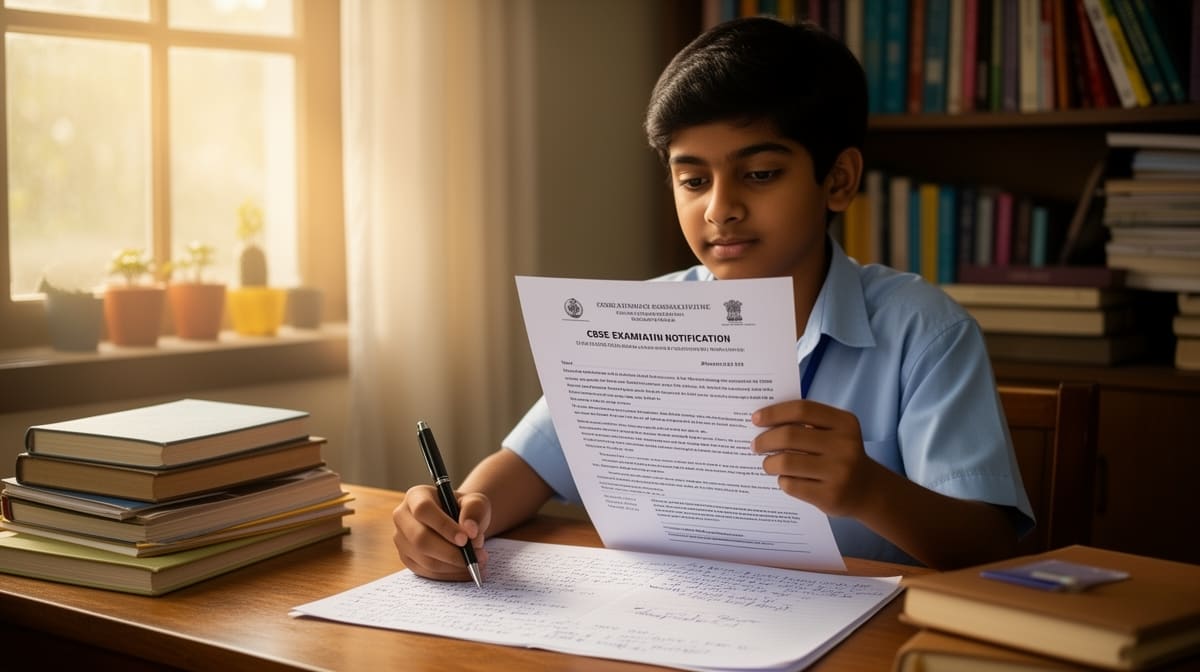
- September 4, 2025: CBSE issued a public notification withdrawing the facility without prior warning.
- September 15, 2025: CBSE issued a further clarification citing reasons such as the need for face-to-face instruction and continuous internal assessment.
Relief Sought
The petitioners sought quashing of the impugned notifications and a direction to CBSE to permit their registration for the Additional Subject examination in 2026, arguing that the withdrawal was retrospective, arbitrary, and violated their legitimate expectations.
The Legal Issue
The central question was whether CBSE could retrospectively withdraw a long-standing facility under its Examination Bye Laws without prior notice, thereby depriving students who had already acted upon the existing policy, and whether such action violated the Doctrine of Legitimate Expectation and Article 14 of the Constitution.
Arguments Presented
For the Petitioner
Mr. Rajshekhar Rao, Senior Counsel, argued that the CBSE Examination Bye Laws have the force of law as established in Jigya Yadav v. CBSE and B.K. Srinivasan v. State of Karnataka. He contended that the withdrawal of the Additional Subject facility, though approved internally in December 2024, was not publicly notified until September 2025 - after the petitioners had already made irreversible academic decisions. He relied on Anushka Rengunthwar v. Union of India and Rakesh Kumar v. Union of India to assert that legitimate expectation arises from consistent, public practice, and that retrospective application of policy changes that disadvantage beneficiaries is arbitrary. He further highlighted that CBSE had previously introduced sunset clauses for similar withdrawals, demonstrating awareness of the need for transitional justice.
For the Respondent
Ms. Manisha Singh, counsel for CBSE, argued that the petitioners had no vested right to the Additional Subject facility, as it was merely a policy concession, not a statutory entitlement. She relied on Madras City Wine Merchants Association v. State of Tamil Nadu and Jiwesh Kumar v. Union of India to assert that policy changes, even if disruptive, do not trigger legitimate expectation if they are within the authority’s competence and serve public interest. She maintained that the amendment was validly enacted through the Governing Body and that students could pursue the subject through NIOS, rendering the grievance illusory.
The Court's Analysis
The Court began by affirming the statutory character of CBSE’s Examination Bye Laws, citing Jigya Yadav to hold that these rules are not contractual but have the force of law and are enforceable under Article 226. It then turned to B.K. Srinivasan, emphasizing that subordinate legislation must be publicly notified to acquire legal effect. The Court found that merely publishing minutes of the Governing Body meeting on December 26, 2024, did not constitute valid notification. The first public notice came on September 4, 2025 - after the petitioners had already passed their exams and committed to a gap year.
"Any amendment to the CBSE Bye Laws, particularly one which withdraws a benefit or creates a disqualification, must not only be formally incorporated in the Bye Laws, but also be adequately notified in advance so as to enable affected candidates to regulate their conduct accordingly."
The Court then examined the Doctrine of Legitimate Expectation, applying the test from Army Welfare Education Society v. Sunil Kumar Sharma. It held that the petitioners’ expectation was not a mere hope but arose from a specific, publicly available right under Clause 43(i), reinforced by consistent practice over a decade. The petitioners had acted in good faith, investing an entire academic year in preparation. The sudden withdrawal, without transitional safeguards, was found to be manifestly arbitrary under Article 14.
The Court distinguished Madras City Wine Merchants Association and Jiwesh Kumar, noting that in those cases, the rights had not yet crystallized at the time of policy change. Here, the petitioners’ right had already vested upon passing Class XII in May 2025. The Court also rejected CBSE’s reliance on NIOS as a viable alternative, noting that leading universities and entrance exams require a consolidated marksheet from a single recognized board, making NIOS an impractical substitute.
The Verdict
The petitioners won. The Delhi High Court held that retrospective application of a policy change that extinguishes a legitimate expectation, without notice or transitional protection, violates Article 14 and the Doctrine of Legitimate Expectation. The Court directed CBSE to permit the petitioners to register for the Additional Subject examination within three working days.
What This Means For Similar Cases
Legitimate Expectation Arises from Publicly Available Rights
- Practitioners must now argue that any public authority’s consistent, published policy - even if discretionary - can create a legitimate expectation if individuals act upon it.
- Merely labeling a benefit as a "policy concession" will not defeat a claim if the policy has been publicly available and consistently applied.
Policy Changes Must Be Prospective and Notice-Based
- Educational bodies and regulatory authorities must publicly notify amendments through official channels (e.g., website, gazette) before they take effect.
- Withdrawals of benefits affecting existing students must include sunset clauses or transitional periods, as demonstrated by CBSE’s own prior conduct.
NIOS Is Not a Substitute for Board-Based Eligibility
- Legal challenges to educational policies must now include evidence of real-world admission barriers - such as university requirements for consolidated mark sheets - to rebut claims of "alternative remedies."
- Courts will not accept theoretical alternatives when they are practically unworkable in the Indian higher education ecosystem.