The Uttarakhand High Court has set a significant precedent in university disciplinary matters by quashing a debarment order against a B.Tech student, holding that mere scrabbling on the palm without evidence of its use during an examination does not constitute unfair means. This judgment reinforces the principle that disciplinary actions must be based on concrete evidence of misconduct, not mere suspicion.
Background & Facts
The Dispute
The petitioner, a student enrolled in the B.Tech (Electronics and Communication) four-year course at G.B. Pant University of Agriculture and Technology, Pantnagar, was debarred from the 2nd semester of First Year for the academic session 2023-24 by an order dated 13.08.2025. The debarment was imposed after the petitioner was found using unfair means during the examination of the said semester.
Key Facts
- The petitioner took admission in B.Tech (Electronics and Communication) for the academic session 2023-27.
- During the 2nd semester examination of First Year, the petitioner was accused of using unfair means.
- The petitioner was debarred for the entire academic year 2023-24 by the Registrar of the University.
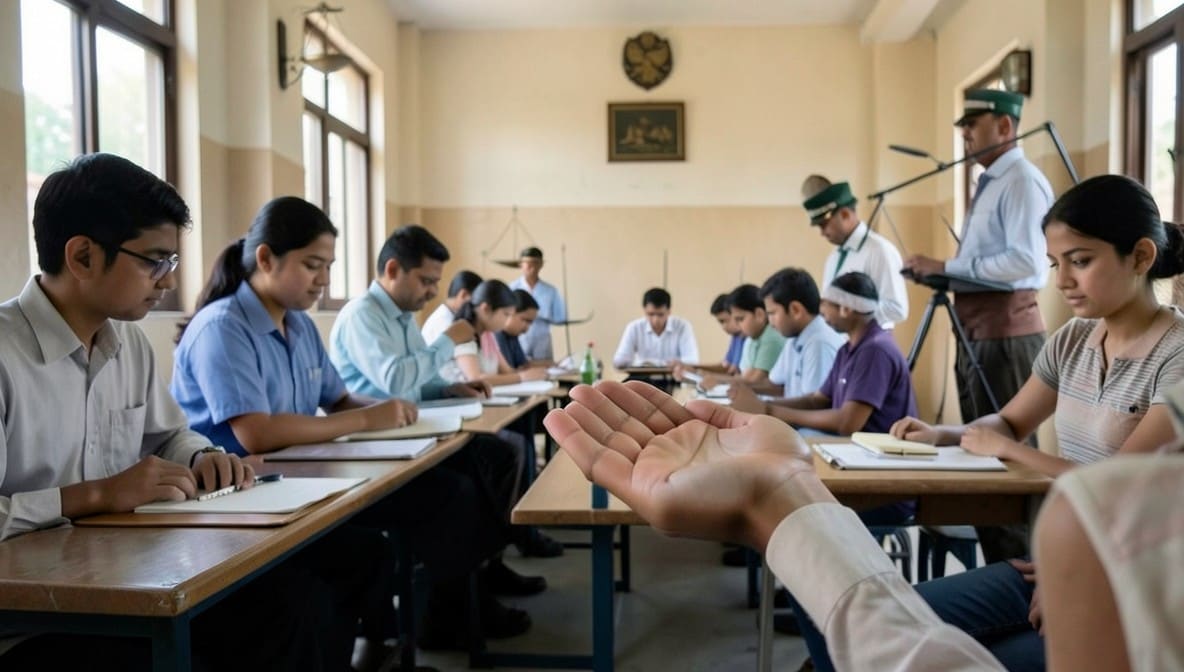
- The specific allegation was that the petitioner had scrabbled certain information on his palm, but there was no evidence that this information was actually used during the examination.
Procedural History
The petitioner pursued the following legal recourse:
- Filed Writ Petition (M/S) No. 2530 of 2024 before the Uttarakhand High Court challenging the debarment.
- The High Court disposed of the petition vide order dated 16.05.2025, directing the petitioner to make a representation to the Vice Chancellor in light of the judgment in Dipesh Phulera v. G.B. Pant University of Agriculture and Technology (WPMS No. 1612 of 2023).
- The petitioner completed the other academic years of the course while pursuing the representation.
- The Registrar of the University, acting on the direction of the Vice Chancellor, upheld the debarment but restricted it to the 2nd semester of First Year for the academic session 2023-24.
- Aggrieved by this order, the petitioner filed the present writ petition (M/S No. 1175 of 2026).
The Parties' Positions
For the Petitioner
- The petitioner relied on the judgment dated 18.02.2026 in Aryansh Singh v. G.B. Pant University of Agriculture and Technology (Writ Petition (M/S) No. 2555 of 2025), where the High Court quashed a similar debarment order.
- In Aryansh Singh, the Court held that mere scrabbling on the palm without evidence of its use in the examination does not constitute unfair means.
- The petitioner argued that his case was identical and squarely covered by the judgment in Aryansh Singh.
For the Respondent-University
- The University admitted that the controversy in the present case was squarely covered by the judgment in Aryansh Singh.
- The University did not contest the applicability of the precedent and agreed that the writ petition could be decided in terms of the said judgment.
Relief Sought
The petitioner sought:
- Quashing of the impugned order dated 13.08.2025 passed by the Registrar of the University.
- Restoration of the petitioner’s academic standing for the 2nd semester of First Year.
- Directions to the University to allow the petitioner to continue his studies without the stigma of debarment.
The Legal Issue
The central question before the Court was whether mere scrabbling of information on the palm, without evidence of its use during an examination, constitutes unfair means under the University’s disciplinary rules, warranting debarment.
Arguments Presented
For the Petitioner
- The petitioner’s counsel argued that the judgment in Aryansh Singh was directly applicable to the present case.
- It was contended that the University failed to establish that the scrabbled information was actually used during the examination, rendering the debarment order arbitrary and unsustainable.
- The petitioner relied on principles of natural justice, emphasizing that disciplinary actions must be based on concrete evidence of misconduct, not mere suspicion.
For the Respondent-University
- The University’s counsel admitted that the case was covered by the judgment in Aryansh Singh.
- No substantive arguments were advanced to distinguish the present case from the precedent.
The Court's Analysis
The Court observed that the judgment in Aryansh Singh had already settled the legal question at issue. In that case, the High Court had held:
"The mere fact that certain information was scrabbled on the palm of the petitioner therein does not establish that it was utilized during the examination. In the absence of any evidence to show that the scrabbled information was actually used, the debarment order cannot be sustained."
The Court noted that the University had not produced any evidence to show that the petitioner had used the scrabbled information during the examination. The debarment order was thus devoid of any factual basis and violated principles of natural justice.
The Court further emphasized that disciplinary actions in academic institutions must be fair, reasonable, and evidence-based. Mere suspicion or the possibility of misconduct is insufficient to impose penalties as severe as debarment, which adversely affects a student’s academic career.
The Verdict
The Court allowed the writ petition and quashed the impugned order dated 13.08.2025 passed by the Registrar of the University. The debarment of the petitioner from the 2nd semester of First Year for the academic session 2023-24 was set aside. The University was directed to restore the petitioner’s academic standing and allow him to continue his studies without any stigma of debarment.
What This Means For Similar Cases
Evidence of Use Is Mandatory for Debarment
- Disciplinary committees in universities must ensure that unfair means are proven beyond mere suspicion.
- Scrabbling on the palm or any other surface is not sufficient to establish misconduct unless there is evidence of its use during the examination.
- Institutions must document and prove the actual use of unfair means before imposing penalties like debarment.
Natural Justice Must Guide Academic Penalties
- Debarment orders must comply with principles of natural justice, including the right to be heard and the right to a fair inquiry.
- Arbitrary or disproportionate penalties are liable to be quashed by courts if they lack a factual or legal basis.
- Students facing disciplinary action should challenge orders that are based on assumptions rather than evidence.
Precedent-Based Relief for Students
- Students aggrieved by similar debarment orders can rely on this judgment to seek relief.
- The judgment in Aryansh Singh and the present case set a clear precedent that mere suspicion of unfair means is insufficient to sustain disciplinary action.
- Legal representation should emphasize the lack of evidence in such cases to secure favorable outcomes.