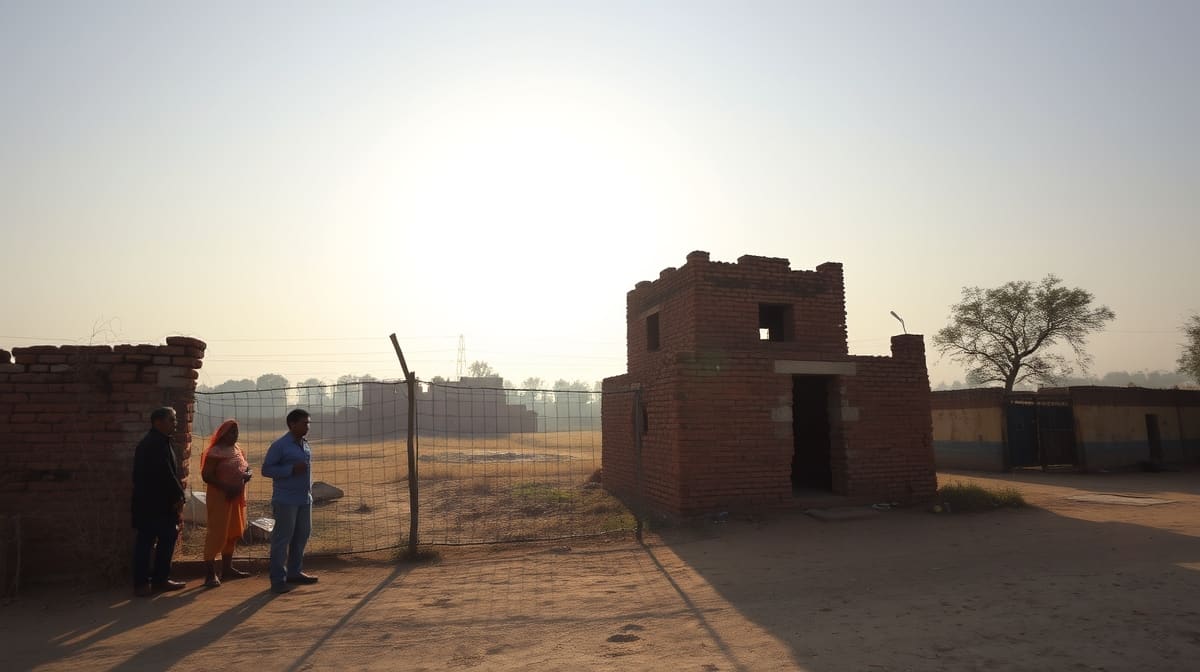
The Rajasthan High Court has clarified that when a land occupant surrenders equivalent pasture land in good faith pursuant to state policy, authorities cannot delay indefinitely deciding on regularization. This judgment reinforces the principle that administrative inaction after compliance with procedural conditions violates legitimate expectation and the duty to act fairly.
Background & Facts
The Dispute
The petitioner, Hamir Singh, a resident of Village Chaba, Tehsil Shergarh, District Jodhpur, occupied land recorded as government pasture land and constructed a residential structure thereon. The land was not included within the officially notified abadi (residential) boundary of the village. In 2019, the State issued notices seeking his dispossession, claiming encroachment on government pasture land, in implementation of a prior High Court order in D.B. C.W.P. (PIL) No. 6954/2019 dated 30.05.2019.
Key Facts
- The petitioner and other villagers had been occupying the disputed land for residential purposes for years, with no alternative land available for relocation.
- The abadi boundary of Village Chaba was never extended despite population growth and urbanization pressures.
- On 15.07.2020, the petitioner filed S.B. Civil Writ Petition No. 8932/2020 seeking declaration of the land as abadi land.
- A Coordinate Bench of the High Court, on 20.11.2020, permitted the petitioner to offer an equivalent area of pasture land for recording as government pasture, in exchange for regularization of his residential plot.
- The petitioner and other villagers collectively surrendered 28 bighas of land, which was formally recorded as Government pasture land by the Revenue Department.
- The petitioner submitted a formal application for regularization on 12.03.2022, relying on the Revenue Department’s circular dated 27.11.2021 (Group-6), which explicitly provides for regularization of residential structures on pasture land where equivalent land is surrendered.
- No decision has been taken on the regularization application despite the surrender of land and submission of the application.
Procedural History
- 30.05.2019: High Court order in D.B. C.W.P. (PIL) No. 6954/2019 directed action against encroachments on pasture land.
- 15.07.2020: Petitioner filed S.B. Civil Writ Petition No. 8932/2020 seeking regularization.
- 20.11.2020: Coordinate Bench permitted surrender of equivalent pasture land in lieu of regularization.
- 12.03.2022: Petitioner submitted formal regularization application under Revenue Circular dated 27.11.2021.
- 04.05.2026: Present writ petition (No. 20641/2025) filed seeking direction to decide regularization application.
Relief Sought
The petitioner sought a direction to the State authorities to decide his regularization application within a stipulated time, and to restrain any coercive action pending such decision.
The Legal Issue
The central question was whether the State’s acceptance of surrendered pasture land in compliance with its own circular creates a legitimate expectation and a binding obligation to decide on regularization, and whether prolonged administrative inaction in such circumstances amounts to arbitrariness under Article 14 of the Constitution.
Arguments Presented
For the Petitioner
The petitioner’s counsel argued that the surrender of 28 bighas of land was a substantial compliance with the Court’s direction and the State’s own policy under the circular dated 27.11.2021. The State had accepted the land and recorded it as pasture, thereby acknowledging the quid pro quo. Delaying the decision for over four years, despite fulfillment of conditions, violated the principle of legitimate expectation and the duty of fair administrative action. Reliance was placed on State of Haryana v. Bhagwan Das and K. S. Puttaswamy v. Union of India to establish that administrative silence after compliance is unconstitutional.
For the Respondent
The State’s counsel conceded that the land was accepted and recorded as pasture, but submitted that the regularization application was still under internal consideration. No final order had been passed due to procedural complexities and inter-departmental coordination. No objection was raised to the factual submissions made by the petitioner.
The Court's Analysis
The Court observed that the State had not merely permitted the surrender of land - it had actively accepted and recorded the 28 bighas as government pasture land. This was not a passive act but a formal acknowledgment of the petitioner’s compliance with the conditions laid down by the Court and the State’s own circular. The circular dated 27.11.2021 explicitly provides for regularization in such cases, creating a clear administrative framework.
"The State cannot be permitted to accept the benefit of the surrendered land and then indefinitely delay the decision on regularization, thereby leaving the petitioner in a state of perpetual uncertainty."
The Court held that such delay, without any reasonable justification, amounts to arbitrariness under Article 14. The petitioner had acted in good faith, relied on the State’s policy, and fulfilled his part of the bargain. The State’s obligation to decide was not discretionary but mandatory once the conditions were met. The Court rejected the argument that internal processing delays justify inaction, emphasizing that public interest demands timely resolution of land rights affecting livelihoods.
The Verdict
The writ petition was disposed of with the direction that the respondent authorities shall take a final decision on the petitioner’s regularization application within six months from the date of receipt of a certified copy of this order. No coercive action, including dispossession, shall be taken against the petitioner during this period. The State shall pass appropriate orders for regularization of the land in question in accordance with the Revenue Department’s circular dated 27.11.2021.
What This Means For Similar Cases
Administrative Acceptance Triggers Mandatory Decision
- Practitioners can now argue that when authorities accept surrendered land under a policy circular, they are bound to decide regularization applications within a reasonable time.
- Delay beyond six months without justification may be challenged as violative of Article 14.
Circulars Create Binding Expectations
- State circulars that outline clear conditions for regularization are not mere guidelines - they create enforceable legitimate expectations.
- Petitioners should cite such circulars as binding administrative policy, not discretionary advice.
Stay Against Coercive Action Is Automatic
- In cases where land has been surrendered in compliance with court directions or policy, courts will grant automatic stay against dispossession pending decision.
- No separate application for stay is required if the petition seeks a decision within a timeframe.