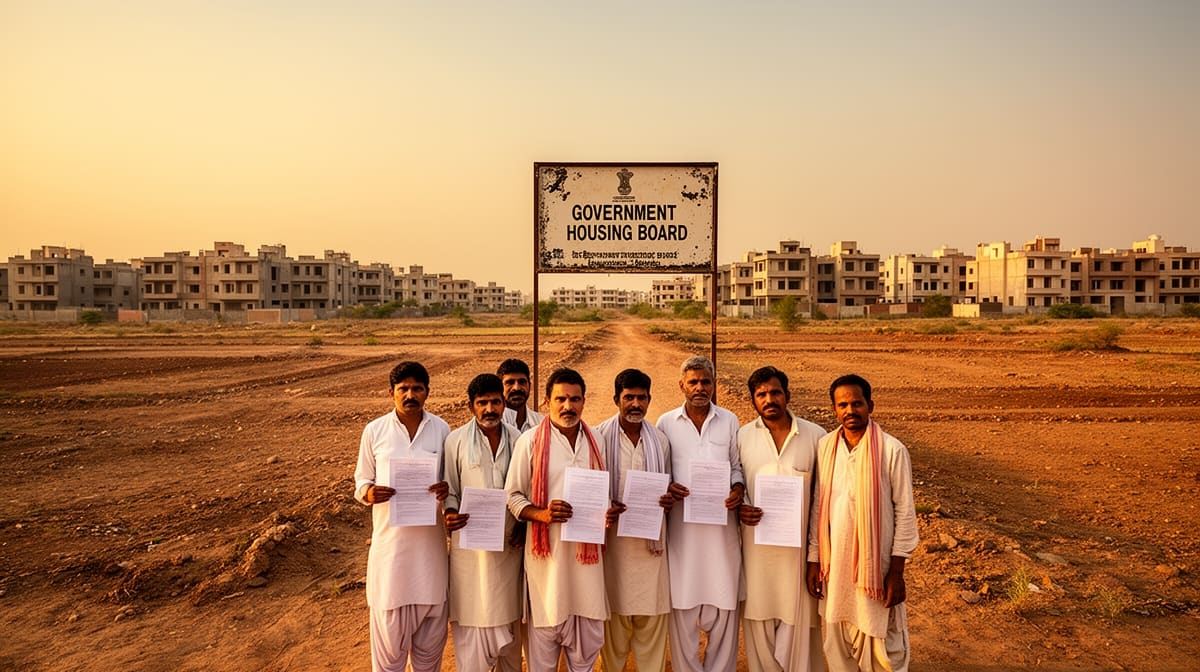
The Rajasthan High Court has affirmed that prolonged inaction by state authorities in implementing lawful land allotment orders constitutes a violation of the right to livelihood under Article 21. This judgment reinforces the principle that administrative delay, when unjustified, amounts to a denial of substantive justice.
Background & Facts
The Dispute
The petitioner, a resident of Village Jesurana in Jaisalmer, was granted allotment of agricultural land in Murabba No. 71/2025 of Chak 5 BWN, Mohangarh, pursuant to two orders dated 12.02.2002 and 27.12.2022. Despite these orders, the respondents - state revenue and colonisation authorities - have failed to complete the physical allotment or execute the necessary documentation for over two decades.
Procedural History
- 2002: First allotment order issued by competent authority
- 2022: Appellate authority reaffirmed the allotment
- 2026: Petitioner filed writ petition under Article 226 seeking enforcement
- No explanation provided by respondents for the delay
Relief Sought
The petitioner sought: (i) quashing of the inaction, (ii) direct allotment of the land, (iii) alternative land if original is unavailable, and (iv) a time-bound decision on pending orders.
The Legal Issue
The central question was whether prolonged and unexplained administrative inaction in implementing a lawful land allotment order violates the right to livelihood under Article 21 of the Constitution.
Arguments Presented
For the Petitioner
The petitioner’s counsel argued that the delay of over 20 years, despite two binding orders, amounted to a denial of substantive rights. He relied on State of U.P. v. Raj Kumar and Chandrashekhar v. State of U.P. to contend that right to livelihood includes access to agricultural land for sustenance, and that unjustified delay in executing such orders is tantamount to arbitrariness under Article 14.
For the Respondent
No advocate appeared for the respondents. The state filed no counter-affidavit or explanation for the delay, leaving the court with no factual or legal justification for the inaction.
The Court's Analysis
The Court examined the nature of the petitioner’s claim as one grounded in economic survival, not mere entitlement. It observed that agricultural land is not merely property but a means of livelihood for rural communities. The Court held that administrative delay without justification erodes the very purpose of the allotment order.
"The State cannot remain silent for over two decades on a lawful order granting land for agricultural purposes, especially when the petitioner has no other means of sustenance. Such inaction is not mere negligence - it is a denial of constitutional guarantee."
The Court rejected the notion that the petitioner must await indefinite bureaucratic processes. It emphasized that Article 21 encompasses the right to live with dignity, which includes access to land for farming. The absence of any explanation from the state rendered the delay arbitrary and violative of natural justice.
The Court declined to direct immediate allotment, recognizing that procedural formalities may still need completion. Instead, it provided a structured remedy: a fresh representation with a certified copy of the order, triggering a mandatory time-bound decision.
The Verdict
The petitioner succeeded. The Court held that unjustified administrative delay in implementing land allotment orders violates Article 21 and directed the respondents to decide the petitioner’s fresh representation within 12 weeks, failing which the petitioner may approach the Court again.
What This Means For Similar Cases
Administrative Delay Is Not Innocuous
- Practitioners must now treat unexplained delays exceeding 5 years in land allotment as prima facie violations of Article 21
- A mere assertion of "pending formalities" without documentation or timeline is insufficient to justify inaction
- Writ petitions under Article 226 are maintainable even where final physical possession has not been granted
Time-Bound Decisions Are Now Mandatory
- Authorities must now operate under a 12-week presumptive deadline for deciding representations tied to prior lawful orders
- Failure to decide within this period opens the door for contempt proceedings or further writ relief
- Certified copies of court orders must be treated as binding directives, not advisory notes
Right to Livelihood Extends Beyond Employment
- Access to agricultural land for subsistence farming qualifies as a core component of livelihood under Article 21
- Courts will no longer tolerate bureaucratic inertia where land is the sole means of survival
- This principle applies equally to Scheduled Tribes, landless farmers, and marginalized rural communities