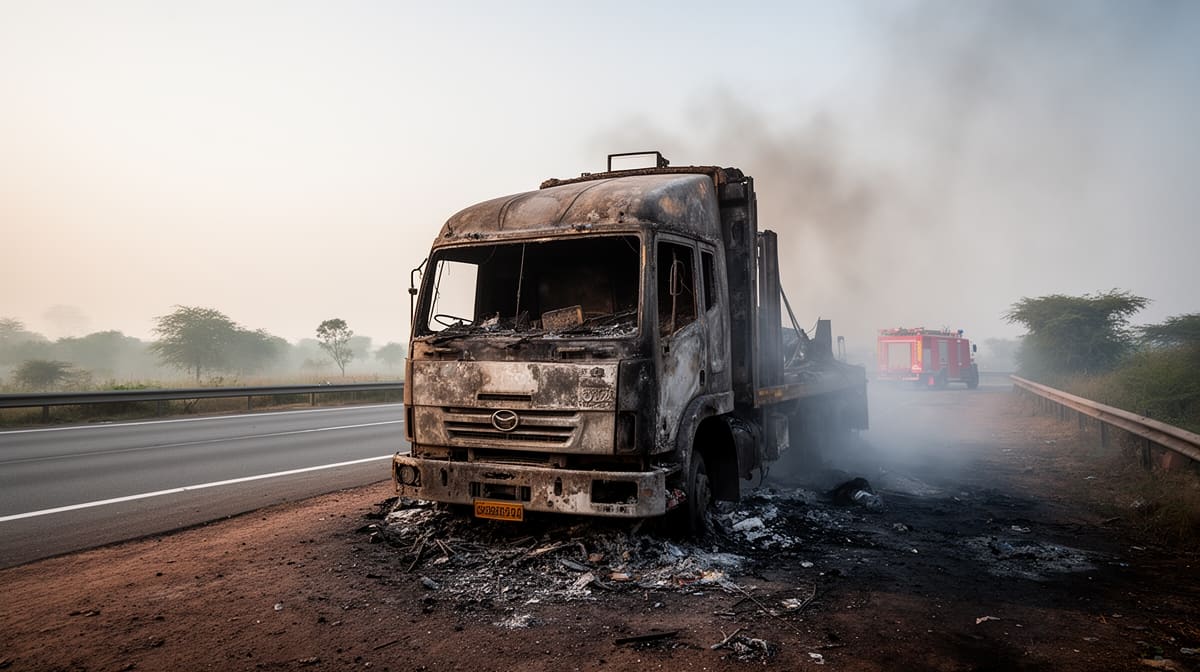
The Delhi State Consumer Disputes Redressal Commission delivered a significant ruling on the maintainability of insurance claims and the validity of repudiation based on technical grounds. The Commission held that a complainant using a vehicle for self-employment qualifies as a consumer under the Consumer Protection Act, 1986, and that repudiation of an insurance claim based on an investigator’s report - without corroboration from official records - amounts to deficiency in service and unfair trade practice. The Commission directed the insurer to pay the insured declared value (IDV) of Rs. 23,60,000 with interest and additional costs for mental agony and litigation expenses.
Background & Facts
The Dispute
The complainant, Mr. Satish Kumar Chauhan, purchased a Tata Motors Truck (Model LPK2518, Registration No. HR 69 B 5953) on loan from Citibank (Opposite Party No. 2) for Rs. 23,60,000. The vehicle was insured with IFFCO Tokio General Insurance Company Limited (Opposite Party No. 1) under Policy No. 94187393, valid from 23.09.2015 to 22.09.2016, with an annual premium of Rs. 59,268 and an insured declared value (IDV) of Rs. 23,60,000. The truck was the complainant’s sole source of livelihood, used for transporting construction materials between Delhi and Ghaziabad.
Key Facts
- 13.10.2015: The truck was forcibly intercepted by unidentified individuals, who robbed the vehicle and abducted the driver, Mr. Sekh Manjur. The driver was later abandoned near Sector 44, Noida.
- 14.10.2015: The complainant lodged FIR No. 1125 at Police Station K.M. Pur, South Delhi, under Sections 365, 392, and 34 of the IPC.
- Post-incident: The complainant filed an insurance claim (Claim No. 36551453) with Opposite Party No. 1, submitting all requisite documents, including the FIR, insurance policy, registration certificate, and the driver’s driving licences (No. 48373/TV/MON/09 issued by RTO, Mon Nagaland, and No. 15605/FR/NW/11 issued by Wokha, Nagaland).
- 07.06.2016: Opposite Party No. 1 repudiated the claim, citing an investigator’s report that alleged the driver’s licences were invalid. The report claimed one licence had expired and the other was not found in the issuing authority’s records.
- RTI Verification: The complainant filed an RTI application with the District Transport Office, Wokha, Nagaland, which confirmed that the driver’s licence (No. 15605/FR/NW/11) was valid until 13.06.2017, directly contradicting the insurer’s repudiation.
Procedural History
- 28.10.2016: Complaint filed before the Delhi State Consumer Disputes Redressal Commission (Complaint Case No. 1332/2016).
- 08.03.2019: Opposite Party No. 2 (Citibank) was deleted from the array of parties as the dispute was settled.
- 13.03.2026: The Commission reserved its order.
- 13.04.2026: The Commission delivered its judgment, allowing the complaint.
Relief Sought
The complainant sought:
- Payment of the IDV of Rs. 23,60,000 under the insurance policy, along with interest.
- Exemplary damages of Rs. 5,00,000 for mental agony and harassment.
- Litigation costs.
- Stay on the demand for monthly EMIs of Rs. 72,000 to Citibank until the disposal of the complaint.
The Legal Issue
The Commission addressed two primary legal questions:
- Whether the complainant qualifies as a consumer under Section 2(1)(d) of the Consumer Protection Act, 1986, despite using the vehicle for commercial purposes?
- Whether the repudiation of the insurance claim by Opposite Party No. 1 was justified, particularly when based on an investigator’s report contradicted by official records?
Arguments Presented
For the Complainant
- The complainant argued that he falls within the definition of a consumer under the Consumer Protection Act, 1986, as the vehicle was used exclusively for earning his livelihood through self-employment. He relied on precedents such as Laxmi Engineering Works v. P.S.G. Industrial Institute and Kavita Ahuja v. Shipra Estates to support this contention.
- The repudiation of the claim was challenged as arbitrary and baseless, as it relied on an investigator’s report that was contradicted by official records from the District Transport Office. The complainant contended that the insurer failed to establish a fundamental breach of policy conditions that would justify repudiation.
- The complainant highlighted the deficiency in service and unfair trade practice by Opposite Party No. 1, citing the inordinate delay in repudiating the claim and the lack of transparency in the investigation process.
For the Opposite Party No. 1 (Insurer)
- Opposite Party No. 1 contended that the complainant does not qualify as a consumer under Section 2(1)(d) of the Consumer Protection Act, 1986, as the vehicle was used for commercial purposes.
- The insurer justified the repudiation on the ground that the driver did not possess a valid driving licence at the time of the incident. This conclusion was based on an investigator’s report, which alleged that one licence had expired and the other was not found in the records of the issuing authority.
- The insurer argued that the repudiation was in accordance with the policy condition, which stipulates that no claim is payable if the vehicle is driven without a valid licence.
The Court's Analysis
The Commission conducted a detailed analysis of the legal principles governing the case:
Maintainability of the Complaint
The Commission rejected the insurer’s contention that the complainant does not qualify as a consumer under the Consumer Protection Act, 1986. It held that the exclusion of commercial purpose under Section 2(1)(d) does not apply where the goods or services are used exclusively for earning livelihood by means of self-employment. The Commission relied on the following precedents:
- Laxmi Engineering Works v. P.S.G. Industrial Institute (1995) 3 SCC 583: The Supreme Court held that the exclusion of commercial purpose does not apply where goods are used for earning livelihood through self-employment.
- Kavita Ahuja v. Shipra Estates (2016) 1 CPJ 31 (NC): The National Commission reiterated that commercial purpose must be interpreted pragmatically, and small-scale activities for livelihood qualify as consumer transactions.
- National Insurance Co. Ltd. v. Nitin Khandelwal (2008) 11 SCC 259: The Supreme Court held that in cases of theft, breach of policy conditions like invalidity of a driving licence is not germane to the claim.
The Commission observed that the complainant’s truck was his sole source of income, and there was no evidence of large-scale commercial activity. Thus, the complainant fell within the definition of a consumer, and the complaint was maintainable.
Validity of Repudiation
The Commission critically examined the grounds for repudiation and held that the insurer’s reliance on the investigator’s report was unjustified and arbitrary. Key observations included:
-
Evidentiary Value of Official Records: The Commission emphasized that private investigation reports cannot override official records issued by a competent statutory authority. The RTI response from the District Transport Office confirmed the validity of the driver’s licence, directly contradicting the insurer’s repudiation.
-
Settled Legal Principles: The Commission relied on the following judgments to underscore that repudiation must be based on fundamental breaches of policy conditions, not technical irregularities:
- United India Insurance Co. Ltd. v. Lehru AIR 2003 SC 1292: The Supreme Court held that once the insured has taken reasonable care to verify the driver’s licence, the insurer cannot avoid liability on technical grounds.
- National Insurance Co. Ltd. v. Swaran Singh (2004) 3 SCC 297: The Supreme Court held that the insurer must prove a willful and fundamental breach of policy conditions to repudiate a claim. Mere absence or irregularity of a driving licence is insufficient.
- Lakhmi Chand v. Reliance General Insurance Co. Ltd. (2016) 3 SCC 100: The Supreme Court reiterated that the breach must go to the root of the contract to justify repudiation.
-
Technical Irregularity vs. Fundamental Breach: The insurer’s contention that the driving licence was invalid due to non-conversion to a smart card format was dismissed as a procedural irregularity, not a fundamental breach. The Commission held that such irregularities cannot justify repudiation unless they directly contribute to the cause of loss.
-
Deficiency in Service: The Commission noted that the insurer’s conduct reflected deficiency in service and unfair trade practice. The claim was kept pending for over six months without justification, and the repudiation was issued after an inordinate delay of eight months, causing financial hardship to the complainant.
"It is a settled principle of law that findings of a private investigator, appointed by the insurer, do not have overriding evidentiary value over official records issued by a competent statutory authority."
The Verdict
The Commission allowed the complaint and directed Opposite Party No. 1 to:
- Pay the insured declared value (IDV) of Rs. 23,60,000 with interest as follows:
- 6% per annum from the date of filing the claim until realization, provided the payment is made on or before 12.06.2026.
- 9% per annum from the date of filing the claim until realization, if payment is not made by 12.06.2026.
- Pay Rs. 1,00,000 as compensation for mental agony and harassment.
- Pay Rs. 50,000 as litigation costs.
What This Means For Similar Cases
Official Records Trump Private Investigations
- Burden of Proof on Insurers: Insurers cannot rely solely on private investigation reports to repudiate claims. They must corroborate such reports with official records from competent authorities. Failure to do so will render the repudiation arbitrary and unjustified.
- RTI as a Tool for Verification: Complainants can use RTI applications to verify the authenticity of documents cited by insurers. Official responses carry significant evidentiary weight and can directly contradict insurer’s claims.
Technical Irregularities Do Not Justify Repudiation
- Fundamental Breach Requirement: Insurers must establish that the breach of policy conditions is fundamental and directly contributes to the cause of loss. Mere technical irregularities, such as procedural lapses in licence formats, are insufficient grounds for repudiation.
- Judicial Scrutiny of Repudiation Grounds: Courts will critically examine the nexus between the breach and the loss. If the breach is unrelated to the incident (e.g., theft vs. driving licence validity), repudiation will likely be set aside.
Timely Settlement of Claims Is Non-Negotiable
- Deficiency in Service for Delay: Insurers must settle claims promptly. Delays beyond reasonable periods, especially without justification, amount to deficiency in service and can result in additional compensation for mental agony and litigation costs.
- Interest as a Deterrent: Courts may impose higher interest rates for delayed payments, serving as a deterrent against unjustified repudiations and delays.
Self-Employed Individuals Are Consumers
- Commercial Purpose Exception: The exclusion of commercial purpose under Section 2(1)(d) of the Consumer Protection Act, 1986 does not apply to individuals using goods or services exclusively for earning livelihood. This principle protects small-scale operators, such as truck owners, from being denied consumer rights.
- Pragmatic Interpretation: Courts will interpret commercial purpose pragmatically, ensuring that self-employed individuals are not deprived of remedies under consumer protection laws.