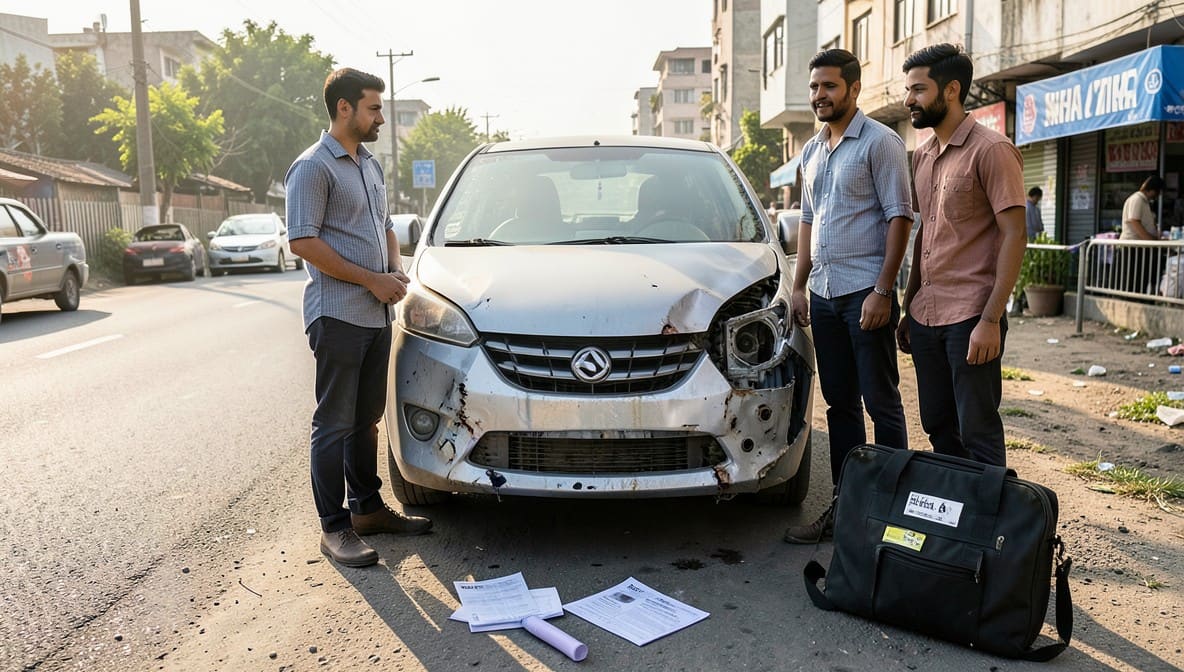
The Rajasthan High Court has affirmed that an insurance claim cannot be denied merely because the insured had a pre-existing medical condition, if the sequence of events clearly establishes that death followed an external, violent accident. The judgment reinforces the principle that the burden rests on the insurer to prove the condition, not the accident, caused death.
Background & Facts
The Dispute
The dispute arose from the repudiation of a motor insurance claim by three insurance companies - Bajaj Allianz General Insurance Company, The Oriental Insurance Company Limited, and The New India Assurance Company Limited - following the death of Pramod Chhabra in a road accident on 24.12.2018. The respondent, Rajshree Chhabra (Jain), widow of the deceased, filed a claim under two Personal Guard Policies issued by Bajaj Allianz, each with a sum insured of Rs. 60,00,000 and a bonus of Rs. 50,000. The policies covered death arising from accidents, defined as external, visible, and violent events.
Key Facts
- The deceased, Pramod Chhabra, was driving his vehicle (Registration No. RJ-14-CT-3285) on 24.12.2018 at approximately 6:00 AM after dropping a relative at Gandhi Nagar Railway Station.
- His vehicle collided with another taxi (Registration No. RJ-14-TE-2275), resulting in grievous injuries.
- He was immediately taken by ambulance to the Trauma Centre, Jaipur, where he was declared dead on arrival.
- An FIR was registered at Police Station Bajaj Nagar, Jaipur, on 24.12.2018.
- A post-mortem examination was conducted on 25.12.2018, which recorded multiple injuries: bleeding from the nose, injury to the left eye, and swelling on the left jaw.
- The FSL report and Medical Jurist’s opinion from SMS Hospital, Jaipur, concluded the cause of death as Chronic Ischemic Heart Disease and Atherosclerosis.
- The police submitted a final report on 11.07.2019, concluding the incident was an accident caused by loss of vehicle control, possibly due to a cardiac condition.
- The insurance companies repudiated the claim on the ground that death resulted from a pre-existing medical condition, not an accident as defined in the policy.
- No prior medical records, treatment history, or diagnostic reports of heart disease were produced by the insurers.
- No independent medical inquiry was conducted by any insurer to verify the alleged pre-existing condition.
Procedural History
- 24.12.2018: Road accident involving deceased Pramod Chhabra.
- 25.12.2018: Post-mortem examination conducted.
- 11.07.2019: Police submit final report classifying incident as accident.
- 2021: Claim filed before Permanent Lok Adalat, Jaipur Metropolitan - First, under Case No. 217/2021.
- 08.01.2026: Permanent Lok Adalat passed award directing payment of Rs. 60,00,000 with 7% interest and Rs. 11,000 as compensation for mental agony.
- 2026: Three writ petitions filed before the Rajasthan High Court:
- S.B. Civil Writ Petition No. 6286/2026 (Bajaj Allianz)
- S.B. Civil Writ Petition No. 6085/2026 (Oriental Insurance)
- S.B. Civil Writ Petition No. 6549/2026 (New India Assurance)
- 21.04.2026: Arguments concluded.
- 16.05.2026: Judgment pronounced.
Relief Sought
The petitioners sought quashing of the Permanent Lok Adalat’s award dated 08.01.2026, and a direction to deny the insurance claim on the ground that death was not caused by an accident as defined in the policy. The respondent sought enforcement of the award and payment of Rs. 60,00,000 with 7% interest from the date of death and Rs. 11,000 as compensation.
The Legal Issue
The central question was whether death resulting from an external, violent accident can be excluded from insurance coverage merely because the insured had a pre-existing medical condition, and whether the insurer’s reliance on a medical opinion without corroborative documentary evidence suffices to repudiate a claim.
Arguments Presented
For the Appellant/Petitioner
The insurers contended that the cause of death was Chronic Ischemic Heart Disease and Atherosclerosis, as opined by the Medical Jurist, and that the accident was merely a triggering event, not the proximate cause. They relied on United India Insurance Co. v. M/s. Harchand Rai, Smt. Alka Shukla v. LIC, and ICICI Lombard v. Sivagami to argue that where a pre-existing condition is the dominant cause, the event cannot be classified as an accident under policy terms. They emphasized that the policy required death to arise directly from an external, visible, and violent cause, and that cardiac failure negated this requirement.
For the Respondent/State
The respondent argued that the accident was undisputed and occurred while the deceased was alive and in control of the vehicle. The post-mortem report and panchanama clearly documented external injuries consistent with a road accident. The insurer’s reliance on the Medical Jurist’s opinion was challenged as speculative, unsupported by medical records, and uncorroborated. The respondent cited Bharat Watch Co. v. National Insurance Co. Ltd. and Manmohan Nanda v. United India Insurance Co. Ltd. to assert that the insurer bears the burden of proving the exclusion, and that a medical opinion without supporting documentation cannot override physical evidence. The Permanent Lok Adalat’s findings were defended as well-reasoned and based on a holistic appreciation of evidence.
The Court's Analysis
The Court undertook a meticulous review of the evidence and the Permanent Lok Adalat’s reasoning. It emphasized that the insurer’s repudiation was not based on denial of the accident, but on disputing the cause of death. The Court noted that the deceased was observed driving the vehicle immediately before the collision, and that the injuries sustained were severe and visible, as documented in the post-mortem and panchanama.
"The post-mortem report clearly reflects that the deceased had sustained grievous injuries, including bleeding from the nose, injury to the left eye, and swelling over the face. The panchanama further records that the cause of death was attributable to injuries sustained in the accident."
The Court held that the Medical Jurist’s opinion, while relevant, was not conclusive. It lacked corroboration from prior medical history, diagnostic reports, or independent investigation. The insurer failed to establish that the deceased was suffering from a known cardiac condition prior to the accident, or that the cardiac event preceded the collision.
The Court further observed that the possibility of the accident triggering a cardiac arrest could not be ruled out, and that the insurer’s theory of a pre-accident cardiac event was purely speculative. The Permanent Lok Adalat correctly applied the principle that the burden of proving an exclusion under the policy lies with the insurer.
The Court distinguished the precedents cited by the petitioners, noting that in United India Insurance and Alka Shukla, there was clear medical evidence of pre-existing, symptomatic disease. Here, no such evidence existed. The Court also affirmed the limited scope of judicial review over Permanent Lok Adalat awards under Section 22C of the Legal Services Authorities Act, 1987, and held that interference under Article 227 is warranted only in cases of patent illegality or perversity, which were absent here.
The Verdict
The writ petitions were dismissed. The Permanent Lok Adalat’s award dated 08.01.2026 was upheld. The insurers are directed to pay the sum insured of Rs. 60,00,000, with interest at 7% per annum from the date of death (24.12.2018) until realization, and an additional compensation of Rs. 11,000 for mental agony. No costs were awarded. The judgment applies mutatis mutandis to all connected petitions.
What This Means For Similar Cases
Medical Opinions Require Corroboration
- Insurers cannot rely solely on a post-mortem or expert opinion to repudiate claims without supporting medical records, treatment history, or diagnostic reports.
- A medical opinion must be tested against physical evidence, witness accounts, and the sequence of events.
Burden of Proof Lies with the Insurer
- When a claim is made under an accident policy, the insurer bears the burden of proving that the death was not caused by an external, violent event.
- Mere suspicion of a pre-existing condition is insufficient; concrete evidence is required.
Accident and Medical Condition Are Not Mutually Exclusive
- An accident can trigger or exacerbate a pre-existing condition; the key is whether the accident was the proximate cause.
- If the insured was alive and active immediately before the accident, and injuries are documented, the claim cannot be denied merely because a medical condition is later identified.
Permanent Lok Adalat Awards Are Presumptively Valid
- Courts must exercise restraint in interfering with Permanent Lok Adalat awards unless there is patent illegality or perversity.
- The factual findings of such forums, based on a holistic review of evidence, deserve deference.