The Bombay High Court has affirmed a foundational principle in land acquisition law: landowners are entitled to full compensation for land acquired not only for the main highway but also for ancillary public purposes such as service roads, open spaces, and internal amenities. This judgment resolves long-standing ambiguity in implementation and reinforces the statutory mandate of fair compensation under the Right to Fair Compensation and Transparency in Land Acquisition Rehabilitation and Resettlement Act, 2013.
Background & Facts
The Dispute
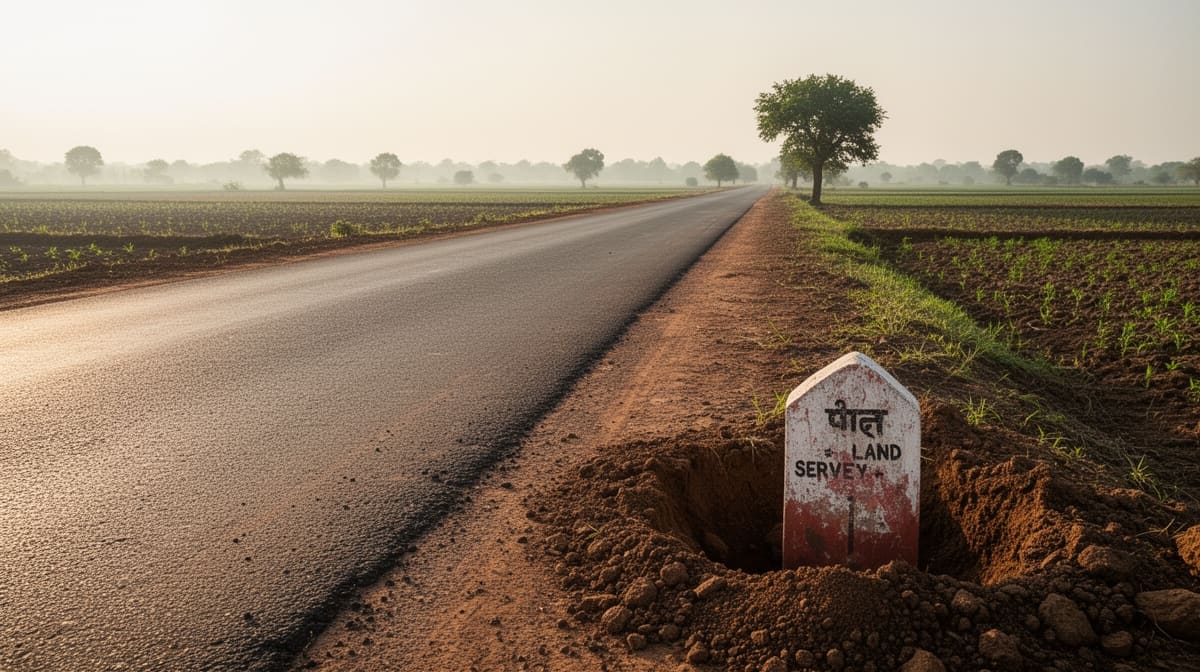
The petitioners, descendants of the original landowner Limbraj Khaladkar, sought compensation for 26R (approximately 6.5 acres) of agricultural land acquired by the National Highway Authority of India (NHAI) for the widening of National Highway No. 211 (Dhule-Solapur Road) in Osmanabad district. The dispute arose over whether compensation was due for 2168 sq. mtr of land designated for a service road and public amenities, which the Deputy Collector, Land Acquisition, refused to pay for, claiming it was reserved for "public purpose" and thus exempt from compensation.
Key Facts
- The land was notified for acquisition under Section 3(A) of the National Highways Act, 1956 on 15.03.2014.
- A further notification under Sections 3(D) and 3(G) was issued on 20.05.2014.
- The Deputy Collector, Respondent No. 5, passed a final award on 03.11.2014, determining total compensation of Rs. 64,09,201/-, comprising Rs. 54,47,000/- for the land and Rs. 9,62,201/- for the residential house.
- Of the total land, 2168 sq. mtr (approximately 0.54 acres) was identified by the Deputy Director, Land Records, as reserved for a service road and open spaces.
- The petitioners were offered compensation only for 432 sq. mtr (the actual highway footprint), with the remaining 2168 sq. mtr excluded on the grounds that it was "for public use."
- The petitioners challenged this exclusion through a writ petition filed on 12.06.2016.
- On 14.06.2018, a fresh award was issued under the Right to Fair Compensation and Transparency in Land Acquisition Rehabilitation and Resettlement Act, 2013 (RFCTLARR Act), reaffirming the same compensation structure but explicitly applying the 2013 Act’s provisions.
- The petitioners sought 100% solatium and interest from 2014, invoking Section 24(2) of the RFCTLARR Act.
- The Respondent No. 5, supported by the Town Planner and State authorities, relied on Maharashtra’s Development Control Rules (1974) and Rule 19.2 - 19.3 to argue that land reserved for public amenities is not compensable.
Procedural History
- 12.06.2016: Writ Petition No. 1986 of 2016 filed before Bombay High Court, Aurangabad Bench.
- 04.09.2018: Single Judge allowed the petition, relying on Pt. Chet Ram Vashist v. Municipal Corporation of Delhi.
- 14.06.2018: Fresh award issued under RFCTLARR Act, 2013, but not brought to the Court’s attention during initial hearing.
- 26.02.2021: Review application by Respondent No. 5 led to vacation of the 04.09.2018 order and restoration of the petition.
- 20.03.2023: Final affidavit filed by Respondent No. 5 reiterating denial of compensation for service road land.
- 07.04.2026: Judgment reserved.
- 12.06.2025: Judgment pronounced.
The Parties' Positions
For the Petitioners
- Argued that the RFCTLARR Act mandates compensation for all land acquired for public purpose, including service roads and open spaces.
- Relied on Section 24(2) of the RFCTLARR Act, which requires payment of double the market value plus 100% solatium.
- Cited Pt. Chet Ram Vashist and subsequent Bombay High Court decisions (Vrajlal Jinabhai Patel, State of Maharashtra v. Bhimashankar Chippa) affirming compensability of amenity land.
- Contended that the State’s reliance on municipal bye-laws cannot override statutory compensation rights under the RFCTLARR Act.
For the Respondents
- Respondent No. 5 and Town Planner argued that land reserved for service roads, internal roads, and open spaces under sanctioned layouts is not "acquired" in the legal sense but merely "reserved" for public use.
- Invoked Rule 19.2 and 19.3 of the Maharashtra Development Control Rules, 1974, to claim exemption from compensation.
- Respondents 2 - 4 contended that compensation had been deposited with Respondent No. 5 under Section 3-A of the National Highways Act, and disbursement was their sole responsibility.
- Argued that the petitioners had no legal right to claim compensation for land not physically used for the highway carriageway.
Relief Sought
The petitioners sought:
- Payment of full compensation of Rs. 64,09,201/- as per the 14.06.2018 award.
- 100% solatium under Section 24(2) of the RFCTLARR Act.
- Interest at 9% per annum from 03.11.2014 (date of award) until payment.
- Costs for delay and arbitrary denial.
The Legal Issue
The central question was whether land acquired for service roads, internal roads, and open spaces under a sanctioned layout plan for a national highway project qualifies as "acquired land" under the Right to Fair Compensation and Transparency in Land Acquisition Rehabilitation and Resettlement Act, 2013, entitling the owner to full compensation, including solatium and interest.
Arguments Presented
For the Petitioner
The petitioners relied on the Supreme Court’s decision in Pt. Chet Ram Vashist v. Municipal Corporation of Delhi, which held that reservation of land for public amenities does not extinguish the owner’s right to compensation. The Court clarified that while the owner may hold the land in trust for public use, the State cannot claim ownership without payment. The petitioners further cited State of Maharashtra v. Bhimashankar Sidramappa Chippa and Shirdi Nagar Panchayat v. Kishor Sharad Borawake, both affirming that compensation is due for land taken for public utility purposes under the RFCTLARR Act. They emphasized that Section 24(2) of the 2013 Act mandates double market value and 100% solatium, and that the State’s internal rules cannot override statutory rights.
For the Respondent
The State authorities, particularly Respondent No. 5 and the Town Planner, contended that the 2168 sq. mtr land was not "acquired" but merely "reserved" under municipal development rules. They argued that Rule 19.2 and 19.3 of the Maharashtra Development Control Rules, 1974, exempt such land from compensation as it is intended for public use. They also cited Section 3-H and 3-J of the National Highways Act to assert that compensation had been deposited and disbursement was the sole duty of the Deputy Collector. They maintained that the petitioners had no legal basis to claim compensation for land not physically used for the highway carriageway.
The Court's Analysis
The Court undertook a rigorous analysis of statutory intent under the RFCTLARR Act, 2013, and the precedential authority of Pt. Chet Ram Vashist. It rejected the State’s argument that "reservation" equates to "non-acquisition," noting that the Act defines acquisition broadly to include any land taken for public purpose, regardless of its specific use.
"Reserving any site for any street, open space, park, school etc. in a layout plan is normally a public purpose as it is inherent in such reservation that it shall be used by the public in general. The effect of such reservation is that the owner ceases to be a legal owner of the land in dispute and he holds the land for the benefit of the society or the public in general."
The Court emphasized that the Supreme Court in Pt. Chet Ram Vashist explicitly rejected the notion that public purpose justifies uncompensated taking. The Court further held that municipal development rules cannot override the statutory framework of the RFCTLARR Act, which is a central legislation enacted to ensure fair compensation and transparency. The State’s reliance on Rule 19.2 - 19.3 was deemed irrelevant, as these are local building regulations and not laws governing land acquisition compensation.
The Court also noted that the compensation amount of Rs. 64,09,201/- had already been determined under the 2013 Act and deposited with the Deputy Collector. The refusal to disburse the full amount was therefore arbitrary and violative of Article 14 of the Constitution. The Court distinguished Union of India v. Tarsem Singh on the grounds that it dealt with procedural delays, not substantive denial of compensation.
The Verdict
The petitioners succeeded. The Court allowed the writ petition and directed Respondent No. 5, the Deputy Collector, to pay the full compensation of Rs. 64,09,201/- to the petitioners within two months from the date of judgment. If payment is not made within this period, Respondent No. 5 shall pay costs of Rs. 50,000/- in addition to the principal amount. The compensation shall be paid with consequential benefits, including interest at the rate of 9% per annum from 03.11.2014 until actual payment.
What This Means For Similar Cases
Compensation Is Due for All Acquired Land, Regardless of Use
- Practitioners must now argue that any land taken under a notification under the RFCTLARR Act - whether for highway carriageway, service road, median, or open space - is compensable.
- Municipal or state development rules cannot override statutory compensation rights under the 2013 Act.
- The burden shifts to the acquiring authority to prove that land was not acquired, not to the landowner to prove it was.
Delay in Payment Triggers Penalties and Interest
- The Court’s imposition of Rs. 50,000/- costs for non-payment within two months sets a clear precedent for enforcing timely disbursement.
- Interest at 9% from the date of award (03.11.2014) reinforces that delay cannot be used as a tool to reduce liability.
- Practitioners should now routinely claim interest from the date of the award, not from the date of filing.
Precedent from Pt. Chet Ram Vashist Is Binding Across All Acquisition Contexts
- This judgment reaffirms that Pt. Chet Ram Vashist applies not only to municipal land but to all acquisitions under central statutes, including highways.
- The doctrine that "public purpose does not mean free acquisition" is now firmly entrenched in Indian land law.
- Any authority denying compensation for service roads or amenities must now justify its action against this binding precedent.