The Madras High Court has clarified that public notification of a national transmission project under the Electricity Act, 2003, supersedes subsequent private land acquisitions. The judgment establishes that objections raised after the statutory public notice period cannot override infrastructure projects of national importance, reinforcing the primacy of procedural timelines in energy development.
Background & Facts
The Dispute
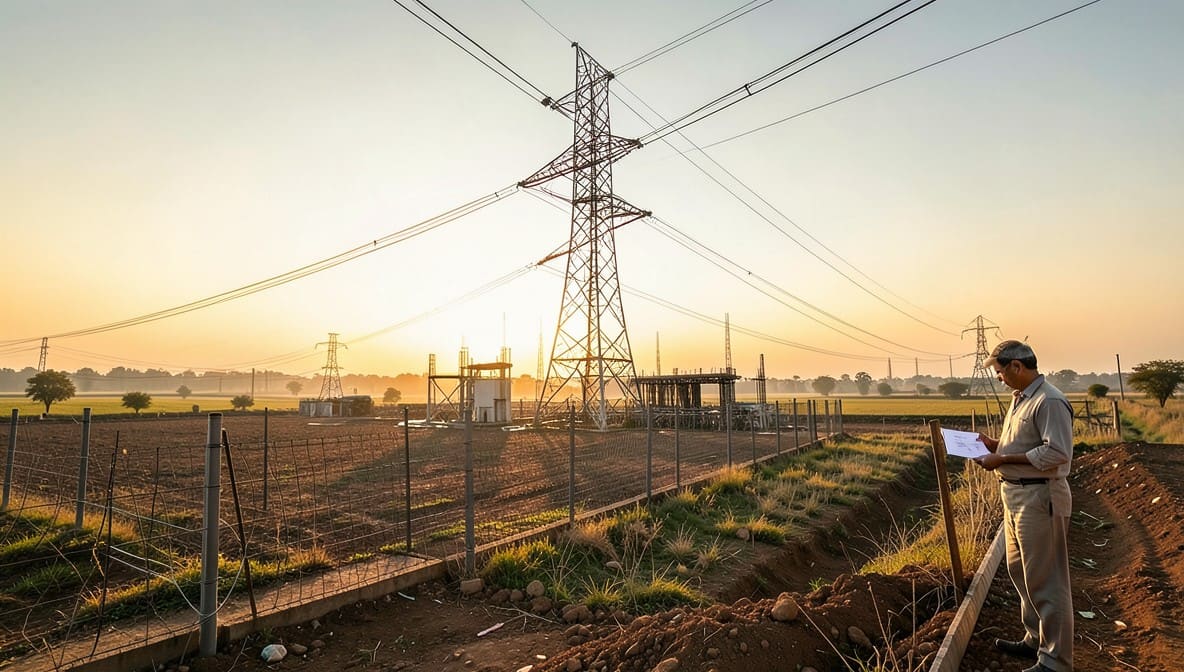
The petitioner, M/s. Progen Renewables Ltd., a private wind energy company, sought to prevent the erection of 400 KV transmission towers on its land in Tirunelveli District, Tamil Nadu. The petitioner had purchased the land bearing Survey Numbers 351/1 and 353/2A on 23 June 2025, and had commenced construction of a 25 MW solar power plant under a preferential tariff scheme approved by the Tamil Nadu Green Energy Corporation Ltd. (TNGECL). The respondents, led by Power Grid Corporation of India Ltd. (PGCIL), proposed to install transmission towers as part of a 104.5 km interstate transmission system to evacuate power from Kudankulam Nuclear Power Plant Units 3 and 4.
Procedural History
- 15 March 2024: Power Finance Consulting Limited appointed as Bid Process Coordinator.
- 19 July 2024: Application filed under Section 68(1) of the Electricity Act, 2003 for prior approval of the transmission project.
- 12 August 2024: Government of India granted approval to Power Grid Kudankulam Transmission Limited (PGKTL), a wholly owned subsidiary of PGCIL.
- 22 January 2025: Public notice published in Tamil, Hindi, and English newspapers, and in the Gazette of India, inviting objections to the proposed route.
- 3 May 2025: Petitioner applied to TNGECL for solar plant approval.
- 23 June 2025: Petitioner purchased the subject land.
- 17 July 2025: Respondents issued notice to the petitioner regarding transmission line alignment on the land.
- 18 July 2025: Petitioner objected, demanding route alteration.
- 27 November 2025: TNGECL issued Load Flow Study confirming the solar plant’s connection to Radhapuram Substation.
Relief Sought
The petitioner sought a writ of mandamus to restrain the respondents from erecting transmission towers on its land, alleging violation of Rule 3(1) of the Works of Licensees Rules, 2006, and Section 16 of the Indian Telegraph Act, 1885.
The Legal Issue
The central question was whether a landowner who acquires property after public notice of a transmission project under Section 164 of the Electricity Act, 2003, can invoke Rule 3(1) of the Works of Licensees Rules, 2006, to halt construction on the grounds of unconsidered objections.
Arguments Presented
For the Petitioner
The petitioner argued that Rule 3(1) of the Works of Licensees Rules, 2006, mandates prior written permission from the District Magistrate before any work on private land if objections are raised. It contended that the respondents failed to obtain such permission and ignored its 18 July 2025 objection. The petitioner relied on Eswari v. State of Tamil Nadu (2025 WLR 543), asserting that sub-delegation of powers under Section 164 to PGKTL was invalid and that Section 16 of the Indian Telegraph Act required the District Collector to adjudicate objections before work could proceed.
For the Respondent
The respondents countered that the public notice dated 22 January 2025, published in national and regional newspapers and the Gazette of India, provided ample opportunity for objections before any land acquisition. The petitioner acquired the land five months after this notice and seven months after the central government’s approval under Section 68(1). The respondents cited Power Grid Corp. v. Century Textiles (2017) 5 SCC 143 and Ponnusamy v. Union of India (W.A. No. 1178 of 2021), arguing that the District Collector’s role under Section 16 is limited to determining compensation, not halting projects. They further asserted that PGKTL was not a sub-delegate but the direct recipient of approval under Section 68(1).
The Court's Analysis
The Court undertook a detailed statutory interpretation of Section 164 of the Electricity Act, 2003, which confers upon transmission licensees the same powers as the Telegraph Authority under Section 10 of the Indian Telegraph Act, 1885. It emphasized that Section 10 permits placement of lines on private land with a duty to minimize damage and pay compensation, but does not require prior consent from landowners.
"The public notice under Section 164 is the critical stage for objections; subsequent land acquisition cannot retroactively invalidate a project approved under national interest provisions."
The Court held that Rule 3(1) of the Works of Licensees Rules, 2006, applies only to new lines not previously laid, and even then, the District Magistrate’s authority is confined to fixing compensation under Rule 3(2), not blocking the project. The petitioner’s purchase of land occurred after the statutory public notice period, rendering its objections legally irrelevant to project approval. The Court distinguished Eswari on grounds that it involved land acquisition without public notice, whereas here, notice was given and objections were invited and received during the public consultation window.
The Court also rejected the claim of sub-delegation, noting that PGKTL was incorporated as a wholly owned subsidiary of PGCIL and was the direct recipient of the Section 68(1) approval. The fact that construction had already commenced on 108 of 278 towers further supported the public interest imperative.
The Verdict
The writ petition was dismissed. The Court held that public notice under Section 164 of the Electricity Act, 2003, constitutes the decisive procedural milestone for objections, and subsequent land acquisition does not confer a right to halt transmission projects. The District Collector’s role is limited to compensation determination under Section 16 of the Telegraph Act, not project veto.
What This Means For Similar Cases
Public Notice Is the Critical Threshold
- Practitioners must verify whether a transmission project has been publicly notified under Section 164 before advising clients on land acquisition.
- Any purchase of land after public notice carries the risk of being subordinate to national infrastructure projects.
- Legal due diligence must include checking Gazette of India and major newspapers for transmission project notices.
Compensation, Not Obstruction, Is the Remedy
- Landowners cannot seek injunctions to stop transmission lines based on objections raised post-purchase.
- The only viable recourse is to file for compensation under Section 16 of the Indian Telegraph Act, 1885, or Rule 3(2) of the Works of Licensees Rules, 2006.
- Courts will not entertain writ petitions seeking to halt projects on procedural grounds if public notice was duly issued.
Subsidiaries Are Not Sub-Delegates
- A wholly owned subsidiary receiving direct approval under Section 68(1) is not an unlawful sub-delegation.
- Corporate structure does not invalidate statutory approvals if the entity is clearly designated as the licensee.
- Legal challenges based on alleged sub-delegation must demonstrate actual delegation to a non-authorized third party, not corporate restructuring.