The National Consumer Disputes Redressal Commission upheld the insurer’s assessment of non-performing stock, ruling that the discharge voucher executed by the claimant under financial duress does not bar a consumer complaint under the Insurance Act.
Background & Facts
The Dispute
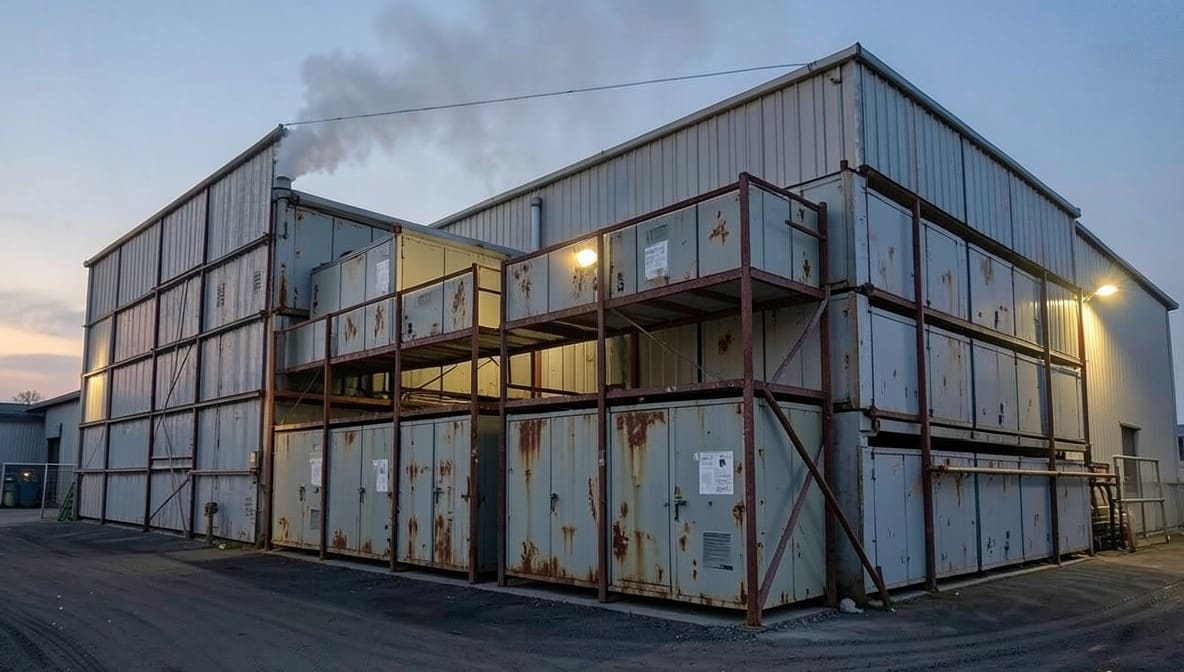
M/s. TEEKAY Marines Pvt. Ltd., a processor and exporter of marine products, suffered a fire on 14.06.2017 at its cold-storage facility. The loss was covered by a "Standard Fire & Special Perils Policy" issued by M/s. SBI General Insurance Company Ltd. (OP-1) for the years 2014-15, 2015-16 and 2016-17 (valid 07.07.2016 to 06.07.2017). The insurer paid Rs.7,46,91,671 on 04.05.2018 against the claim but disallowed Rs.8,62,86,173 as "non-performing/obsolete" stock.
Key Facts
- 07.07.2014, 07.07.2015 and 07.07.2016: Insurance policies issued for Rs.20 crore, Rs.25 crore and Rs.25 crore respectively.
- 14.06.2017 10:45 p.m.: Fire caused by electrical short circuit in deep-freeze cold-storage plant.
- 15.06.2017-20.06.2017: Surveyor (Proclaim Insurance Surveyors & Loss Assessors Private Limited) inspected the premises.
- 14.07.2017: Claim form submitted by the complainant.
- 30.03.2018: Final Survey Report dated, classifying stock as performing (203,248 kg) and non-performing (236,357 kg) valued at Rs.8,62,86,173.
- 04.05.2018: Insurer transferred Rs.7,46,91,671 to the complainant’s loan account.
- 27.04.2018: Discharge voucher executed by the complainant, acknowledging receipt of Rs.7,47,03,089 as full and final settlement.
- 21.06.2018: Insurer’s letter dated 27.06.2018 rejected the claim for non-performing stock.
- 13.08.2026: Date of pronouncement of the present order.
Procedural History
- Consumer Complaint No. 2669 of 2018 filed before the National Consumer Disputes Redressal Commission, New Delhi, seeking reimbursement of Rs.8,62,86,173 and interest at 18% from 27.04.2018.
- The Commission heard arguments from both parties and examined the surveyor’s report, the discharge voucher, and extensive correspondence.
Parties' Positions
- Complainant: Argues that the discharge voucher was executed under financial stress and undue influence; the classification of stock as obsolete is arbitrary; the surveyor’s report is not final and should be revisited.
- OP-1 (Insurer): Maintains that the discharge voucher constitutes a full and final settlement, estopping any further claim; the non-performing stock has no commercial value and is correctly excluded.
- OP-2 (Bank): Contends it is a pro-forma party and not maintainable.
Relief Sought
The complainant sought:
- Reimbursement of Rs.8,62,86,173 as the balance insurance claim.
- Interest at 18% from 27.04.2018 until realization.
- Costs of the complaint and any other appropriate order.
The Legal Issue
Whether the execution of a discharge voucher, purportedly under financial duress, bars the insured from filing a consumer complaint challenging the insurer’s assessment of non-performing stock, and whether the insurer’s classification of such stock as non-indemnifiable is permissible under Section 64-UM of the Insurance Act, 1938.
Arguments Presented
For the Complainant
- The discharge voucher was signed under coercion and financial distress, rendering it ineffective to bar the claim.
- The surveyor’s report is not the final word; the insurer may depart from it if it is arbitrary or not in compliance with the code of conduct prescribed under Section 64-UM(1-A).
- Citing National Insurance Co. Ltd. v. Boghara Polyfab (P) Ltd. and Nathani Steels Ltd. v. Associated Constructions to argue that a full-and-final settlement does not preclude arbitration or a consumer claim where fraud, undue influence or coercion is alleged.
For the Respondent (Insurer)
- The discharge voucher constitutes a full and final settlement, invoking estoppel against any further claim.
- The non-performing stock had ceased to have commercial utility and therefore is excluded under the policy’s terms.
- Reliance on Arnesh Kumar v. State of Bihar (though not directly on point) to emphasize that contractual settlements are binding.
The Court's Analysis
The Commission first examined the nature of a discharge voucher. It observed that while a discharge voucher ordinarily operates as an “accord and satisfaction,” its validity can be challenged where the execution is shown to be under duress or undue influence. The Court relied on the observations in National Insurance Co. Ltd. v. Boghara Polyfab (2009) 1 SCC 267, noting that “mere execution of a full and final settlement receipt or a discharge voucher cannot be a bar to arbitration even when validity is challenged on the ground of fraud, coercion or undue influence.”
"The complainant was left with no option but to sign the discharge voucher under stress to seek some reprieve for payment of loan amount obtained from the Bank."
The Commission then turned to the statutory framework. Section 64-UM obliges the insurer to obtain a report from an approved surveyor, but the proviso expressly allows the insurer to pay any amount different from that assessed, provided the insurer does not act arbitrarily. The Court held that the surveyor’s report, while persuasive, is not sacrosanct; it may be departed from if the insurer can demonstrate a reasonable basis for the deviation. However, the Commission found that the insurer had not provided any independent justification for disallowing the non-performing stock beyond the surveyor’s classification.
The Court also considered the jurisdiction of the consumer forum. Citing Khatema Fibers Ltd. v. New India Assurance Co. Ltd. (2023) 15 SCC 327, it reiterated that the forum’s jurisdiction is limited to deficiency in service. The insurer’s assessment, based on the surveyor’s report, did not amount to a deficiency in service because the surveyor complied with the code of conduct and the insurer exercised its contractual discretion.
Finally, the Commission evaluated the claim of duress. The correspondence dated 27.04.2018 and the series of reminder letters demonstrated the complainant’s financial distress, but the Court held that the complainant had voluntarily executed the voucher and subsequently affirmed the net adjusted loss of Rs.7,47,03,089 “without prejudice and admission of liability.” This affirmation, coupled with the lack of concrete evidence of coercion, led the Commission to conclude that the discharge voucher was valid and estopped the claim.
The Verdict
The Commission dismissed the consumer complaint. No compensation, interest, or costs were awarded. The insurer’s assessment of the non-performing stock stands, and the discharge voucher executed on 27.04.2018 is deemed a full and final settlement, precluding any further claim.
What This Means For Similar Cases
Discharge Vouchers Do Not Automatically Bar Claims
- A discharge voucher can be challenged only if the claimant can prove execution under duress, fraud or undue influence.
- Mere acknowledgment of a net adjusted loss “without prejudice” weakens the argument of coercion.
Surveyor Reports Are Not Conclusive
- Insurers may deviate from a surveyor’s valuation, but must provide a reasoned justification.
- Courts will scrutinise whether the insurer’s deviation is arbitrary or complies with the code of conduct under Section 64-UM(1-A).
Consumer Forum’s Limited Jurisdiction
-
The forum can intervene only where there is a deficiency in service; disputes over valuation methodology are generally beyond its purview.
-
Parties should consider civil litigation if they seek forensic examination of a surveyor’s report.
-
Practitioners should obtain contemporaneous evidence of any coercion before signing a discharge voucher.
-
Draft discharge vouchers with clear clauses preserving the right to contest valuation.
-
Advise insurers to document the rationale for any deviation from the surveyor’s assessment.