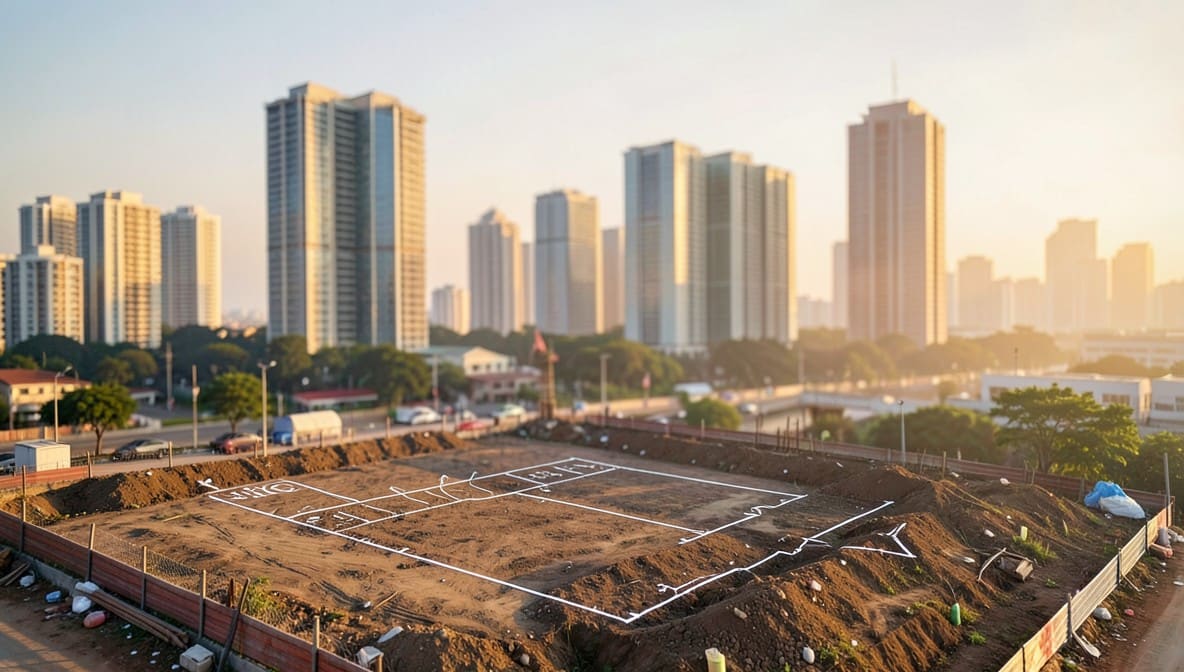
The Bombay High Court has clarified that Transferable Development Rights (TDR) acquired lawfully but left unutilised due to circumstances beyond the owner’s control cannot be deemed extinguished merely because the underlying development project was abandoned. This ruling affirms the proprietary nature of TDR as a transferable asset under the Development Control and Promotion Regulations, 1991.
Background & Facts
The Dispute
The petitioner, Bluestone Properties Private Limited, acquired Transferable Development Rights (TDR) in respect of Plot Nos. 290 and 291 in Khar, Mumbai, through a series of transactions beginning in the 1980s. The TDR, originally belonging to Khar Milton Cooperative Society Limited, was transferred to the petitioner after the Society’s reversionary rights were sold to Vaghani Family Trust and Realty Investment Trust on 30/03/2000. The petitioner then entered into a Memorandum of Understanding (MOU) on 24/04/2005 with Tanuben Kapadia and others to acquire the TDR and settle outstanding dues owed to State Bank of Saurashtra, which had taken possession of the property under SARFAESI Rules after default.
Key Facts
- The petitioner paid Rs. 6 crores to the Bank to discharge the mortgage debt on Janu Kunj Bungalow on Plot No. 291 (the Suit Property)
- On 10/08/2005, the Bank executed a Deed of Conveyance and Assignment in favour of the petitioner
- On 01/10/2005, the petitioner acquired reversionary rights from the Trusts
- On 04/10/2005, Articles of Agreement were executed between the Society, Trusts, and the petitioner granting rights to utilise TDR up to 6000 sq. ft.
- On 02/02/2006, the Municipal Corporation of Greater Mumbai (MCGM) issued an Intimation of Disapproval (IOD) and loaded TDR of 1178.68 sq. m. onto the Suit Property
- On 31/01/2007, a Commencement Certificate (CC) was issued but no construction commenced
- The CC expired on 31/01/2008
- The occupant of Janu Kunj Bungalow refused to vacate, triggering prolonged litigation
- The occupant finally vacated in 2019, and the building was demolished by MCGM
- On 23/05/2019, the Society terminated the Articles of Agreement dated 04/10/2005, citing failure to obtain CC and Occupation Certificate (OC)
- On 05/05/2022, the Tahsildar divided the Larger Land: 889.83 sq. m. to the Society and 623.27 sq. m. to the petitioner
- On 31/08/2023, the petitioner requested de-utilisation of the TDR and revalidation of the Development Rights Certificate (DRC)
- A reminder was sent on 09/10/2023; no response received
Procedural History
- 02/02/2006: IOD issued by MCGM; TDR of 1178.68 sq. m. loaded on Suit Property
- 31/01/2007: Commencement Certificate issued
- 31/01/2008: Commencement Certificate expired
- 23/05/2019: Society terminated development agreement
- 05/05/2022: Land division order by Tahsildar
- 04/06/2021: MCGM wrote to State Government seeking guidance on TDR de-utilisation
- 31/08/2023: Petitioner’s first request for de-utilisation
- 09/10/2023: Reminder sent to MCGM
- 13/03/2024: Writ Petition No. 1395 of 2024 filed before Bombay High Court
Relief Sought
The petitioner sought:
- De-utilisation of TDR of 1180 sq. m. from the Suit Property
- Revalidation of the Development Rights Certificate (DRC No. SRA/539/Const.)
- Permission to utilise the TDR on another property
The Legal Issue
The central question was whether Transferable Development Rights (TDR), once loaded onto a property under the Development Control and Promotion Regulations, 1991, are extinguished if the underlying development project is abandoned and never commenced, in the absence of an explicit statutory provision permitting de-utilisation.
Arguments Presented
For the Petitioner
Mr. Girish S. Godbole, Senior Advocate, argued that TDR is a distinct, transferable property right under the DCPR 1991, akin to an easement or entitlement. He submitted that the TDR was lawfully acquired, paid for, and recorded in the DRC issued in the petitioner’s name. The failure to commence construction was due to prolonged litigation with the occupant, which was beyond the petitioner’s control. He relied on the principle that statutory rights cannot be arbitrarily extinguished without express provision, and cited the Corporation’s own letter dated 04/06/2021 acknowledging an administrative gap. He further submitted that the CC had expired without any actual development, meaning the TDR was never utilised.
For the Respondent
Advocate Joel Carlos contended that the DCPR 1991 contains no provision for de-utilisation of TDR once loaded. He argued that the issuance of IOD and CC constituted utilisation, and that the DRC’s validity period of 10 years (expiring 26/12/2015) had already lapsed. He asserted that allowing de-utilisation would create regulatory chaos and undermine the integrity of the development control framework. He further submitted that the Society had terminated the agreement, and the petitioner had no continuing right to the TDR.
The Court's Analysis
The Court rejected the respondent’s contention that issuance of IOD or CC equated to utilisation of TDR. It observed that utilisation requires actual construction activity, not merely administrative approvals. The Court noted that the Commencement Certificate expired on 31/01/2008 without any work having commenced, and that the petitioner had been prevented from proceeding due to litigation over possession - a circumstance beyond its control.
"It is not the case of the Corporation that the TDR which was loaded was actually utilised. In fact because of the litigation, the development did not commence even though the commencement certificate was issued."
The Court emphasised that TDR is a statutory entitlement capable of transfer, and its value lies in its potential for future development. The mere loading of TDR onto a property does not constitute its consumption. The Court held that the absence of a specific provision for de-utilisation cannot be interpreted as a prohibition, particularly where the right remains wholly unexercised.
The Court further noted that the Corporation itself had acknowledged the regulatory gap in its letter dated 04/06/2021, indicating that the issue was not novel but unaddressed. The Court concluded that denying relief would be arbitrary and violate the principle of equity, especially since no third party had any claim over the TDR and the petitioner had paid substantial consideration for it.
The Court also accepted the petitioner’s undertaking to indemnify the Corporation against future third-party claims, as recorded in the additional affidavit dated 02/04/2026.
The Verdict
The writ petition was allowed. The Court directed the Municipal Corporation of Greater Mumbai to:
- De-utilise the TDR of 1180 square metres from the Suit Property
- Revalidate the Development Rights Certificate bearing No. SRA/539/Const. in favour of the petitioner
- Permit the petitioner to utilise the said TDR on another property The petitioner shall execute an Indemnity Bond in favour of the Corporation within three weeks. No order as to costs.
What This Means For Similar Cases
TDR Is a Proprietary Right, Not a Temporary Permit
- Practitioners can now argue that TDR, once lawfully acquired and recorded in a DRC, constitutes a distinct property right under the DCPR
- Non-utilisation due to litigation, title disputes, or third-party obstruction does not extinguish the right
- The burden shifts to authorities to prove actual utilisation, not mere administrative action
Regulatory Gaps Cannot Be Used to Deny Legitimate Entitlements
- Where statutes are silent on a specific remedy (e.g., de-utilisation), courts may infer equitable relief if the right remains unused and no public interest is harmed
- Authorities cannot rely on procedural silence to deprive investors of valuable development rights
- Developers should document all impediments to development (e.g., court orders, possession disputes) to support future claims for TDR revalidation
Procedural Compliance Must Be Distinct from Substantive Utilisation
- Issuance of IOD or CC does not equate to TDR utilisation
- Expiry of CC without construction = no utilisation
- Developers must retain copies of DRCs, TDR assignment deeds, and correspondence with authorities to substantiate claims of non-utilisation