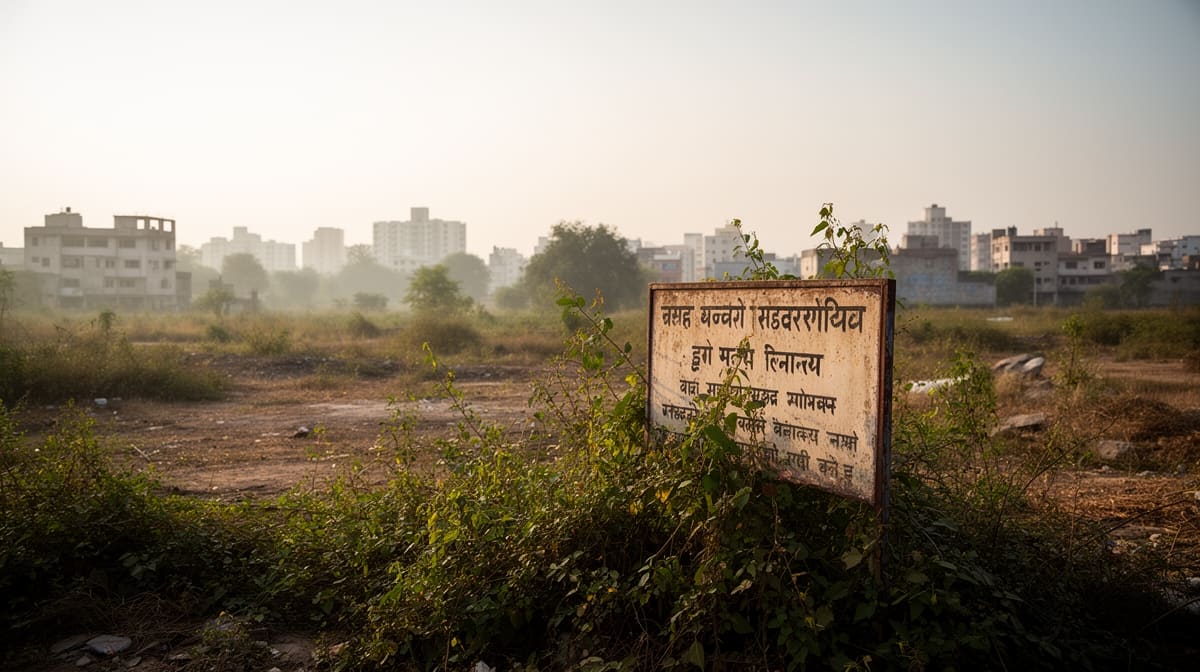
The Bombay High Court has affirmed a critical principle in urban land governance: prolonged state inaction in acquiring reserved land triggers automatic lapse of reservation, safeguarding property rights under Article 300A of the Constitution. This judgment clarifies the statutory timelines under the Maharashtra Regional and Town Planning Act, 1966, and reinforces that administrative delay cannot extinguish private ownership.
Background & Facts
The Dispute
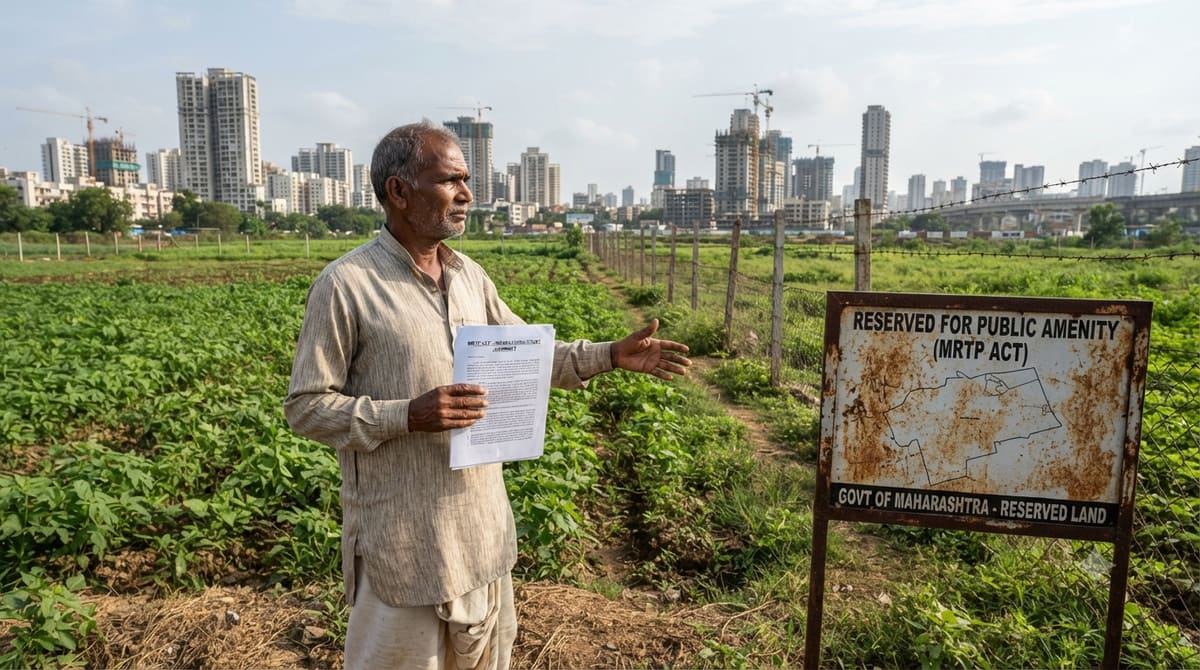
The petitioners, owners of land bearing Gat No. 90 measuring 3 H 40 R within the municipal limits of Latur, challenged the indefinite reservation of their property for public purposes - specifically, a Playground, High School, and two 9-metre wide Development (D.P.) roads - under the Final Development Plan for Latur city, sanctioned on 02.01.2002. Despite the passage of over two decades, the Latur City Municipal Corporation (Respondent No. 2) failed to initiate acquisition proceedings, leaving the petitioners unable to use or develop their land.
Key Facts
- The petitioners’ land was reserved under Reservation Nos. 82 (Playground) and 83 (High School and Playground) in the Final Development Plan dated 02.01.2002.
- The petitioners issued a formal notice under Section 127(1) of the MRTP Act on 26.11.2015, calling upon the Corporation to initiate acquisition.
- The notice included 7/12 extracts evidencing ownership through partition, as required under the Act.
- The Corporation did not respond to the notice between 26.11.2015 and 20.02.2025, nor did it initiate any acquisition proceedings under Section 126.
- On 01.01.2024, nearly eight years after the notice, the Corporation requested additional documents (7/12 Extract, 8-A Extract, and a map), which the petitioners refused to submit, asserting the notice was valid and the Corporation’s inaction was the issue.
- The Corporation offered Transferable Development Rights (TDR) as compensation, but the petitioners rejected it, citing lack of fair negotiation and statutory non-compliance.
- The petitioners filed the writ petition on 17.03.2023.
Procedural History
- 02.01.2002: Final Development Plan for Latur city sanctioned, reserving petitioners’ land.
- 26.11.2015: Petitioners served notice under Section 127(1) MRTP Act.
- 20.02.2025: Corporation filed affidavit-in-reply, for the first time alleging the notice was defective due to non-attachment of title documents.
- 01.01.2024: Corporation issued notice requesting 7/12 and 8-A extracts.
- 17.03.2023: Writ Petition No. 1257 of 2023 filed under Article 226 of the Constitution.
- 17.03.2026: Final hearing conducted at admission stage with consent of parties.
The Parties' Positions
For the Petitioners: The notice under Section 127 was valid and sufficient. The Corporation’s failure to act within the statutory 2-year window after notice, and the 10-year window from the D.P. sanction, triggered automatic lapse. The offer of TDR without negotiation is coercive and violates Article 300A.
For the Respondents: The notice under Section 127 was defective for lack of annexed title documents. The Corporation’s belated request for documents was reasonable. TDR is a statutory alternative to monetary compensation and cannot be rejected arbitrarily.
Relief Sought
The petitioners sought:
- A declaration that the reservation of their land under Reservation Nos. 82 and 83 has lapsed under Section 127(1) MRTP Act.
- A writ of mandamus directing the State to issue a notification under Section 127(2) declaring the land free from reservation.
The Legal Issue
The central question was whether Section 127(1) of the MRTP Act triggers automatic lapse of land reservation if the planning authority fails to initiate acquisition within two years of receiving a valid notice, and whether such lapse is contingent on technical defects in the notice, particularly when the authority has not raised objections during the statutory period.
Arguments Presented
For the Petitioner
Counsel Shri S.V. Natu relied on Shrirampur Municipal Council v. Satyabhamabai Bhimaji Dawkher (2013 5 SCC 627) to argue that the statutory timelines under Sections 126 and 127 are mandatory and not directory. He emphasized that the Corporation’s silence for nearly a decade after receiving the notice constituted inaction, and that the 7/12 extracts attached were public documents verifiable by the authority. He further cited Shree Vinayak Builders v. State of Maharashtra (2022) 4 Mah.L.J. 739 to assert that forced acceptance of TDR without fair negotiation violates Article 300A.
For the Respondent
Shri S.P. Urgunde contended that the notice under Section 127 was defective for non-attachment of title documents, rendering it invalid. He argued that the Corporation’s subsequent request for documents on 01.01.2024 was a reasonable step and that the petitioners’ refusal to comply precluded any claim of lapse. He maintained that TDR is a valid statutory compensation mechanism and the petitioners’ rejection of it was not legally tenable.
The Court's Analysis
The Court undertook a purposive interpretation of Sections 126 and 127 of the MRTP Act, aligning it with constitutional safeguards under Article 300A. It rejected the Corporation’s technical objection regarding defective notice, noting that the petitioners had annexed 7/12 extracts - public records that the Corporation could have independently verified. The Court observed that the Corporation remained silent for nearly eight years after receiving the notice, only raising objections after the writ petition was filed.
"The expression 'No steps as aforesaid' used in Section 127 of the 1966 Act has to be read in the context of the provisions of the 1894 Act and mere passing of a resolution by the Planning Authority or sending of a letter to the Collector or even the State Government cannot be treated as commencement of the proceeding for the acquisition of the land..."
The Court held that the Corporation’s failure to initiate acquisition within two years of the notice dated 26.11.2015, and within ten years of the D.P. sanction on 02.01.2002, triggered automatic lapse under Section 127(1). The offer of TDR was deemed insufficient to override statutory obligations, as the Supreme Court in Shrirampur had warned that indefinite reservation without compensation violates Article 300A.
The Court further clarified that the Corporation’s attempt to impose TDR as a non-negotiable alternative amounted to coercion, and that acquisition under Section 126 is by agreement, not unilateral determination. The petitioners’ offer to allow acquisition within one year was ignored, further evidencing the State’s inaction.
The Verdict
The petitioners succeeded. The Court declared that the reservation of the petitioners’ land under Reservation No. 82 (Playground), Reservation No. 83 (High School and Playground), and the two 9-metre wide D.P. roads in Gat No. 90, measuring 3 H 40 R, has lapsed under Section 127(1) of the MRTP Act. The State is directed to issue a notification under Section 127(2) declaring the land free from reservation within eight weeks. No costs were awarded.
What This Means For Similar Cases
Lapse Is Automatic, Not Discretionary
- Practitioners must now treat the 10-year window from D.P. sanction and the 2-year window from Section 127 notice as absolute deadlines.
- Any delay beyond these periods, regardless of administrative oversight, triggers automatic lapse - no formal declaration is needed.
- Landowners may file writ petitions immediately upon expiry of the statutory period.
Technical Defects Cannot Override Substantive Rights
- Minor procedural omissions (e.g., non-attachment of documents) cannot invalidate a Section 127 notice if the authority had access to public records (e.g., 7/12 extracts) and remained silent.
- Authorities must raise objections to notices within a reasonable time; belated objections after litigation begins are not sustainable.
- Courts will not permit authorities to use technicalities to perpetuate deprivation of property.
TDR Cannot Be Imposed Unilaterally
- TDR or FSI offered under Section 126 must be subject to negotiation; it cannot be forced upon landowners.
- Landowners retain the right to reject TDR if it is not fair, equitable, or proportionate to market value.
- Any attempt to compel acceptance of TDR without due process violates Article 300A and is liable to be set aside.