The Delhi High Court has reaffirmed that even a truthful disclosure and criminal acquittal do not create an automatic right to compassionate appointment in a disciplined force, particularly when the acquittal stems from hostile witnesses or technical grounds. The judgment underscores the employer’s discretion to evaluate character and suitability beyond the criminal court’s verdict.
Background & Facts
The Dispute
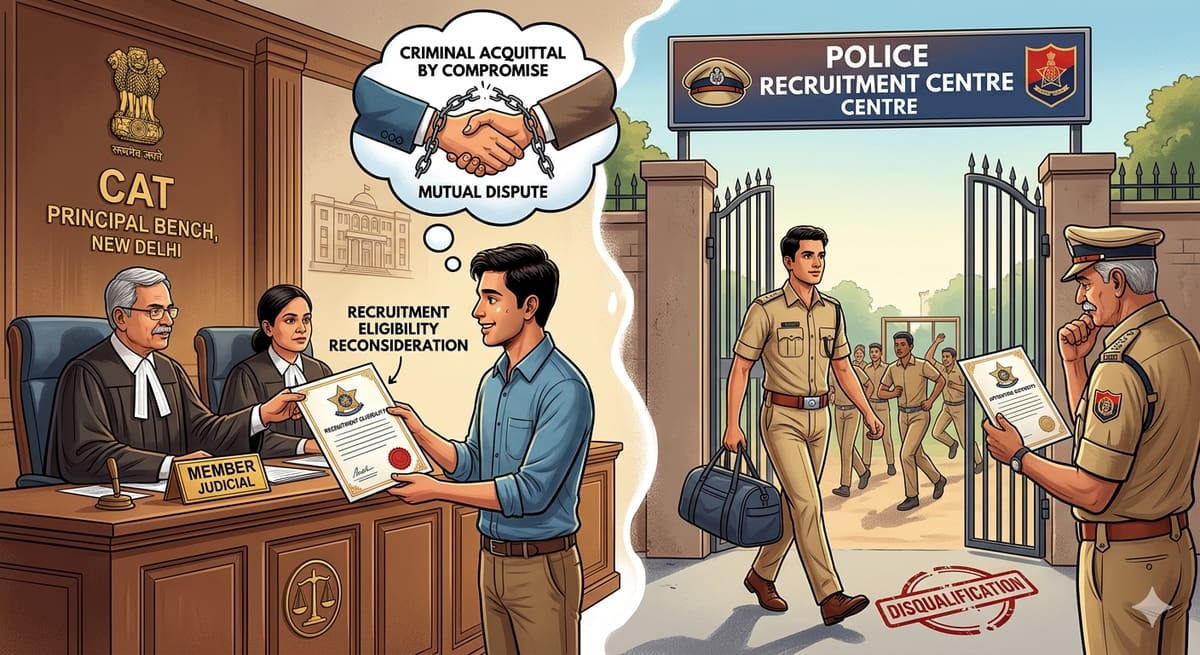
The petitioner sought compassionate appointment as Head Constable (Ministerial) in the Delhi Police following the death of his father in 2013. His candidature was approved provisionally in 2014, subject to verification of character and antecedents. During verification, it was revealed that he had been involved in FIR No. 138/2009 under multiple IPC sections including house trespass with weapons, rioting, and grievous hurt. Although he disclosed this involvement in his attestation form, he was acquitted by the Trial Court on 23.11.2011 after prosecution witnesses turned hostile. The authorities treated this as a "technical acquittal" rather than a clean exoneration.
Procedural History
- 2013: Petitioner’s father died in service, triggering eligibility for compassionate appointment
- 2014: Candidature provisionally approved pending verification
- 2015: Show cause notice issued on 19.11.2015 questioning suitability due to criminal antecedents
- 2016: Candidature cancelled by Deputy Commissioner of Police on 14.03.2016
- 2017: Petitioner filed Original Application (O.A. No. 2365/2017) before the Central Administrative Tribunal
- 2020: Tribunal dismissed the O.A., upholding the cancellation
- 2026: Writ Petition filed before Delhi High Court under Articles 226 and 227
Relief Sought
The petitioner sought quashing of the show cause notice and cancellation order, and directed reinstatement of his candidature on the ground that truthful disclosure and acquittal rendered the rejection illegal and arbitrary.
The Legal Issue
The central question was whether truthful disclosure of criminal antecedents and a subsequent acquittal - particularly one based on hostile witnesses - creates an indefeasible right to compassionate appointment in a disciplined force like the Delhi Police.
Arguments Presented
For the Petitioner
The petitioner’s counsel argued that: (i) he had truthfully disclosed the criminal case in the attestation form, fulfilling the requirement of honesty; (ii) he was acquitted by the Trial Court, which extinguished any stigma of guilt; (iii) the authorities could not override the criminal court’s verdict; and (iv) reliance was placed on Sandeep Singh v. GNCTD where acquittal was held to be clean due to absence of evidence.
For the Respondent
The State contended that: (i) compassionate appointment is a discretionary exception, not a right; (ii) the Screening Committee is empowered to assess suitability based on the nature of the offence, the circumstances of acquittal, and the candidate’s propensity for future misconduct; (iii) acquittal due to hostile witnesses is not an honourable acquittal and does not equate to exoneration on merit; and (iv) the Delhi Police’s screening policy, upheld in Mehar Singh and Avtar Singh, permits rejection even after acquittal to preserve institutional integrity.
The Court's Analysis
The Court examined the settled jurisprudence on the interplay between criminal acquittals and public employment, particularly in disciplined forces. It held that while truthful disclosure is mandatory, it does not mitigate the seriousness of antecedents or act as a shield against rejection. The Court emphasized that the standard of proof in departmental proceedings is preponderance of probabilities, not proof beyond reasonable doubt.
"Acquittals arising out of compromise or witnesses turning hostile cannot be equated with clean acquittals on merits, and that such acquittals do not bind the employer while assessing suitability."
The Court relied on Mehar Singh v. Commissioner of Police and Avtar Singh v. UOI, where the Supreme Court held that the Screening Committee may legitimately consider whether an acquittal is honourable or technical. The acquittal in this case was based on victims - many of whom were women - turning hostile despite Medico-Legal Certificates confirming grievous injuries. This indicated a probable compromise or witness intimidation, not a clean exoneration.
The Court further clarified that judicial review under Articles 226 and 227 is limited to examining whether the decision was mala fide, arbitrary, or procedurally flawed - not whether the Court would have reached the same conclusion. The Screening Committee’s assessment, grounded in MLCs and the nature of offences, was found to be reasoned and non-arbitrary.
Additionally, the Court noted the inordinate delay of over thirteen years since the death of the petitioner’s father. Compassionate appointment is meant to provide immediate relief to families in financial distress. The prolonged lapse defeated the very object of the scheme, as no evidence was presented to show continuing penury.
The Verdict
The petitioner’s writ petition was dismissed. The Court held that truthful disclosure and acquittal based on hostile witnesses do not entitle a candidate to compassionate appointment in a disciplined force. The Screening Committee’s decision to reject candidature on grounds of unsuitability was lawful, reasonable, and consistent with binding precedents.
What This Means For Similar Cases
Acquittal Does Not Equal Suitability
- Practitioners must advise clients that acquittal, even if legally valid, is not conclusive for public employment in sensitive services
- The nature of the offence and the reason for acquittal (e.g., hostile witnesses, compromise) are decisive factors
- Honesty in disclosure is a baseline requirement, not a mitigating factor
Screening Committees Have Broad Discretion
- Employers in police, paramilitary, and other disciplined forces may apply stringent character assessments
- Decisions based on reasoned evaluation of antecedents, MLCs, and prosecutorial conduct are immune from judicial interference unless mala fide
- Courts will not substitute their opinion for that of expert screening panels
Delay Undermines Compassionate Appointments
- Compassionate appointments are time-sensitive relief mechanisms, not deferred entitlements
- Delay exceeding five to seven years may be fatal to claims unless compelling evidence of ongoing financial distress is produced
- Petitioners must file applications promptly and substantiate financial hardship contemporaneously with the death