Rajasthan High Court judgments

488 Rajasthan High Court judgments explained in plain English: what was decided, the law applied and why it matters. Page 4 of 21.

RS-CIT Certification Satisfies Computer Proficiency for LDCs Appointed Post-2010 | Type Test Condition Void: Rajasthan HC
Case Law Analysis
|Rajasthan High Court

RS-CIT Certification Satisfies Computer Proficiency for LDCs Appointed Post-2010 | Type Test Condition Void: Rajasthan HC

The Rajasthan High Court has declared that requiring a separate typing test for Lower Division Clerks appointed after July 5, 2010, is illegal, holding that RS-CIT certification fully satisfies the computer proficiency requirement under the amended service rules. This ruling directly impacts thousands of state employees entitled to seniority, promotions, and arrears without additional testing, reinforcing parity in recruitment conditions.


BNS 2023 Section 272 | Bail Granted When FSL Report Refutes Causation for Culpable Homicide: Rajasthan HC
Case Law Analysis
|Rajasthan High Court

BNS 2023 Section 272 | Bail Granted When FSL Report Refutes Causation for Culpable Homicide: Rajasthan HC

The Rajasthan High Court granted bail to a compounder accused of culpable homicide after the FSL report conclusively established sudden cardiac failure as the cause of death, not the alleged injection. This ruling reinforces that prosecutorial allegations unsupported by medical evidence cannot sustain a prima facie case under BNS 2023, protecting healthcare providers from baseless criminal liability.

Section 483 BNSS | Bail Granted for MDMA Possession Below Commercial Quantity Where Trial Delay and No Flight Risk Exist : Rajasthan HC
Case Law Analysis
|Rajasthan High Court

Section 483 BNSS | Bail Granted for MDMA Possession Below Commercial Quantity Where Trial Delay and No Flight Risk Exist : Rajasthan HC

The Rajasthan High Court granted bail to an accused possessing 9.43 grams of MDMA, ruling that possession below the commercial quantity threshold, combined with prolonged pre-trial detention and absence of flight risk, justifies release under Section 483 BNSS. This reinforces that statutory bail thresholds and procedural delays can override strict NDPS Act presumptions, benefiting first-time offenders in delayed prosecutions.

CrPC Sections 82 & 83 | Proclamation Invalid Without Proof of Intentional Evasion + Proper Publication: Rajasthan HC
Case Law Analysis
|Rajasthan High Court

CrPC Sections 82 & 83 | Proclamation Invalid Without Proof of Intentional Evasion + Proper Publication: Rajasthan HC

The Rajasthan High Court has struck down a proclamation and attachment order against an accused who was away for livelihood, ruling that mere non-appearance due to absence from the registered address-without evidence of deliberate evasion-cannot trigger Sections 82 and 83 CrPC. The court emphasized that strict compliance with publication norms and a reasoned finding of intentional avoidance are mandatory safeguards under natural justice, protecting innocent absconders from punitive proceedings.

Article 21 | Five Years of Pre-Trial Detention Alone Violates Right to Speedy Trial, Justifying Bail Regardless of Offence Gravity : Rajasthan HC
Case Law Analysis
|Rajasthan High Court

Article 21 | Five Years of Pre-Trial Detention Alone Violates Right to Speedy Trial, Justifying Bail Regardless of Offence Gravity : Rajasthan HC

The Rajasthan High Court has ruled that a pre-trial detention exceeding five years, without trial conclusion, constitutes a per se violation of Article 21, entitling the accused to bail even in heinous offences like murder. This sets a new benchmark for judicial intervention in chronic trial delays, affecting all accused facing prolonged incarceration without conviction.

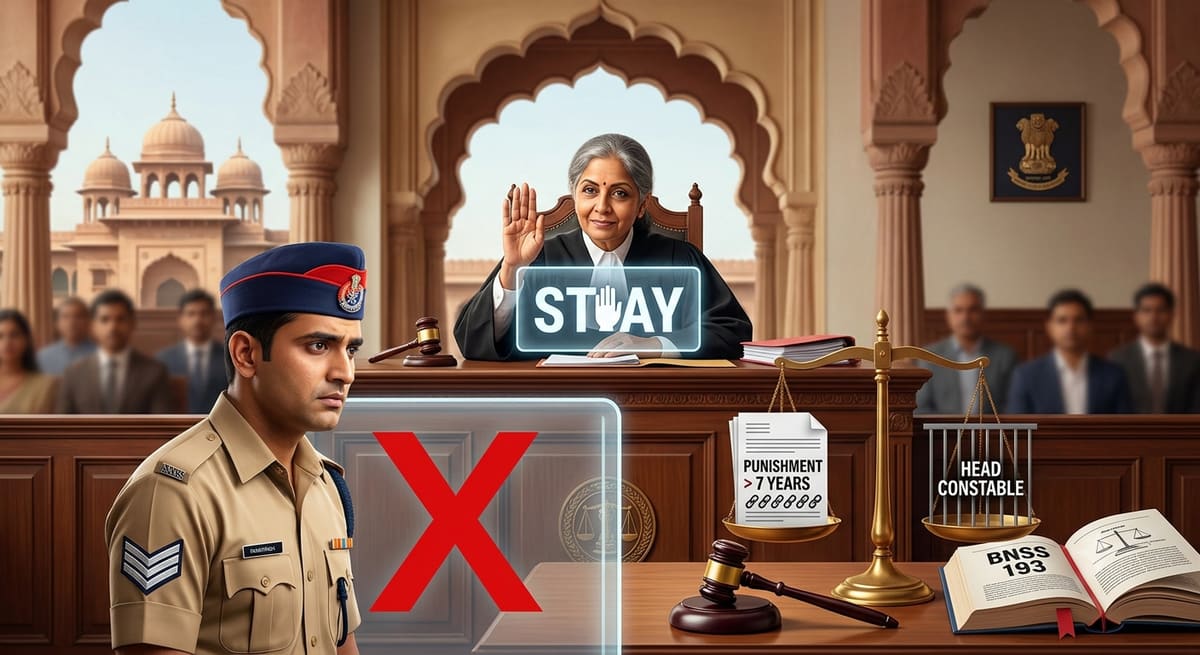
BNSS Section 193 | Head Constable Ineligible to Investigate Offences Punishable Beyond 7 Years Imprisonment : Rajasthan HC Stays Trial
Case Law Analysis
|Rajasthan High Court

BNSS Section 193 | Head Constable Ineligible to Investigate Offences Punishable Beyond 7 Years Imprisonment : Rajasthan HC Stays Trial

Rajasthan High Court ruled that a Head Constable lacks authority to investigate offences carrying imprisonment exceeding seven years under BNSS, staying trial proceedings. The decision underscores statutory competence requirements for investigating officers, impacting criminal procedure compliance in serious offences.

NMC FAQ Clarification Overrides Senior Residency Requirement for Assistant Professor Eligibility : Rajasthan HC
Case Law Analysis
|Rajasthan High Court

NMC FAQ Clarification Overrides Senior Residency Requirement for Assistant Professor Eligibility : Rajasthan HC

Rajasthan High Court rules that NMC's FAQ clarification, requiring two years of cumulative government hospital experience post-PG degree, supersedes the one-year senior residency mandate for Assistant Professor eligibility. The judgment directs inclusion of the petitioner in the interview process, setting a precedent for medical education service law.

Section 94 JJ Act Mandatory | POCSO Trial Cannot Proceed Without Victim Age Verification: Rajasthan HC
Case Law Analysis
|Rajasthan High Court

Section 94 JJ Act Mandatory | POCSO Trial Cannot Proceed Without Victim Age Verification: Rajasthan HC

Rajasthan High Court rules that trial courts must prioritize and conclusively determine a victim's age under Section 94 of the Juvenile Justice Act before proceeding with POCSO cases, ensuring compliance with statutory safeguards. The directive mandates recording the victim's statement within 30 days, failing which legal measures must be employed to secure attendance.

Section 427 CrPC | Substantive Sentences for Multiple Section 138 NI Act Offences May Run Concurrently, But Default Sentences for Fines Remain Consecutive : Rajasthan HC
Case Law Analysis
|Rajasthan High Court

Section 427 CrPC | Substantive Sentences for Multiple Section 138 NI Act Offences May Run Concurrently, But Default Sentences for Fines Remain Consecutive : Rajasthan HC

The Rajasthan High Court has ruled that when a person is convicted under Section 138 of the Negotiable Instruments Act in multiple cases, the substantive prison terms may be ordered to run concurrently to avoid excessive incarceration. However, any default sentences arising from unpaid fines or compensation must still be served consecutively, preserving the deterrent effect of financial penalties. This clarifies sentencing practice for repeat cheque bounce offenders across India.

Section 7 Prevention of Corruption Act | Circumstantial Evidence Alone Can Sustain Conviction Despite Hostile Witnesses: Rajasthan HC
Case Law Analysis
|Rajasthan High Court

Section 7 Prevention of Corruption Act | Circumstantial Evidence Alone Can Sustain Conviction Despite Hostile Witnesses: Rajasthan HC

Rajasthan High Court rules that circumstantial evidence, including pre-trap proceedings and demand corroboration, is sufficient to establish guilt under the Prevention of Corruption Act, even if key witnesses turn hostile. The judgment reinforces that direct evidence is not mandatory for conviction in corruption cases, impacting anti-corruption prosecutions nationwide.

Strict Liability Under Fatal Accidents Act | Rajasthan HC Enhances Compensation to Rs. 4.31 Lakh for Electrocution Deaths : Rajasthan HC
|Rajasthan High Court

Strict Liability Under Fatal Accidents Act | Rajasthan HC Enhances Compensation to Rs. 4.31 Lakh for Electrocution Deaths : Rajasthan HC

Rajasthan High Court holds electricity boards strictly liable for electrocution deaths under the Fatal Accidents Act, enhancing compensation to Rs. 4,31,600 with 6% interest. The ruling underscores negligence in maintaining electrical infrastructure as grounds for heightened liability, impacting future tort claims against public utilities.

RTPP Rules | Shared Infrastructure Presumes Conflict of Interest in Tenders: Rajasthan HC Disqualifies Bid Without Proof of Collusion
Case Law Analysis
|Rajasthan High Court

RTPP Rules | Shared Infrastructure Presumes Conflict of Interest in Tenders: Rajasthan HC Disqualifies Bid Without Proof of Collusion

Rajasthan High Court rules that shared premises, common chartered accountant, and notary between bidders create a rebuttable presumption of conflict of interest under Rule 81(3)(D) of the RTPP Rules, justifying disqualification even without evidence of actual bid rigging. The ruling sets a strict standard for bidder independence in public procurement.

BNSS Section 430 | Monetary Conditions for Suspension of Sentence in Cheque Bounce Cases Unlawful: Rajasthan HC
|Rajasthan High Court

BNSS Section 430 | Monetary Conditions for Suspension of Sentence in Cheque Bounce Cases Unlawful: Rajasthan HC

The Rajasthan High Court has struck down the imposition of monetary deposits as a condition for suspending sentences under BNSS Section 430 in cheque bounce cases, affirming that such conditions exceed statutory authority and violate the principle of proportionality. This ruling protects accused persons from financial coercion during appellate stays and clarifies the limits of appellate courts’ discretion in bail-related orders.

BNSS Section 483 | Bail Granted in Non-Bailable Offences When No Criminal Record & Trial Will Be Protracted: Rajasthan HC
Case Law Analysis
|Rajasthan High Court

BNSS Section 483 | Bail Granted in Non-Bailable Offences When No Criminal Record & Trial Will Be Protracted: Rajasthan HC

The Rajasthan High Court granted bail to an accused in BNS offences triable by a magistrate, emphasizing that prolonged trial duration combined with clean antecedents and no recovery undermines the necessity of continued custody. This reinforces that procedural fairness under BNSS Section 483 must outweigh mechanical application of non-bailability, especially in non-violent, evidence-light cases.

POCSO Act Bail | Hostile Witnesses and Proven Majority of Victim Justify Bail Under BNSS Section 483 : Rajasthan HC
Case Law Analysis
|Rajasthan High Court

POCSO Act Bail | Hostile Witnesses and Proven Majority of Victim Justify Bail Under BNSS Section 483 : Rajasthan HC

Rajasthan High Court grants bail in a POCSO case where the victim and witnesses turned hostile, and the victim's majority was established through testimony and marital status. The court held that forged school records alone cannot sustain POCSO charges if the victim's age is disproven, impacting bail jurisprudence under BNSS Section 483.

Section 138 NI Act | Nominee Director Liable Only With Specific Averments of Active Role: Rajasthan HC Quashes Proceedings
Case Law Analysis
|Rajasthan High Court

Section 138 NI Act | Nominee Director Liable Only With Specific Averments of Active Role: Rajasthan HC Quashes Proceedings

Rajasthan High Court rules that a nominee director cannot be held vicariously liable under Section 138 of the Negotiable Instruments Act unless the complaint specifically alleges their active involvement or responsibility in the company’s affairs. The ruling underscores that mere nomination by a lending institution does not attract criminal liability without explicit averments.