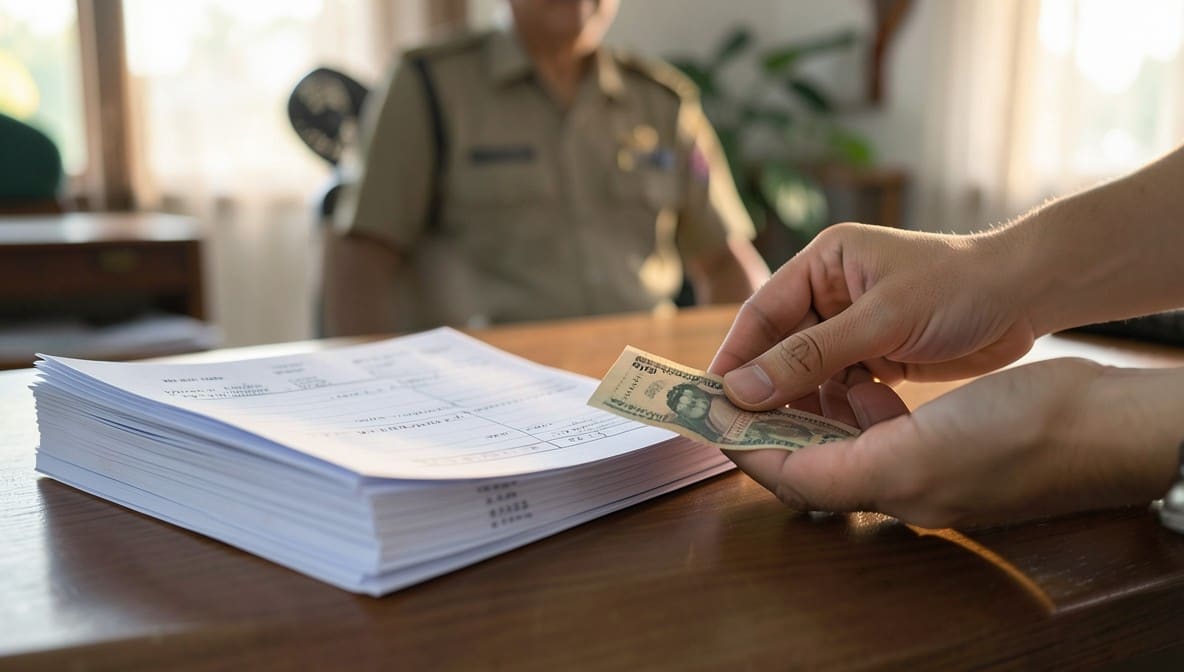
The Rajasthan High Court has granted leave to appeal in a significant corruption case, emphasizing that circumstantial evidence can establish guilt under the Prevention of Corruption Act even when key witnesses turn hostile. This order underscores the evolving standards for proving corruption charges when direct evidence is unavailable, potentially reshaping prosecution strategies in similar cases.
Background & Facts
The Dispute
The State of Rajasthan filed a leave to appeal against the acquittal of Pratapa Ram, a public servant, who was charged under Section 7 of the Prevention of Corruption (Amendment) Act, 2018. The acquittal followed a full trial where the complainant and several witnesses turned hostile, leading the Special Judge to extend the benefit of doubt to the respondent.
Key Facts
- Complainant: Nakul Singh alleged that Pratapa Ram demanded illegal gratification (bribe) for executing pending work
- Trap Proceedings: The Anti-Corruption Bureau (ACB) conducted a verification and staged a trap on the basis of the complaint
- Amount Recovered: ₹10,500 was allegedly recovered from the respondent’s possession during the trap
- Witnesses: The complainant (PW-15) and five other witnesses (PW-5 Javara Ram, PW-6 Jeeva Ram, PW-7 Padam Singh, PW-8 Ganga Singh, and PW-9 Maan Singh) turned hostile and did not support the prosecution’s case
- Prosecution Sanction: Obtained before filing the charge-sheet
- Trial Court Order: Acquitted the respondent on 31.01.2024 in Criminal Original Case No. 18/2022, citing benefit of doubt due to lack of direct evidence
Procedural History
- Date of Offence: Not explicitly mentioned, but trap proceedings were conducted post-complaint
- 15.03.2022: Complaint filed by Nakul Singh (assumed date based on trap proceedings)
- Trap Date: Conducted by ACB (exact date not specified)
- Charge-Sheet: Filed after procuring prosecution sanction
- Trial Proceedings: Complainant and witnesses turned hostile during examination
- 31.01.2024: Trial Court acquitted the respondent
- Delay in Appeal: The State filed the leave to appeal with a 260-day delay, supported by an application under Section 5 of the Limitation Act with an affidavit from Dinesh Tiwari, Assistant Director, Prosecution
- 30.06.2026: Rajasthan High Court condoned the delay, granted leave to appeal, and issued notice to the respondent
Relief Sought
The State seeks reversal of the acquittal order dated 31.01.2024 and conviction of the respondent under Section 7 of the Prevention of Corruption Act based on circumstantial evidence.
The Legal Issue
The central question before the High Court was whether an accused can be convicted under the Prevention of Corruption Act solely on the basis of circumstantial evidence, particularly when the complainant and key witnesses turn hostile and do not support the prosecution’s case.
Arguments Presented
For the Appellant (State of Rajasthan)
- Relied on the judgment in Neeraj Dutta v. State (Government of NCT Delhi), reported in (2023) 4 SCC 731, where the Supreme Court held that circumstantial evidence can establish guilt under the Prevention of Corruption Act even in the absence of direct evidence
- Argued that the pre-trap proceedings and the recovery of ₹10,500 from the respondent’s possession were sufficient to corroborate the demand for illegal gratification
- Contended that the Trial Court failed to appreciate the evidence properly, particularly the circumstances surrounding the trap and the demand made by the respondent
- Cited P. Sarangapani (Dead) through L.R. Paka Saroja v. State of A.P., reported in Manu/SC/1036/2023, where the Supreme Court upheld a conviction despite the complainant’s death, relying on other evidence
For the Respondent
- The respondent’s arguments were not explicitly recorded in the judgment, but the Trial Court’s order suggests that the benefit of doubt was extended due to the hostile witnesses and lack of direct evidence supporting the prosecution’s case
The Court's Analysis
The High Court critically examined the legal principles governing the use of circumstantial evidence in corruption cases. Key observations include:
-
Circumstantial Evidence Sufficiency: The Court relied on Neeraj Dutta v. State (Government of NCT Delhi), where the Supreme Court held that circumstantial evidence alone can establish guilt under the Prevention of Corruption Act. The Court noted that the absence of direct evidence does not automatically entitle the accused to acquittal if the surrounding circumstances point to guilt.
"In absence of a direct evidence the charge can be established from the surrounding circumstances and the circumstances can be read to establish the charge."
-
Hostile Witnesses: The Court acknowledged that the complainant and several witnesses turned hostile, but emphasized that this does not negate the value of circumstantial evidence. The pre-trap proceedings, the recovery of the bribe amount, and the demand made by the respondent were deemed sufficient to warrant a reconsideration of the case.
-
Trial Court’s Error: The Court observed that the Trial Court failed to properly appreciate the evidence, particularly the circumstantial evidence and the corroborative value of the trap proceedings. The acquittal was based on an overly narrow interpretation of the benefit of doubt, ignoring the legal precedent that permits conviction on circumstantial evidence.
-
Precedent Application: The Court distinguished the present case from scenarios where no evidence exists, relying instead on P. Sarangapani, where the Supreme Court upheld a conviction despite the complainant’s unavailability. This precedent reinforces that corruption charges can be proved through indirect evidence.
The Verdict
The High Court granted leave to appeal, setting aside the procedural delay and directing the matter to be registered as a regular criminal appeal. The Court issued notice to the respondent and permitted additional service through the department if the respondent is in service. The appeal will now proceed on merits, with the State given an opportunity to argue for the respondent’s conviction based on circumstantial evidence.
What This Means For Similar Cases
Circumstantial Evidence Can Override Hostile Witnesses
- Practitioners must now argue that hostile witnesses do not automatically defeat a corruption charge if circumstantial evidence, such as pre-trap proceedings, recovery of bribe money, or demand corroboration, exists
- Prosecution strategies should focus on building a chain of circumstances that collectively point to guilt, even if direct testimony is unavailable
The Burden on Trial Courts to Appreciate Evidence Holistically
- Trial Courts must avoid acquitting accused persons solely on the ground of hostile witnesses without examining the entirety of the evidence, including circumstantial proof
- Judges should apply the principles laid down in Neeraj Dutta and distinguish cases where no evidence exists from those where indirect evidence is available
Implications for Anti-Corruption Investigations
- Investigating agencies like the ACB should prioritize documenting pre-trap proceedings and corroborative evidence to strengthen cases where witnesses may turn hostile
- The judgment reinforces that trap proceedings and recovery of illegal gratification can be sufficient to establish guilt even without direct testimony