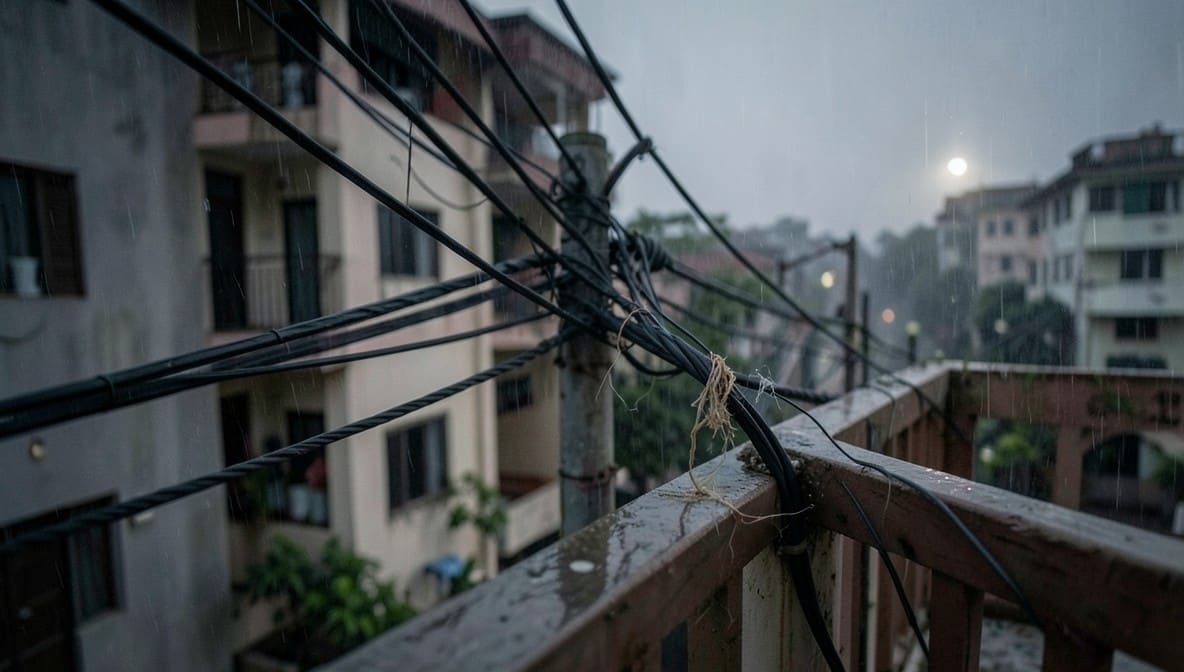
The Rajasthan High Court has reaffirmed the principle of strict liability in cases involving death due to electrocution, holding electricity boards accountable even in the absence of proven negligence. The Court enhanced compensation to Rs. 4,31,600 with 6% interest, setting a precedent for future claims under the Fatal Accidents Act, 1855 where hazardous substances like electricity cause harm.
Background & Facts
The Dispute
The respondents, legal heirs of the deceased Ganpat Rawat, filed a civil suit under the Fatal Accidents Act, 1855 against the Rajasthan State Electricity Board (RSEB) and its Assistant Engineer. The suit alleged that on 09.04.1991, Ganpat Rawat died due to electrocution while attempting to rescue his neighbor Punjki, who had also died after coming into contact with a broken live electric wire lying on the ground in village Jevtari, Udaipur. The respondents claimed that the accident occurred due to the appellants' negligence in maintaining the electric line, which had been in a dilapidated condition for years.
Key Facts
- The respondents claimed compensation of Rs. 4,75,000 under various heads for the death of Ganpat Rawat.
- The appellants denied negligence, contending that the electric wire broke due to a severe storm on the midnight of 08.04.1991, which they classified as an Act of God.
- The appellants argued that the power supply was cut off immediately upon receiving information about the fallen wire.
- The respondents alleged that the appellants' employees failed to maintain the electric line, which had not been repaired for 2-3 years prior to the incident.
Procedural History
- 161/1991: Civil suit filed before the Additional District Judge No. 1, Udaipur.
- 28.03.1995: Trial Court partly decreed the suit, holding the appellants negligent and awarding Rs. 1,27,000 as compensation with 6% interest from the date of filing the suit.
- 1995: Appellants filed Civil First Appeal No. 73/1995 challenging the Trial Court's decree.
- 2026: Respondents filed a cross-objection under Order XLI Rule 22 CPC seeking enhancement of compensation.
- 30.06.2026: High Court pronounced judgment, dismissing the appeal and partly allowing the cross-objection.
The Parties' Positions
- Appellants: Argued that the accident was caused by an Act of God (storm) and that they had no prior knowledge of the fallen wire. They contended that the deceased and Punjki were negligent in walking carelessly in the dark.
- Respondents: Argued that the appellants were negligent in maintaining the electric line and failed to take timely action despite knowing the hazardous condition. They relied on the principle of strict liability to hold the appellants accountable.
Relief Sought
- Appellants: Sought dismissal of the civil suit and setting aside of the Trial Court's decree.
- Respondents: Sought enhancement of compensation to Rs. 4,31,600 with 6% interest, along with additional amounts for loss of consortium, funeral expenses, and loss of estate.
The Legal Issue
The central legal question was whether the appellants could be held strictly liable for the deaths caused by electrocution, even in the absence of proven negligence, and whether the compensation awarded by the Trial Court should be enhanced based on the principles laid down by the Supreme Court in recent judgments.
Arguments Presented
For the Appellants
- The appellants contended that the electric line broke due to a severe storm, which qualified as an Act of God, absolving them of liability.
- They argued that the power supply was cut off immediately upon receiving information about the fallen wire, and thus, no negligence could be attributed to them.
- They relied on the testimonies of their witnesses (DW-1 to DW-4) to establish that the storm caused the wire to break and that maintenance was regularly carried out.
For the Respondents
- The respondents argued that the appellants were negligent in maintaining the electric line, which had not been repaired for 2-3 years prior to the incident.
- They relied on the principle of strict liability, citing Supreme Court judgments (Parvati Devi v. Commissioner of Police, Delhi and Madhya Pradesh Electricity Board v. Shail Kumari), to argue that the appellants were liable irrespective of negligence.
- They sought enhancement of compensation based on the multiplier method and future prospects, as laid down in Sarla Verma v. Delhi Transport Corp. and National Insurance Company Ltd. v. Pranay Sethi.
The Court's Analysis
The Court conducted a detailed analysis of the evidence and legal principles involved:
-
Negligence and Act of God:
- The Court examined the testimonies of the respondents' witnesses (PW-1 and PW-2), who stated that no storm occurred on the night of the incident and that the electric line had not been repaired for years.
- The appellants' witnesses (DW-1 to DW-4) gave contradictory statements regarding the storm and maintenance of the electric line. DW-3 admitted that no documentary evidence was produced to prove maintenance work.
- The Court observed that the Naksha Mauka (Ex-2) clearly indicated that the broken wire was rusted and carbonized, suggesting long-term neglect.
- The Court held that the appellants' contention of an Act of God lacked merit, as the evidence did not support the occurrence of a storm. The negligence of the appellants' employee (Bhanwar Singh), who was absent from duty on the night of the incident, was also established.
-
Principle of Strict Liability:
- The Court relied on the Supreme Court's observations in Parvati Devi v. Commissioner of Police, Delhi, where it was held that authorities responsible for supplying electricity are strictly liable for deaths caused by electrocution, irrespective of negligence.
- The Court also cited Madhya Pradesh Electricity Board v. Shail Kumari, which emphasized that entities dealing with hazardous substances like electricity have an extra duty to prevent mishaps, and liability arises even without proof of negligence.
- Applying these principles, the Court held that the appellants were strictly liable for the deaths caused by the live electric wire, as they failed to ensure the safety of the public.
-
Enhancement of Compensation:
- The Court noted that the Trial Court had awarded compensation based on the deceased's income of Rs. 1,000 per month, but had not accounted for future prospects or applied the correct multiplier.
- Relying on the Supreme Court's judgments in Pranay Sethi and Magma General Insurance Company v. Nanuram, the Court enhanced the compensation as follows:
- Annual income: Rs. 12,000.
- Multiplier of 16 (based on the deceased's age of 35 years).
- Deduction of 1/4th for personal expenses (instead of 1/3rd, considering the number of dependants).
- Addition of 40% towards future prospects.
- Loss of consortium: Rs. 40,000 for each of the five dependants.
- Funeral expenses: Rs. 15,000.
- Loss of estate: Rs. 15,000.
- The total compensation was recalculated as Rs. 4,31,600, with the enhanced amount being Rs. 3,04,600.
"Once it is established that the death occurred on account of electrocution while walking on the road, necessarily the authorities concerned must be held to be negligent, and therefore, in the case in hand, it would be NDMC who would be responsible for the death in question."
"Even assuming that all such measures have been adopted, a person undertaking an activity involving hazardous or risky exposure to human life, is liable under law of torts to compensate for the injury suffered by any other person, irrespective of any negligence or carelessness on the part of the managers of such undertakings."
The Verdict
The High Court dismissed the appellants' appeal and partly allowed the respondents' cross-objection. The key outcomes were:
- The appellants were held strictly liable for the deaths caused by electrocution, and their contention of Act of God was rejected.
- The compensation awarded by the Trial Court was enhanced to Rs. 4,31,600, with the appellants directed to deposit the enhanced amount of Rs. 3,04,600 within two months.
- The enhanced amount was to carry 6% interest from the date of filing the civil suit, disbursable as per the Trial Court's decree.
What This Means For Similar Cases
Strict Liability for Electricity Hazards
- Electricity boards and authorities dealing with hazardous substances like electricity can be held strictly liable for deaths or injuries caused by electrocution, even in the absence of proven negligence.
- The principle applies where the escape or transmission of electricity causes harm, and entities cannot evade liability by claiming Act of God or lack of knowledge.
- Practitioners should rely on Supreme Court precedents like Parvati Devi and Madhya Pradesh Electricity Board to establish liability in similar cases.
Compensation Calculation Under Fatal Accidents Act
- Courts will apply the multiplier method and account for future prospects while calculating compensation, as laid down in Sarla Verma and Pranay Sethi.
- Deduction for personal expenses will be adjusted based on the number of dependants (e.g., 1/4th instead of 1/3rd for larger families).
- Loss of consortium, funeral expenses, and loss of estate are separate heads of compensation, and practitioners should plead for adequate amounts under each head.
Evidence and Burden of Proof
- Documentary evidence (e.g., maintenance records, incident reports) is crucial to disprove claims of negligence or Act of God.
- Contradictory testimonies of defense witnesses can weaken the case of entities seeking to evade liability.
- Spot inspections (e.g., Naksha Mauka) can provide critical evidence of long-term neglect or hazardous conditions.