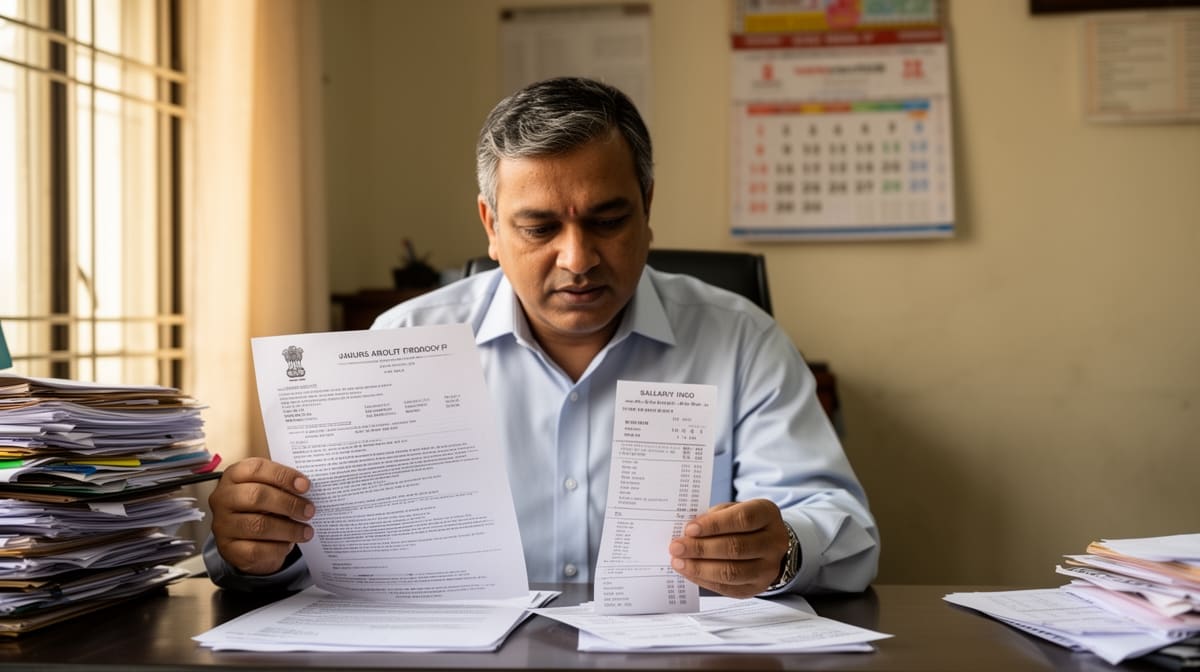
The Rajasthan High Court has reaffirmed that employers cannot withhold an employee's salary without a specific, communicated order, even when the employee is reassigned to lighter duties due to medical unfitness. This judgment reinforces the principle that salary payments must continue unless explicitly stopped by a lawful order, providing critical protection for employees facing arbitrary salary deductions.
Background & Facts
The Dispute
The petitioner, Ram Kishan, was appointed as a Conductor in the Rajasthan State Road Transport Corporation (RSRTC) on 05.07.2013. He served at the Jodhpur Depot until 2024, when he suffered a brachial plexus injury leading to Monoparesis (right upper limb). The Medical Board recommended light duties, and he was reassigned to office work at the Jodhpur Depot.
Key Facts
- The petitioner was appointed as Conductor on 05.07.2013 and served until 2024
- In 2024, he was diagnosed with Monoparesis (right upper limb) due to brachial plexus injury
- The Medical Board recommended light duties, and he was reassigned to office work
- On 09.10.2025, RSRTC issued a circular mandating 3000 km monthly driving for drivers/conductors but exempted medically unfit personnel via SMS Hospital examination
- Despite medical unfitness, the petitioner faced periodic transfers to route duties and daily duty charts assigning him driving
- His salary was withheld for non-compliance with driving duties due to health reasons
Procedural History
- The petitioner filed the present writ petition (S.B. Civil Writ Petition No. 12834/2026) seeking relief against salary withholding
- The matter was heard on 29.06.2026 before the Rajasthan High Court at Jodhpur
Relief Sought
The petitioner sought the following reliefs:
- Declaration that the impugned act of withholding salary is illegal, arbitrary, and unjust
- Reinstatement of full salary and prevention of any unfair action of salary withholding
- Refund of withheld salary with 18% per annum interest from the date of withholding
- Any other appropriate order or direction deemed just by the Court
- Costs of the writ petition
The Legal Issue
The central question was whether an employer can withhold an employee's salary without a specific, communicated order, particularly when the employee has been medically reassigned to lighter duties and continues to perform assigned work.
Arguments Presented
For the Petitioner
- The petitioner was appointed as Conductor and later reassigned to office duties due to medical unfitness
- Multiple Medical Boards consistently found him unfit for conductor duties
- Despite valid reassignment orders, the respondents withheld his salary without any specific order
- The issue is squarely covered by the Coordinate Bench decision in Azaz Ahmad v. Rajasthan State Road Transport Corporation & Ors. (SBCWP No. 24014/2025)
For the Respondent
- The respondents acknowledged that the petitioner's medical unfitness led to salary withholding
- However, they could not refute that the issue was covered by the judgment in Azaz Ahmad
The Court's Analysis
The Court relied on the Coordinate Bench decision in Azaz Ahmad, which authoritatively addressed the issue of salary withholding for medically reassigned employees. The Court reproduced the relevant paragraphs from Azaz Ahmad, emphasizing that:
"There is no justification for the respondents to withhold the salary of the petitioner when there is no specific order in this regard. As long as the petitioner is discharging his duties in the civil post as per the orders passed by the respondents, they are duty bound to extend the salary unless any other specific order is in force withholding the salary which has been communicated to the petitioner."
The Court noted that the petitioner was performing his assigned duties as per the respondents' orders, and there was no specific order communicated to him for withholding his salary. Thus, the respondents' action was arbitrary and illegal.
The Verdict
The writ petition was disposed of with the following directions:
- The respondents are directed to pay the arrears of salary to the petitioner
- The respondents shall continue to pay the regular salary until a proper decision is taken based on the opinion of a fresh Medical Board
- The petitioner may file a fresh representation within one week if not already filed
- The headquarters shall fix a date and time for the petitioner's appearance before a fresh Medical Board and intimate the same to him
- If the petitioner fails to appear before the Medical Board without reasonable cause, the respondents may take appropriate action
- If the Medical Board finds the petitioner unfit for driving duties, he shall not be assigned such duties and shall continue with lighter duties
- Liberty is granted to the respondents to seek recall of the salary payment direction if a specific order to withhold salary was passed in accordance with law
What This Means For Similar Cases
Salary Withholding Requires Specific, Communicated Order
- Employers cannot withhold salary based on general policies or circulars alone
- A specific order must be passed and communicated to the employee for salary withholding to be lawful
- This principle applies even when an employee is medically unfit and reassigned to lighter duties
Medical Reassignment Does Not Justify Salary Deduction
- Employees reassigned to lighter duties due to medical unfitness remain entitled to full salary
- Arbitrary salary deductions without a lawful order violate principles of natural justice and service law
- Employers must ensure compliance with medical board recommendations and reassignment orders
Precedent for Future Disputes
- The judgment in Azaz Ahmad and this case serve as binding precedents for similar disputes
- Employees facing arbitrary salary withholding can rely on these judgments to seek relief
- Employers must review their policies to ensure they align with the legal requirements established by these rulings