Gujarat High Court judgments

107 Gujarat High Court judgments explained in plain English: what was decided, the law applied and why it matters. Page 3 of 5.

Section 151 CPC | Inherent Power to Restore Possession to Lessee During Suit Pendency Upheld : Gujarat HC
Case Law Analysis
|Gujarat High Court

Section 151 CPC | Inherent Power to Restore Possession to Lessee During Suit Pendency Upheld : Gujarat HC

The Gujarat High Court affirmed that a trial court may invoke Section 151 CPC to return possession to a lessee who has been unlawfully dispossessed while the underlying suit is pending. It clarified that even a mis-stated statutory citation does not defeat the court’s inherent jurisdiction. This ruling safeguards lessees’ rights to possession during protracted litigation.


Gross negligence fails to satisfy Section 5 Limitation Act; 1,790-day condonation denied in land acquisition appeals | Gujarat HC
Case Law Analysis
|Gujarat High Court

Gross negligence fails to satisfy Section 5 Limitation Act; 1,790-day condonation denied in land acquisition appeals | Gujarat HC

The Gujarat High Court denied the State’s plea to condone a 1,790-day delay in land-acquisition appeals, holding that gross negligence is not a bona-fide cause under Section 5 of the Limitation Act. The ruling prevents governments from using negligence to revive time-barred appeals, impacting pending acquisition cases.

Section 307 IPC | Delayed FIR & Lack of Mens Rea Evidence Discharge Accused in Attempt to Murder Case : Gujarat HC
Case Law Analysis
|Gujarat High Court

Section 307 IPC | Delayed FIR & Lack of Mens Rea Evidence Discharge Accused in Attempt to Murder Case : Gujarat HC

Gujarat High Court discharged an accused under Section 307 IPC, ruling that a 30-month delay in filing the FIR, absence of injury, and lack of direct evidence of intent to kill failed to establish a prima facie case. The judgment reinforces that mere suspicion or rash driving does not suffice for attempt to murder charges without proof of mens rea.

Section 138 NI Act | Post-Conviction Settlement Permits Quashing with Costs : Gujarat HC Affirms Compoundability at Any Stage
Case Law Analysis
|Gujarat High Court

Section 138 NI Act | Post-Conviction Settlement Permits Quashing with Costs : Gujarat HC Affirms Compoundability at Any Stage

Gujarat High Court quashes conviction under Section 138 of the Negotiable Instruments Act even after appeal-stage settlement, but imposes Rs. 10,000 costs for delayed resolution. The ruling reaffirms that compoundable offences under Section 147 can be settled at any judicial stage, offering relief to accused while deterring frivolous litigation.

Section 227 CrPC | Legal Advice Without Knowledge of Age or Forgery Does Not Constitute Prima Facie Offence Under POCSO or Section 465 IPC : Gujarat HC
|Gujarat High Court

Section 227 CrPC | Legal Advice Without Knowledge of Age or Forgery Does Not Constitute Prima Facie Offence Under POCSO or Section 465 IPC : Gujarat HC

The Gujarat High Court discharged an advocate from POCSO and forgery charges, holding that merely advising marriage registration without actual knowledge of the victim’s minority or involvement in document fabrication cannot amount to a prima facie offence. This clarifies the boundary between professional legal assistance and criminal liability, offering critical protection to lawyers acting in good faith in sensitive family matters.

Hindu Marriage Validity Under Section 7 | Saptapadi & Datta Homa Mandatory for Legal Recognition : Gujarat HC Directs Certificate Correction
Case Law Analysis
|Gujarat High Court

Hindu Marriage Validity Under Section 7 | Saptapadi & Datta Homa Mandatory for Legal Recognition : Gujarat HC Directs Certificate Correction

The Gujarat High Court ruled that a Hindu marriage certificate must reflect the date of a legally complete ceremony, including essential rituals like Saptapadi and Datta Homa. The Court directed the Registrar to cancel an erroneous certificate issued based on an incomplete ceremony and issue a fresh one, reinforcing the mandatory nature of these rituals for legal validity.

Section 125 CrPC | Loan EMIs for Second Family Cannot Reduce Child Maintenance Obligation, Even if Mother Earns More : Gujarat HC
Case Law Analysis
|Gujarat High Court

Section 125 CrPC | Loan EMIs for Second Family Cannot Reduce Child Maintenance Obligation, Even if Mother Earns More : Gujarat HC

The Gujarat High Court ruled that a father’s financial obligations toward his minor children under Section 125 CrPC cannot be diminished by EMIs paid on loans taken to support a second family, regardless of the mother’s income or the children’s scholarships. This clarifies that maintenance liability is anchored in the child’s need and the father’s capacity, not in competing familial expenses.

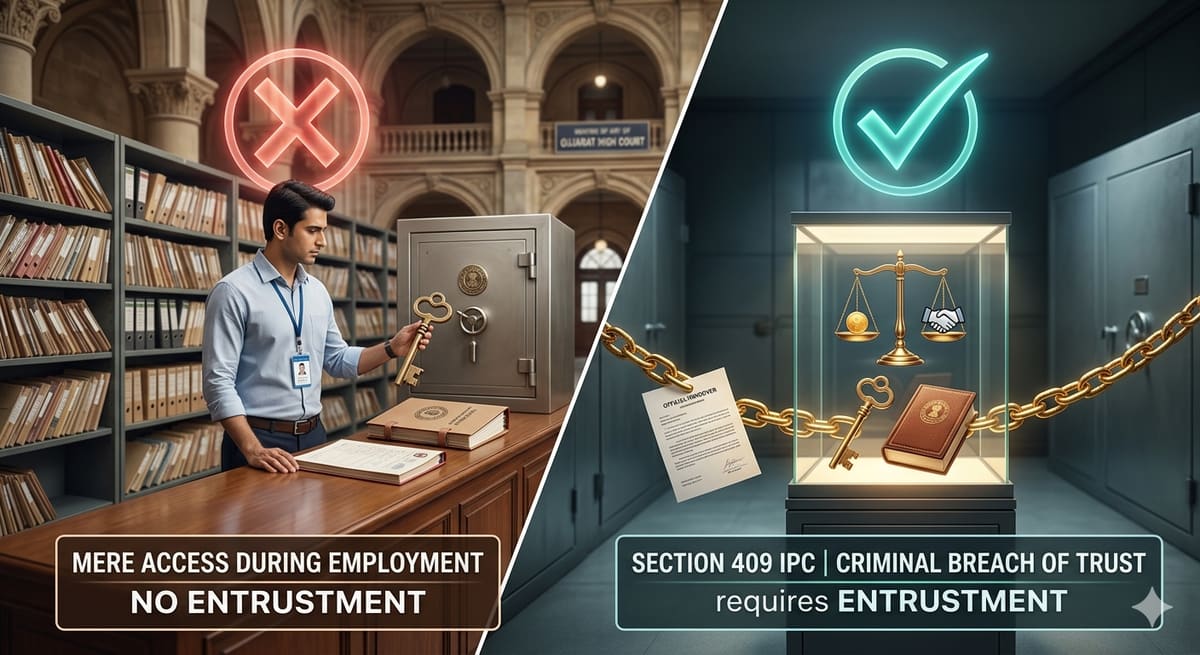
Section 409 IPC | Mere Access to Property During Employment Not Criminal Breach of Trust Without Entrustment : Gujarat HC
Case Law Analysis
|Gujarat High Court

Section 409 IPC | Mere Access to Property During Employment Not Criminal Breach of Trust Without Entrustment : Gujarat HC

Gujarat High Court discharges an employee accused under Sections 409 and 427 IPC, ruling that criminal breach of trust requires proof of entrustment and dishonest intent-mere access to property during employment is insufficient. The judgment clarifies the essential elements of Sections 405 and 409 IPC, impacting employers and employees in similar disputes.

Article 226 & Trademark Act | Mandamus for Speedy Disposal of Pending Applications Within 3 Months : Gujarat HC
Case Law Analysis
|Gujarat High Court

Article 226 & Trademark Act | Mandamus for Speedy Disposal of Pending Applications Within 3 Months : Gujarat HC

Gujarat High Court holds that prolonged delays in trademark application disposal violate constitutional rights under Articles 14, 19(1)(g), and 21, directing authorities to adjudicate pending applications within three months. The ruling sets a precedent for judicial intervention in administrative lethargy affecting intellectual property rights.

Roster System Overrides Doctrine of Consistency | Successive Bail Applications Need Not Be Heard by Same Bench: Gujarat HC
Case Law Analysis
|Gujarat High Court

Roster System Overrides Doctrine of Consistency | Successive Bail Applications Need Not Be Heard by Same Bench: Gujarat HC

The Gujarat High Court ruled that the Chief Justice’s roster authority prevails over the doctrine of consistency in successive bail applications, dismissing a plea for mandatory same-bench hearings. The decision underscores administrative discretion in judicial assignments, even where prior Supreme Court precedent suggested doctrinal uniformity.

Section 15 Births and Deaths Registration Act | Registrars Must Correct Substantive Birth Certificate Errors on Affidavit Evidence; No Mandate to Approach Court : Gujarat HC
Case Law Analysis
|Gujarat High Court

Section 15 Births and Deaths Registration Act | Registrars Must Correct Substantive Birth Certificate Errors on Affidavit Evidence; No Mandate to Approach Court : Gujarat HC

The Gujarat High Court has ruled that registrars under the Births and Deaths Registration Act, 1969, have a non-discretionary duty to correct substantive errors in birth certificates upon submission of affidavits from two credible persons. This clarifies that administrative authorities cannot evade their statutory obligations by directing applicants to file writ petitions - reinforcing accountability in civil registration systems.

Section 302 IPC & Section 27 Evidence Act | Relative Witnesses' Testimony Not Inherently Unreliable; Recovery of Weapon Admissible Even Without Confession: Gujarat HC
Case Law Analysis
|Gujarat High Court

Section 302 IPC & Section 27 Evidence Act | Relative Witnesses' Testimony Not Inherently Unreliable; Recovery of Weapon Admissible Even Without Confession: Gujarat HC

The Gujarat High Court affirmed that testimony from relatives of the accused carries no automatic presumption of unreliability in murder cases, and that recovery of a weapon under Section 27 of the Evidence Act is valid for establishing discovery - even when the accused’s confession of use is excluded as inadmissible. This clarifies evidentiary standards for prosecutors and defense counsel in cases relying on circumstantial evidence and kin testimony.

Forest Rights Act, 2006 | Coercive Eviction Stayed During Statutory Revision; Natural Justice Requires Pause Until Decision: Gujarat HC
Case Law Analysis
|Gujarat High Court

Forest Rights Act, 2006 | Coercive Eviction Stayed During Statutory Revision; Natural Justice Requires Pause Until Decision: Gujarat HC

The Gujarat High Court has halted all demolition and eviction actions against tribal families while their land rights claims are under statutory review under the Forest Rights Act, 2006. This stay upholds the Act’s protective intent and enforces natural justice by preventing irreversible harm before a final determination, directly safeguarding the livelihoods of generations-old forest-dwelling communities.

Section 227 CrPC | Inconsistent Dying Declarations Do Not Defeat Prima Facie Case at Charge Stage: Gujarat HC
Case Law Analysis
|Gujarat High Court

Section 227 CrPC | Inconsistent Dying Declarations Do Not Defeat Prima Facie Case at Charge Stage: Gujarat HC

The Gujarat High Court holds that minor inconsistencies in a dying declaration and post-mortem alcohol levels cannot derail a prima facie case under Section 227 CrPC, reinforcing that discharge applications at this stage must not become tools for re-litigating evidence. This clarifies that courts must assess sufficiency, not credibility, when framing charges - protecting prosecution from procedural abuse through repeated discharge pleas.

Electoral Roll Synchronization Mandatory | Gujarat HC Rules Municipal Voters Must Mirror Assembly Rolls Even Post-Preliminary List : Gujarat HC
Case Law Analysis
|Gujarat High Court

Electoral Roll Synchronization Mandatory | Gujarat HC Rules Municipal Voters Must Mirror Assembly Rolls Even Post-Preliminary List : Gujarat HC

Gujarat High Court holds that inclusion in the Legislative Assembly electoral roll automatically entitles a voter to municipal roll inclusion, even if added after the preliminary list, provided it occurs before the nomination deadline. The ruling reinforces the State Election Commission's duty to synchronize rolls, ensuring no voter is disenfranchised due to procedural delays.

Exhaustion of Remedies Mandatory Under Forest Rights Act Before Writ Petition : Gujarat HC
Case Law Analysis
|Gujarat High Court

Exhaustion of Remedies Mandatory Under Forest Rights Act Before Writ Petition : Gujarat HC

The Gujarat High Court dismissed a writ petition under the Forest Rights Act, 2006, ruling that petitioners must first exhaust all statutory remedies, including Gram Sabha applications, before approaching the court. The judgment reinforces the principle that judicial intervention is premature without availing administrative redress mechanisms, impacting forest-dwelling communities seeking land rights.

Registration of Births and Deaths Act | Conclusive Evidence of Death Suffices for Death Certificate Even Without Body Recovery: Gujarat HC
Case Law Analysis
|Gujarat High Court

Registration of Births and Deaths Act | Conclusive Evidence of Death Suffices for Death Certificate Even Without Body Recovery: Gujarat HC

Gujarat High Court rules that under the Registration of Births and Deaths Act, 1969, a death certificate can be issued based on police certification and family identification alone, even if the body is not recovered. The judgment clarifies that conclusive evidence of death overrides the requirement of physical body recovery, impacting families seeking legal recognition of death for inheritance, insurance, and administrative purposes.