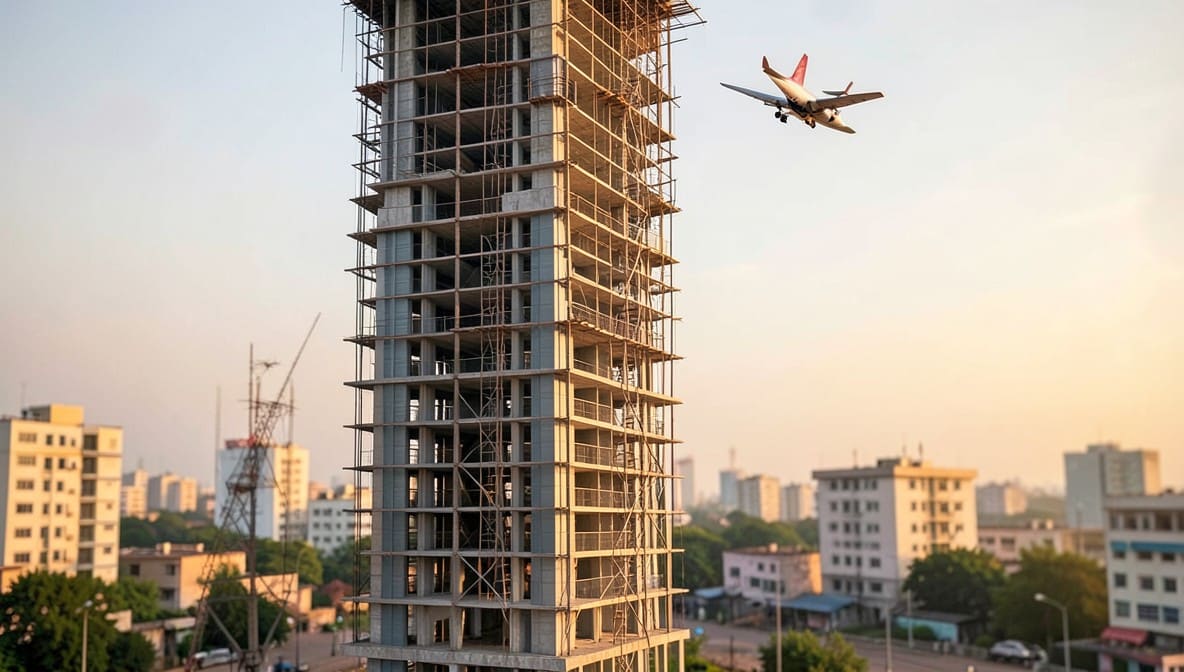
The Gujarat High Court has established a critical legal principle: statutory authorities cannot mandate demolition of structures alleged to exceed aviation height limits without first conducting an aeronautical study to determine actual risk to aircraft operations. This judgment reorients the procedural balance in aviation safety disputes, prioritizing evidence-based assessment over punitive compliance.
Background & Facts
The Dispute
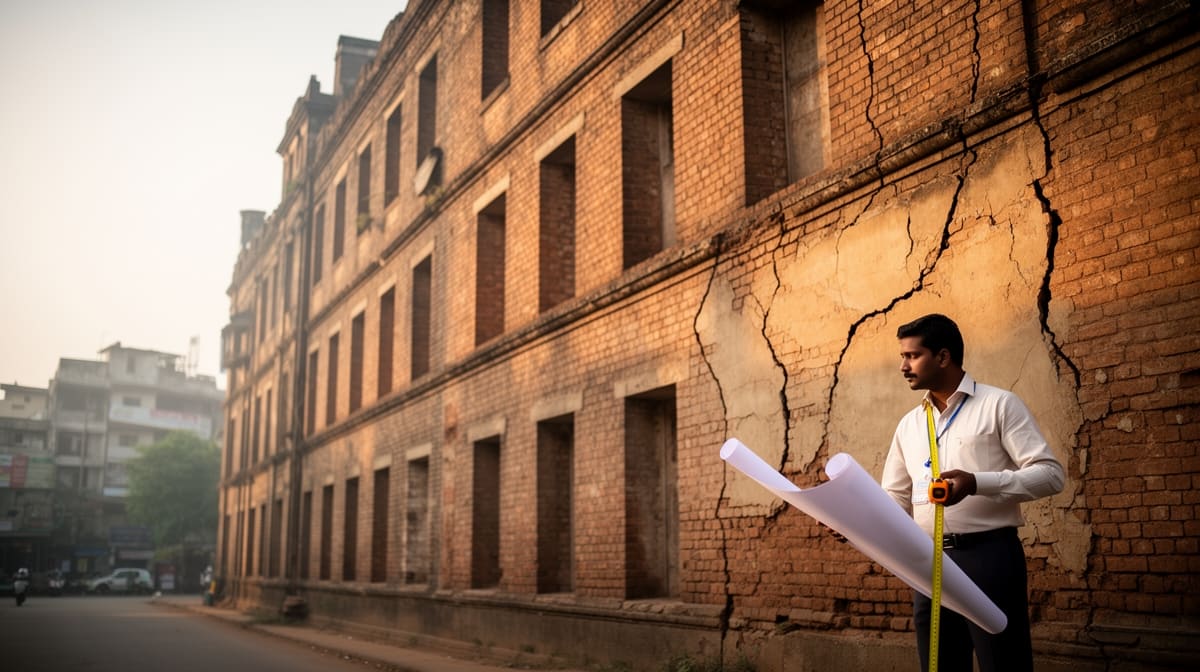
Multiple real estate developers, all partnership firms engaged in construction in Ahmedabad’s suburban areas, faced enforcement actions by the Airport Authority of India (AAI) and Ahmedabad Municipal Corporation for alleged violations of height restrictions under the Ministry of Civil Aviation (Height Restrictions for Safeguarding of Aircraft Operations) Rules, 2015. The core dispute arose not from unauthorized construction, but from discrepancies between the permitted top elevation (above mean sea level) and the measured top elevation of completed buildings. The petitioners contended that the increase in measured elevation was due to revised ground level surveys, not additional construction.
Key Facts
- All petitioners constructed buildings strictly in accordance with development permissions granted by the Ahmedabad Municipal Corporation and/or Ahmedabad Urban Development Authority.
- NOCs were issued by AAI between 2019 and 2020, permitting top elevations of 102.7 meters above mean sea level (AMSL), based on site elevations declared by petitioners at the time of application.
- Post-construction surveys by AAI in 2022 - 2024 revealed top elevations exceeding 102.7 meters by 3.98 to 4.88 meters across projects.
- Petitioners’ explanation: The ground elevation at the site, as recorded in subsequent surveys, had increased from the original figures submitted during NOC applications, thereby increasing the total top elevation despite unchanged building heights.
- No petitioners added floors or structural elements beyond sanctioned plans.
- Multiple projects in the same vicinity (e.g., Ornet Heights, Maple Heights, Sub Plot No. 1/2 of Survey No. 20) were granted revised NOCs permitting top elevations up to 114.51 meters.
- Aerodrome Safeguarding Circular (ADSAC) 08 of 2020 required appeals for revised NOCs to be filed online only if the structure was brought into compliance with the original NOC - a condition petitioners could not meet without demolition.
- Petitioners repeatedly requested aeronautical studies at their own cost to determine whether the structures posed actual hazards to air navigation.
- AAI refused to conduct such studies, insisting on demolition of the alleged excess portion as a precondition.
- In Special Civil Application No. 4052 of 2024, the Appellate Committee rejected the petitioner’s application for revised NOC on 15.12.2023, communicated only on 30.01.2024 - after an impugned order dated 15.01.2024 had already been issued without reference to the decision.
- No opportunity of hearing was afforded to petitioners prior to rejection of revised NOC applications or issuance of demolition notices.
Procedural History
- 2019 - 2020: NOCs issued by AAI for all projects based on declared site elevations.
- 2020 - 2022: Construction completed in full compliance with municipal permissions.
- 2022 - 2023: AAI issued notices to multiple petitioners alleging height violations.
- 2022 - 2024: Petitioners submitted representations requesting aeronautical studies; all were rejected.
- 2023 - 2024: Revised NOC applications filed under Rule 6A; rejected without reasons or hearings.
- 2024: Multiple writ petitions filed before Gujarat High Court under Articles 14, 19(1)(g), 21, 226 and 227.
- 30.04.2026: Judgment delivered by Justice Hemant M. Prachchhak.
The Parties' Positions
For the Petitioners
- Construction was lawful and within municipal permissions.
- Height discrepancy resulted from revised ground elevation data, not unauthorized construction.
- Aeronautical study is mandatory under Rule 5, Schedule II of the 2015 Rules to determine actual hazard.
- Denial of study without hearing violates principles of natural justice.
- Discriminatory treatment: similarly situated projects received revised NOCs.
- Demolition as precondition is not mandated by statute.
For the Respondents (AAI & Others)
- Petitioners violated NOC conditions by exceeding 102.7 meters AMSL.
- ADSAC 08 of 2020 bars consideration of revised NOC or aeronautical study unless structure is brought into compliance.
- Petitioners are estopped from disputing ground elevation data they submitted.
- No statutory obligation to conduct study before demolition.
- Aviation safety requires strict adherence to NOC limits.
Relief Sought
- Direction to AAI to conduct an aeronautical study at petitioners’ cost.
- Quashing of demolition notices and rejection orders.
- Stay on enforcement of demolition orders.
- Direction to reconsider revised NOC applications after aeronautical study.
- Declaration that refusal to study violates Articles 14 and 21 of the Constitution.
The Legal Issue
Can the Airport Authority of India refuse to conduct an aeronautical study to assess whether a structure poses a hazard to aircraft operations, solely on the ground that the structure exceeds the top elevation permitted under a No Objection Certificate, without first determining actual risk - and can it insist on demolition as a precondition for such study?
Arguments Presented
For the Appellant/Petitioner
The petitioners relied on Clause 5 of Schedule II of the Ministry of Civil Aviation (Height Restrictions for Safeguarding of Aircraft Operations) Rules, 2015, which explicitly permits an aeronautical study to determine whether an existing object adversely affects aircraft safety. They argued that the Rules contemplate a risk-based assessment, not a rigid height enforcement regime. They cited KGA Investments v. Union of India and M/s Rajasthan Patrika Private Limited v. Union of India from the Delhi High Court, where similar refusals were held arbitrary. They emphasized that the 2015 Rules do not contain any provision mandating demolition before study. They further contended that the refusal to consider their applications, while granting revised NOCs to similarly situated projects, violated Article 14 of the Constitution. The petitioners offered to bear the cost of the study (Rs. 20 lakhs plus GST as per ADSAC 05 of 2020) and undertake compliance if the study found a hazard.
For the Respondent/State
The respondents relied on Clause 6.2.1 of ADSAC 08 of 2020, which bars consideration of revised NOC applications if the applicant has violated the terms of the original NOC. They argued that the petitioners’ construction exceeded the permitted top elevation, thereby triggering this bar. They contended that the ground elevation data submitted by petitioners was binding and could not be disputed post-construction. They asserted that aviation safety demands strict compliance and that allowing retrospective regularization would encourage violations. They maintained that the petitioners had an alternative remedy under Rule 6A of the 1994 Rules and that the refusal to conduct a study was not arbitrary but procedurally mandated.
The Court's Analysis
The Court undertook a rigorous analysis of the statutory framework, the circulars, and the constitutional principles of equality and natural justice. It began by acknowledging that while the petitioners’ structures exceeded the 102.7 meters AMSL limit, the dispute centered on whether this was due to unauthorized construction or a change in the baseline - the ground elevation - which was not under the petitioners’ control.
The Court observed that the 2015 Rules were designed to ensure aviation safety through a risk-based assessment, not through mechanical enforcement of height limits. Clause 5 of Schedule II explicitly contemplates aeronautical studies for existing objects, indicating legislative intent to evaluate actual hazard, not merely compliance with a static number.
The Court then examined the ADSAC 08 of 2020, which the respondents relied upon to deny study requests. It held that circulars cannot override statutory rules. Where the Rules permit study for existing objects, a circular cannot impose an additional condition - such as prior demolition - that is not found in the statute. The Court emphasized: "A circular cannot create a new statutory obligation or restrict a right conferred by a rule."
"The insistence of the respondents that the petitioners must first remove the objectionable portion of the construction before any such survey is conducted is unjustified and untenable in the facts of the present case."
The Court further noted that the respondents had granted revised NOCs to other similarly situated projects, including those in the same survey number and town planning scheme. This differential treatment, without any stated rationale, amounted to arbitrary and discriminatory action under Article 14.
The Court also found a gross violation of natural justice in Special Civil Application No. 4052 of 2024, where an order was passed on 15.01.2024 without reference to a decision dated 15.12.2023, which was communicated only on 30.01.2024. The petitioner was denied any opportunity to be heard before the rejection of its revised NOC application, violating Rule 6A and fundamental principles of fair procedure.
The Court explicitly endorsed the reasoning of the Delhi High Court in KGA Investments, Rajasthan Patrika, and Manav Infrastructure, noting that these decisions were consistent with the statutory scheme and the constitutional imperative of reasonableness. It held that the respondents’ refusal to conduct a study was not merely procedural but substantive - it deprived petitioners of a meaningful remedy.
The Court concluded that the burden of proof lies with the authority to establish actual risk, not with the petitioner to prove non-risk by demolishing a lawful structure. The aeronautical study is the only objective mechanism to determine whether a structure poses a hazard. Without it, any demolition order is speculative and unlawful.
The Verdict
The petitions were allowed. The Gujarat High Court quashed all notices and orders directing demolition of the structures pending the aeronautical study. The Airport Authority of India is directed to conduct an aeronautical study at the petitioners’ cost, within 12 weeks from the date of this judgment. The study must be carried out by the International Civil Aviation Organization or an agency designated by AAI. Upon receipt of the study report, the Authority must reconsider the revised NOC applications and pass a fresh, speaking order determining the maximum permissible height of each structure. If the study concludes that the structure poses a hazard to aircraft operations, the Authority may then direct removal of the excess portion at the petitioner’s cost. All pending enforcement actions are stayed pending completion of the study.
What This Means For Similar Cases
Aeronautical Study Is Not Discretionary - It Is Mandatory
- Practitioners must now argue that any refusal to conduct a study under the 2015 Rules is ultra vires if the structure is an existing object.
- The burden shifts to the authority to prove hazard - not to the developer to prove safety by demolition.
- A request for study at the petitioner’s cost, coupled with willingness to comply with findings, must be accepted.
Discrimination in Height Clearance Decisions Is Unlawful
- Granting revised NOCs to some projects while denying identical requests to others, without reasoned distinction, violates Article 14.
- Developers must document and cite instances of differential treatment in writ petitions.
- Authorities must record reasons for granting or denying revised NOCs - silence is fatal.
Procedural Compliance Is Non-Negotiable
- No hearing before rejection of revised NOC = void order.
- Communication of decisions after issuance of orders is a procedural fraud.
- Circulars like ADSAC 08 cannot override statutory rules - courts will strike down such overreach.
- Petitioners should always seek stay on demolition notices pending study, not merely challenge the notice itself.