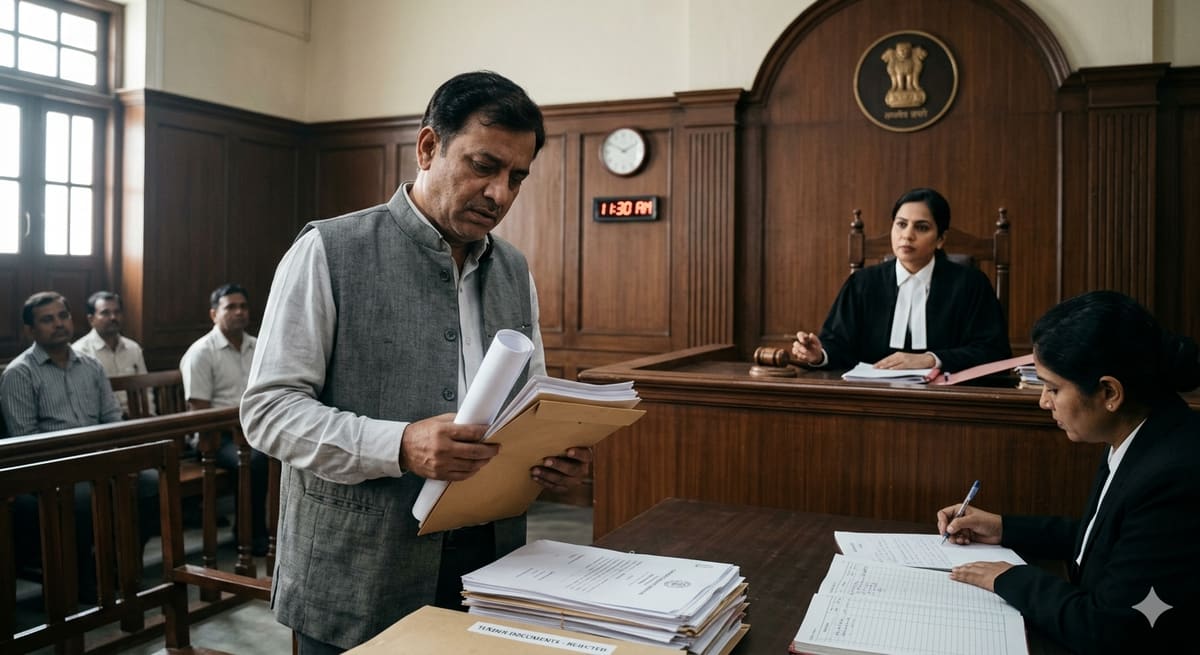
The Gauhati High Court has affirmed that a tender cannot be cancelled without complying with the statutory duty to communicate reasons under Section 26(3) of the Assam Public Procurement Act, 2017, and has ordered the work to be allotted to the petitioner who was the lowest evaluated bidder.
Background & Facts
The Dispute
The petitioner, Dipak Sarma, submitted a bid for the first package of a road construction project under the ASOM MALA scheme. After his technical bid was found responsive and his financial bid adjudged as the lowest (L1), the Public Works Department (PWD) failed to issue a Letter of Intent and later cancelled the tender, issuing a fresh tender notice.
Key Facts
- 17.10.2025: Tender notice floated by the Chief Engineer (Roads) for two packages.
- 19.11.2025: Court order in WP(C)/6450/2025 directed issuance of a site-visiting certificate to the petitioner.
- Date of bid submission: Prior to 17.10.2025, petitioner submitted technical and financial bids.
- Technical evaluation: Petitioner found technically responsive.
- Financial evaluation: Petitioner’s bid adjudged L1, approximately Rs. 7 crore lower than the second bidder.
- No Letter of Intent issued after financial bids were opened.
- 12.02.2026: Re-tender notice issued, cancelling the earlier tender.
- 18.03.2026: Affidavit-in-opposition filed by the State.
- December 2025: Representation made by the local MLA to PWD for changing construction methodology.
- 24.12.2025: Fresh estimate prepared by the Superintending Engineer.
- 29.01.2026: Report on revised estimate dated.
- 16.07.2026: Judgment reserved.
- 03.08.2026: Judgment pronounced.
Procedural History
- 17.10.2025: Tender notice issued.
- 19.11.2025: WP(C)/6450/2025 filed; Court ordered issuance of site-visiting certificate.
- Date unspecified: Petitioner’s bid declared technically responsive and financially L1.
- First writ petition: WP(C)/712/2026 filed to compel issuance of Letter of Intent.
- 12.02.2026: Re-tender notice issued; second writ petition WP(C)/948/2026 filed challenging the cancellation.
- 18.03.2026: State filed affidavit-in-opposition.
- 16.07.2026: Judgment reserved.
- 03.08.2026: Judgment delivered.
Parties' Positions
- Petitioner: Argues that cancellation violated Section 26(3) of the Assam Public Procurement Act, 2017, which mandates immediate communication of reasons to all bidders. Claims the action was arbitrary, motivated by MLA intervention, and that the price differential of Rs. 7 crore demonstrates mala-fide intent.
- Respondent (State of Assam & PWD): Contends the cancellation was based on public interest, citing a change to Cement Treated Sub-Base (CTSB) technology after the financial bids were opened. Argues that no vested right accrued to the petitioner and that procedural lapse under Section 26(3) is merely a procedural defect, not a nullity.
Relief Sought
The petitioner seeks a declaration that the re-tender order dated 12.02.2026 is void, an order directing that the work be allotted to him as the L1 bidder, and costs of the proceedings.
The Legal Issue
Whether the failure to communicate reasons for cancellation as required by Section 26(3) of the Assam Public Procurement Act, 2017 renders the cancellation void and entitles the petitioner, who was adjudged the lowest evaluated bidder, to be awarded the contract.
Arguments Presented
For the Petitioner
- Reliance on Section 26(3) mandating immediate communication of reasons for cancellation.
- Cites Subodh Kumar Singh Rathour v. Chief Executive Officer & Ors. (AIR 2024 SC 3784) for the principle that arbitrary cancellation without cogent material is unlawful.
- Emphasises the price differential of Rs. 7 crore and the alleged MLA influence as evidence of mala-fide intent.
- Argues that the change in technology after financial bids were opened violates the sanctity of the tender process.
For the Respondent
- Argues that the change to CTSB technology serves public interest and was recommended by the local MLA.
- Maintains that no vested right accrues to a bidder merely because his bid is L1, citing Haryana Urban Development Authority v. Orchid Infrastructure Developers (2017) 4 SCC 243.
- Claims that non-communication of reasons under Section 26(3) is a procedural irregularity that does not invalidate the cancellation.
- Points to Sections 27(3) and 27(4) of the Act as providing discretion to the authority.
The Court's Analysis
The Court began by reaffirming the doctrine of public trust and the sanctity of public tenders as articulated by the Supreme Court. It noted that the procurement framework is designed to ensure transparency, competition, and fairness, and that any deviation must be supported by cogent material.
"The sanctity of public tenders lies in their role in upholding the principles of equal opportunity and fairness. Once a contract has come into existence through a valid tendering process, its termination must adhere strictly to the terms of the contract..."
The Court examined the statutory language of Section 26(3), which expressly requires that "reasons for cancellation shall be communicated immediately to all bidders". The Court held that this provision is mandatory, not directory, because it safeguards the bidders' right to a fair process. The absence of any communication to the petitioner was deemed a clear breach.
Reference was made to Subodh Kumar Singh Rathour where the Supreme Court stressed that cancellation must be grounded in real public interest and supported by material evidence. The present case lacked any file-notings or internal memos justifying the cancellation; only a photocopy of documents and an affidavit-in-opposition were produced. The Court found this insufficient to demonstrate a genuine public-interest rationale.
The Court also rejected the State’s reliance on Haryana Urban Development Authority for the proposition that the highest (or lowest) bidder has no vested right. While the Supreme Court held that a bid does not create an automatic entitlement, it also emphasized that the authority must act "fairly, transparently, and without arbitrariness". Here, the arbitrary change of technology after the financial bids were opened, coupled with the alleged MLA influence, amounted to mala-fide conduct.
The Court distinguished the State’s argument that Section 26(3) is merely procedural. It observed that the statutory duty is integral to the procurement process; non-compliance defeats the very purpose of the Act and cannot be brushed aside as a harmless irregularity.
Consequently, the Court concluded that the cancellation order dated 12.02.2026 was void, the tender process up to the award of the L1 status remained valid, and the work must be allotted to the petitioner.
The Verdict
The Gauhati High Court set aside the impugned order dated 12.02.2026, held that the cancellation violated Section 26(3) of the Assam Public Procurement Act, 2017, and directed that the road-construction work be allotted to the petitioner, who was adjudged the lowest evaluated bidder. No costs were awarded.
What This Means For Similar Cases
Compliance with Section 26(3) Is Mandatory
- Authorities must issue a written communication of reasons for any tender cancellation immediately after the decision.
- Failure to do so renders the cancellation void, irrespective of any claimed public-interest justification.
No Automatic Vested Right, But Protection Against Arbitrary Cancellation
- While a bidder does not acquire a vested right merely by being L1, the authority cannot arbitrarily discard the bid without substantive, documented reasons.
- Courts will scrutinise internal file-notings and will not accept photocopies or affidavits as a substitute for proper records.
Judicial Scrutiny of Mala-Fide Motives
- Allegations of political or personal influence must be substantiated with documentary evidence; otherwise, the court may infer mala-fide.
- Practitioners should ensure that any change in technical specifications after financial bids are opened is justified, recorded, and communicated to all bidders.