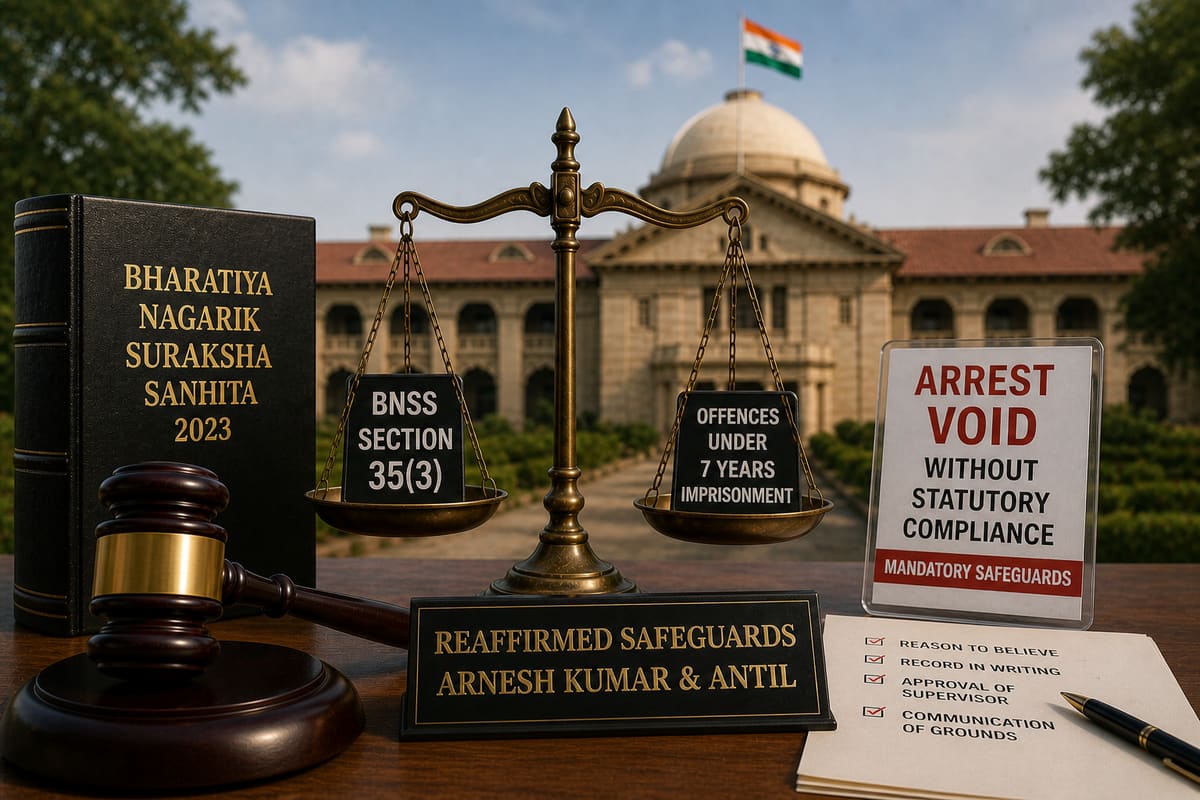
The Allahabad High Court has reinforced that arrest for offences punishable by less than seven years cannot be automatic, even if the offence is cognizable. Relying on Supreme Court precedents in Arnesh Kumar v. State of Bihar and Satender Kumar Antil v. CBI, the Court disposed of a writ petition while directing the petitioners to cooperate with the investigation, failing which the protection granted may be withdrawn.
Background & Facts
The Dispute
The petitioners, Jyoti Srivastava and two others, sought protection from arrest in connection with FIR Case Crime No. 0104 of 2026, registered at Police Station Saadatganj, Lucknow, under Sections 115(2), 352, 351(2), and 191(2) of the Bharatiya Nyaya Sanhita (BNS). The offences alleged carry a maximum punishment of less than seven years' imprisonment. The petitioners did not challenge the FIR but prayed for the benefit of the principles laid down in Arnesh Kumar and Satender Kumar Antil to avoid arrest.
Key Facts
- FIR Details: Registered on an unspecified date under BNS Sections 115(2), 352, 351(2), and 191(2)
- Offences: All offences carry a maximum punishment of less than seven years' imprisonment
- Petitioners' Stand: Did not contest the FIR but sought protection from arrest under Section 35 of the Bharatiya Nagrik Suraksha Sanhita (BNSS), 2023
- Judgments Relied Upon: Arnesh Kumar v. State of Bihar and Satender Kumar Antil v. CBI
Procedural History
- Filing of FIR: Case Crime No. 0104 of 2026 under the aforementioned BNS provisions
- Writ Petition: Criminal Misc. Writ Petition No. 5455 of 2026 filed before the Allahabad High Court, Lucknow Bench
- Hearing Date: June 4, 2026
- Order: Petition disposed of with directions for cooperation in investigation
Relief Sought
The petitioners sought protection from arrest, relying on the legal principles established in Arnesh Kumar and Satender Kumar Antil, which mandate compliance with Section 35 of BNSS, 2023 for offences punishable by less than seven years.
The Legal Issue
The central question was whether Section 35 of the BNSS, 2023 permits automatic arrest for offences punishable by less than seven years' imprisonment, or whether the investigating agency must comply with the conditions laid down in the statute and Supreme Court precedents before effecting such an arrest.
Arguments Presented
For the Petitioners
- Argued that the offences in the FIR carry a maximum punishment of less than seven years, and thus, arrest cannot be automatic
- Relied on Arnesh Kumar v. State of Bihar and Satender Kumar Antil v. CBI, which hold that arrest for such offences must comply with Sections 41 and 41-A of the CrPC (now Section 35 of BNSS, 2023)
- Contended that the investigating agency must satisfy the conditions under Section 35(1)(b) of BNSS, 2023 before effecting an arrest
For the Respondent/State
- The State, represented by the learned Additional Government Advocate (A.G.A.), did not contest the petitioners' reliance on the Supreme Court precedents
- The respondent no. 4 was represented by counsel but notice to them was dispensed with in view of the proposed order
The Court's Analysis
The Court examined Section 35 of the BNSS, 2023, which governs the conditions under which an arrest can be made. The Court noted that the Supreme Court, in Arnesh Kumar and Satender Kumar Antil, had categorically held that arrest for offences punishable by less than seven years cannot be automatic. Instead, the investigating agency must comply with the statutory conditions before effecting an arrest.
The Court observed:
"For effecting an arrest, qua an offence punishable with imprisonment up to seven years, the mandate of Section 35(1)(b)(i) of BNSS, 2023 along with any one of the conditions mentioned in Section 35(1)(b)(ii) of the BNSS, 2023 must be in existence and further if the circumstances warranting an arrest of a person are available in terms of the conditions mentioned under Section 35(1)(b) of the BNSS, 2023, the arrest shall not be undertaken, unless it is absolutely warranted."
The Court further emphasized that the investigating agencies and their officers are duty-bound to comply with the mandate of Section 35(3) of BNSS, 2023 (equivalent to Sections 41 and 41-A of the CrPC), as reiterated in the Supreme Court judgments.
The Verdict
The Court disposed of the writ petition with the following directions:
- The petitioners shall appear before the Investigating Officer of the concerned police station whenever required to cooperate in the investigation
- The petitioners shall continue to cooperate in the investigation till its completion
- If the petitioners fail to cooperate, the protection granted under this order may be withdrawn upon an application moved by the prosecution or the complainant
The Court did not quash the FIR but granted protection from arrest subject to the petitioners' cooperation in the investigation.
What This Means For Similar Cases
Arrest Not Automatic for Offences Under Seven Years
- Statutory Compliance: Investigating agencies must strictly comply with Section 35 of BNSS, 2023 before effecting an arrest for offences punishable by less than seven years. Mere registration of an FIR does not justify automatic arrest
- Conditions Precedent: The conditions under Section 35(1)(b)(i) and (ii) of BNSS, 2023 must be satisfied before an arrest can be made. This includes assessing whether the arrest is absolutely warranted
- Judicial Scrutiny: Courts will scrutinize whether the investigating agency has complied with the statutory conditions before upholding an arrest. Non-compliance may lead to the quashing of arrest orders or grant of bail
Cooperation in Investigation as a Safeguard
- Conditional Protection: The Court's order granting protection from arrest is conditional upon the petitioners' cooperation in the investigation. Practitioners should advise clients to comply with investigation requirements to avoid withdrawal of protection
- Withdrawal of Protection: If the accused fails to cooperate, the prosecution or complainant can move an application for withdrawal of protection, which may result in arrest
- Strategic Advice: Defense counsel should ensure that clients understand the importance of cooperation while also challenging any unjustified arrest attempts under Section 35 of BNSS, 2023
Precedential Value of Arnesh Kumar and Satender Kumar Antil
- Binding Nature: The principles laid down in Arnesh Kumar and Satender Kumar Antil continue to hold precedential value under the new BNSS regime. Courts are bound to follow these judgments unless distinguished or overruled
- Applicability to BNSS: While these judgments were rendered under the CrPC, their ratio applies mutatis mutandis to Section 35 of BNSS, 2023, which is the successor provision to Sections 41 and 41-A of the CrPC
- Defense Strategy: Defense counsel should invoke these judgments in bail applications and writ petitions challenging arrests for offences punishable by less than seven years, emphasizing the need for statutory compliance by investigating agencies