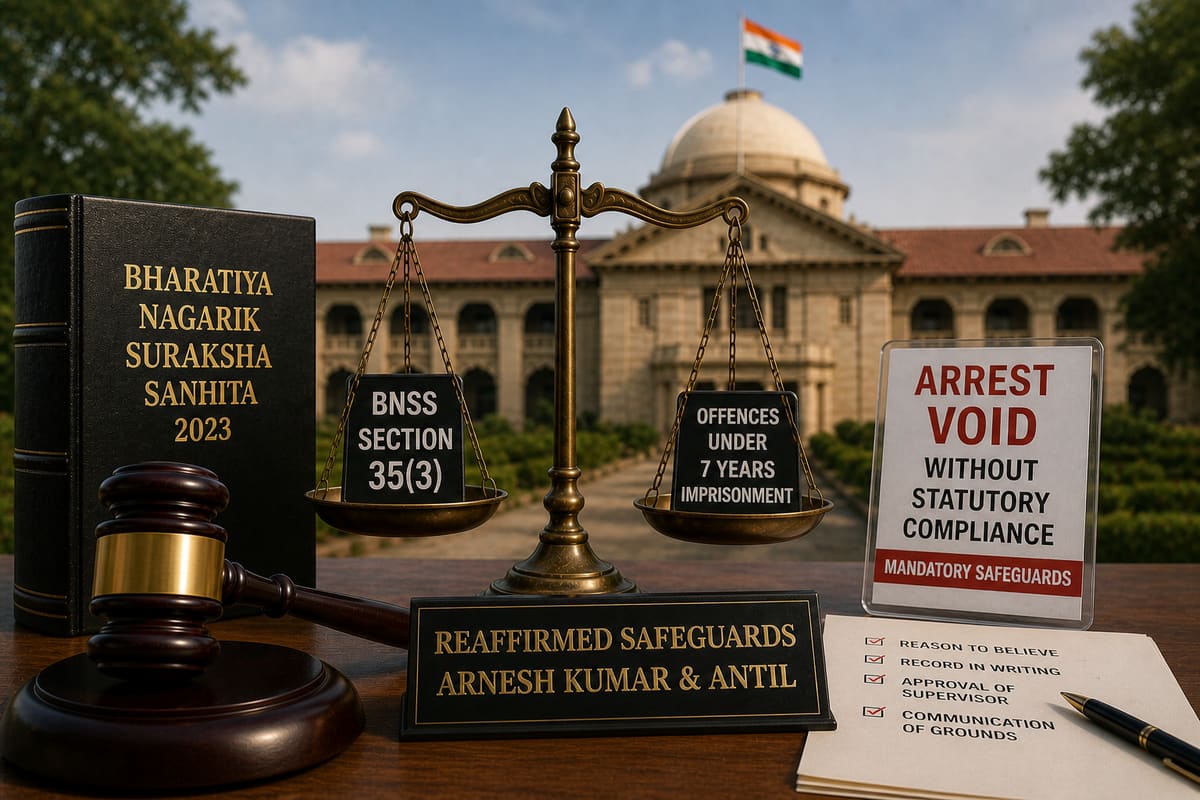
The Allahabad High Court has reaffirmed that arrest in non-bailable offences under the Bhartiya Nagrika Suraksha Sanhita, 2023, cannot be made mechanically, even where the FIR prima facie discloses an offence. The Court emphasized strict adherence to procedural safeguards under the CrPC and binding precedents on preventive arrest, reinforcing the principle that liberty must not be curtailed without due justification.
Background & Facts
The Dispute
The petitioners, Somnath and another, challenged the First Information Report (FIR) dated 24.03.2026, registered at Police Station-Sector 142, District-Gautam Budh Nagar, under Sections 223, 329(3), and 351(2) of the Bhartiya Nagrika Suraksha Sanhita, 2023 (B.N.S. 2023). The FIR arose from an alleged incident involving unlawful assembly and obstruction of public duty. The petitioners sought quashing of the FIR on grounds of abuse of process and lack of credible evidence.
Key Facts
- The FIR was registered on 24.03.2026 following a complaint by a public official
- The alleged offences under B.N.S. 2023 are punishable with imprisonment up to seven years
- No arrest had been made at the time of filing the writ petition
- The Additional Government Advocate confirmed that the charge-sheet had been forwarded to the Circle Officer, indicating ongoing investigation
- The petitioners were not named as accused in any prior complaint or criminal record
Procedural History
- 24.03.2026: FIR No. 051 of 2026 registered under Sections 223, 329(3), and 351(2) of B.N.S. 2023
- 15.04.2026: Charge-sheet submitted to Circle Officer, indicating investigation is active
- 10.05.2026: Writ petition filed before the Allahabad High Court seeking quashing of FIR
- 29.05.2026: Hearing before Division Bench of Justices Achal Sachdev and Salil Kumar Rai
The Parties' Positions
For the Petitioners
- Argued that the FIR was vague, lacked specific allegations, and was filed without proper verification
- Contended that the offences, though non-bailable, did not warrant immediate arrest
- Relied on Arnesh Kumar v. State of Bihar to assert that arrest must be a last resort
- Sought quashing to prevent harassment and abuse of process
For the Respondent (State)
- Submitted that the FIR prima facie disclosed offences under B.N.S. 2023
- Stated that investigation was ongoing and charge-sheet had been forwarded to Circle Officer
- Argued that quashing at this stage would prejudice the investigation
- Did not oppose compliance with procedural safeguards but maintained the FIR was legally valid
Relief Sought
The petitioners sought quashing of FIR No. 051 of 2026 and a direction that no arrest be made without compliance with Section 41-A CrPC and the Arnesh Kumar guidelines.
The Legal Issue
Can an FIR registered under the Bhartiya Nagrika Suraksha Sanhita, 2023, for offences punishable up to seven years be quashed at the preliminary stage, and must authorities comply with procedural safeguards under Section 41-A CrPC and Arnesh Kumar before effecting arrest?
Arguments Presented
For the Petitioner
The petitioners relied on Arnesh Kumar v. State of Bihar to argue that arrest is not automatic even for non-bailable offences. They emphasized that Section 41(1)(b) CrPC requires satisfaction of conditions before arrest, and Section 41-A mandates issuance of a notice before arrest in cases punishable with up to seven years. They contended that the FIR lacked specificity and that the State had not demonstrated necessity for arrest. They also cited Neeharika Infrastructure Pvt. Ltd. v. State of Maharashtra to assert that quashing is permissible where the FIR is an abuse of process.
For the Respondent
The State did not dispute the applicability of Arnesh Kumar but maintained that the FIR was legally registered and disclosed a cognizable offence. It argued that the investigation was still in progress and that the charge-sheet’s submission to the Circle Officer indicated procedural regularity. The State opposed quashing at this stage, asserting that the court should not interfere with ongoing investigations absent clear mala fide or abuse.
The Court's Analysis
The Court acknowledged that the FIR prima facie disclosed offences under B.N.S. 2023, and therefore, quashing at this stage was not warranted under the settled principle that courts should not interfere with investigations unless the FIR is manifestly frivolous or mala fide. The Court cited State of Telangana v. Habib Abdullah Jellani and Neeharika Infrastructure to affirm that quashing is an extraordinary remedy and not available merely because the accused claims innocence.
"The Court cannot act as a super investigation agency and quash an FIR merely because the accused denies the allegations. The stage of investigation is not the stage for adjudication of guilt or innocence."
However, the Court went further to address the imminent risk of arbitrary arrest. It observed that all three offences under B.N.S. 2023 are punishable with imprisonment up to seven years, placing them squarely within the ambit of Section 41-A CrPC and Section 35(3) to 35(7) of B.N.S. 2023, which mirror the safeguards of Arnesh Kumar. The Court noted that the directions in Arnesh Kumar and its own earlier judgment in Vimal Kumar v. State of U.P. (2021) are binding and must be strictly followed.
The Court emphasized that compliance with Section 41-A CrPC - including issuance of a notice, consideration of alternatives to arrest, and recording reasons for arrest - is mandatory. It held that failure to comply would render any arrest illegal, regardless of the nature of the offence under B.N.S. 2023.
The Verdict
The writ petition was dismissed, but the Court issued a binding direction: in the event of any arrest of the petitioners pursuant to the FIR, the authorities must strictly comply with Section 41(1)(b) and Section 41-A of the CrPC, and Sections 35(3) to 35(7) of the Bhartiya Nagrika Suraksha Sanhita, 2023, as well as the guidelines laid down in Arnesh Kumar v. State of Bihar and the Court’s own order dated 28.01.2021 in Vimal Kumar v. State of U.P.. No arrest shall be made without recording reasons in writing and considering whether the accused can be dealt with without arrest.
What This Means For Similar Cases
Arrest Is Not Automatic Even Under New Criminal Codes
- Practitioners must now argue that Section 41-A CrPC applies to all offences under B.N.S. 2023 punishable up to seven years, regardless of the statute’s novelty
- Failure to issue a notice under Section 41-A before arrest renders the arrest illegal, even if the offence is non-bailable
- Courts will treat non-compliance as a violation of Article 21, irrespective of the underlying statute
Procedural Compliance Is Non-Negotiable
- Police must record reasons for arrest in writing, even if the accused is not immediately detained
- The Arnesh Kumar checklist - including assessment of flight risk, possibility of tampering, and necessity - must be applied in every case
- Defence counsel should file applications under Section 41-A CrPC at the earliest stage to prevent unlawful detention
- Any arrest without compliance is subject to challenge under Article 226, and may attract contempt proceedings
Judicial Oversight Extends to Investigation Stages
- Courts retain power to intervene if arrest is made in violation of statutory safeguards, even if the FIR is not quashed
- The mere forwarding of a charge-sheet to a Circle Officer does not validate procedural lapses
- This judgment reinforces that the spirit of Arnesh Kumar transcends the CrPC and applies to all new criminal statutes