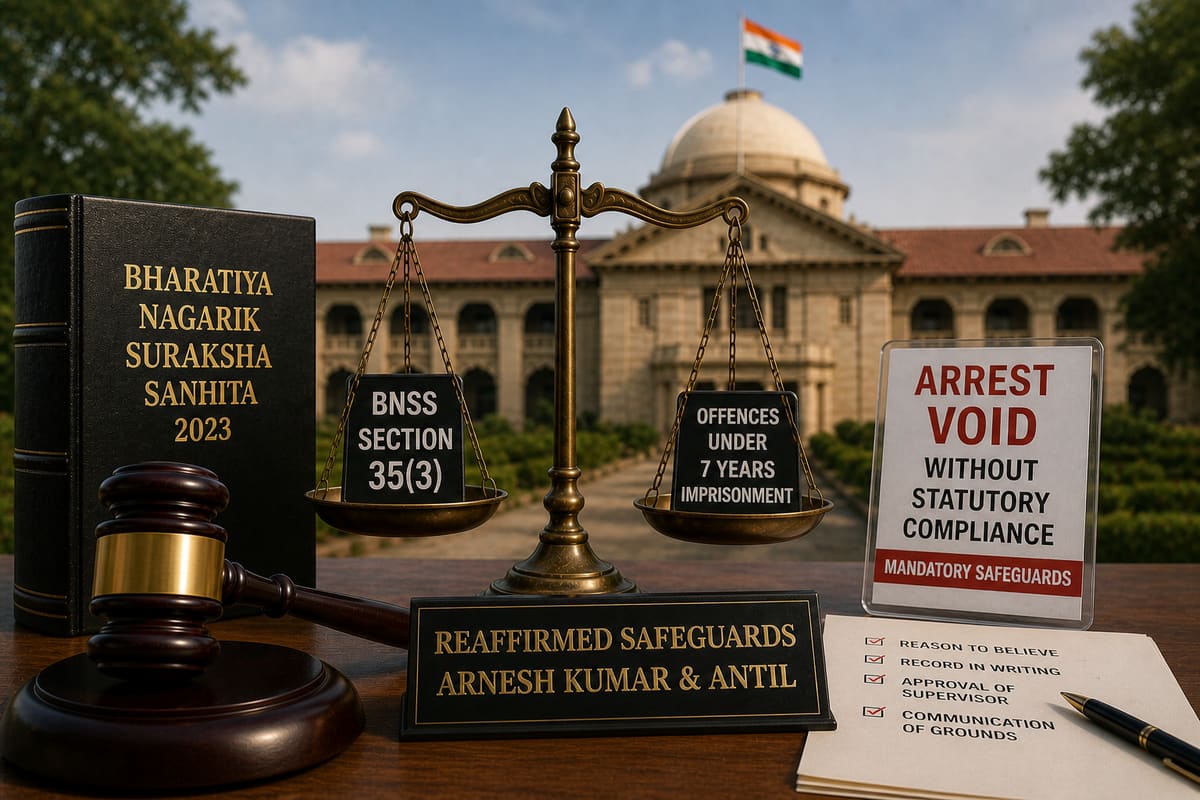
In a significant directive reinforcing procedural safeguards, the Andhra Pradesh High Court has disposed of an anticipatory bail petition by mandating strict compliance with Section 35(3) of the Bharatiya Nagarik Suraksha Sanhita, 2023 and the Supreme Court’s guidelines in Arnesh Kumar v. State of Bihar. The judgment underscores that arrest for offences punishable with imprisonment of seven years or less cannot be automatic and must follow prescribed legal protocols.
Background & Facts
The Dispute
The petitioner, Shaik Jakeer Hussain, sought anticipatory bail under Section 482 of the Bharatiya Nagarik Suraksha Sanhita, 2023 in connection with Crime No. 45 of 2026 registered at Santhapet Police Station, Nellore District. The case was registered for offences punishable under Sections 316(2) and 318(4) of the Bharatiya Nyaya Sanhita, 2023, which prescribe imprisonment for up to seven years.
Key Facts
- The petitioner is accused in Crime No. 45 of 2026 for offences under Sections 316(2) and 318(4) of BNS, which carry a maximum punishment of seven years’ imprisonment
- The petitioner filed the present criminal petition seeking anticipatory bail under Section 482 of BNSS
- The offences alleged fall within the category of those punishable with imprisonment of seven years or less
Procedural History
- 29.05.2026: Criminal Petition No. 4500 of 2026 filed before the Andhra Pradesh High Court seeking anticipatory bail
- 29.05.2026: The High Court disposed of the petition with directions to the respondent/State
Relief Sought
The petitioner sought enlargement on anticipatory bail in the event of his arrest in Crime No. 45 of 2026.
The Legal Issue
The central question was whether the State is obligated to comply with the procedural safeguards under Section 35(3) of BNSS and the Arnesh Kumar guidelines before arresting an accused for offences punishable with imprisonment of seven years or less.
Arguments Presented
For the Petitioner
The petitioner’s counsel relied on the Supreme Court’s judgment in Arnesh Kumar v. State of Bihar and Section 35(3) of BNSS to argue that arrest for offences punishable with imprisonment of seven years or less cannot be arbitrary or automatic. The counsel contended that the State must follow the prescribed procedure to ensure that arrest is justified and necessary.
For the Respondent
The learned Assistant Public Prosecutor, representing the State, did not present substantive counter-arguments but submitted to the court’s jurisdiction for directions.
The Court's Analysis
The High Court observed that the offences alleged against the petitioner are punishable with imprisonment of seven years or less. Relying on Section 35(3) of BNSS and the Supreme Court’s judgment in Arnesh Kumar v. State of Bihar, the Court emphasized that arrest for such offences cannot be routine or automatic. The Court noted that the State must comply with the procedural safeguards to prevent arbitrary arrests and ensure that arrest is resorted to only when absolutely necessary.
"Since it is seen that the offences alleged are punishable with seven years or less than seven years, the respondent/State is directed to comply with the mandate in Section 35(3) of the BNSS, 2023 and all the directions given by the Hon’ble Supreme Court of India in the judgment in Arnesh Kumar vs. State of Bihar and other related rulings."
The Court’s analysis underscores the importance of adhering to legal protocols to protect personal liberty and prevent misuse of arrest powers.
The Verdict
The High Court disposed of the criminal petition with a direction to the respondent/State to comply with Section 35(3) of BNSS and the Arnesh Kumar guidelines before effecting the arrest of the petitioner. The Court did not grant or deny bail explicitly but mandated procedural compliance by the State. No specific monetary relief, interest, or compliance timeline was set, as the order was procedural in nature.
What This Means For Similar Cases
Arrest Cannot Be Automatic for Offences Punishable Up To Seven Years
- Section 35(3) of BNSS mandates that no arrest shall be made for offences punishable with imprisonment of seven years or less without prior approval of a senior police officer
- The Arnesh Kumar guidelines require the police to satisfy themselves about the necessity of arrest based on objective criteria, such as the accused’s criminal history, the nature of the offence, and the likelihood of tampering with evidence or influencing witnesses
- Practitioners must argue that the State’s failure to comply with these safeguards renders any arrest illegal and liable to be set aside
The Burden Shifts to the State to Justify Arrest
- The State must now demonstrate that arrest is necessary, even for offences punishable with imprisonment of seven years or less
- Courts are likely to scrutinize arrest memos and police reports to ensure compliance with Section 35(3) of BNSS and the Arnesh Kumar guidelines
- Defence counsel can challenge arrests made without adherence to these protocols, seeking remedies such as quashing of FIRs or release on bail
Practical Implications for Law Enforcement
- Police officers must document reasons for arrest in writing and obtain prior approval from a senior officer for offences punishable with imprisonment of seven years or less
- Failure to comply with these procedural requirements may result in judicial intervention, including directions for release or compensation for wrongful arrest
- Prosecutors must ensure that arrest memos and charge sheets reflect compliance with these safeguards to avoid adverse judicial observations