The Rajasthan High Court’s recent order in a bail application under the NDPS Act underscores a critical principle: when the quantity of contraband is only marginally above the statutory commercial threshold and includes the weight of packaging, the presumption of seriousness must yield to proportionality. This decision reinforces that bail cannot be automatically denied merely because an offence falls under a stringent statute.
Background & Facts
The Dispute
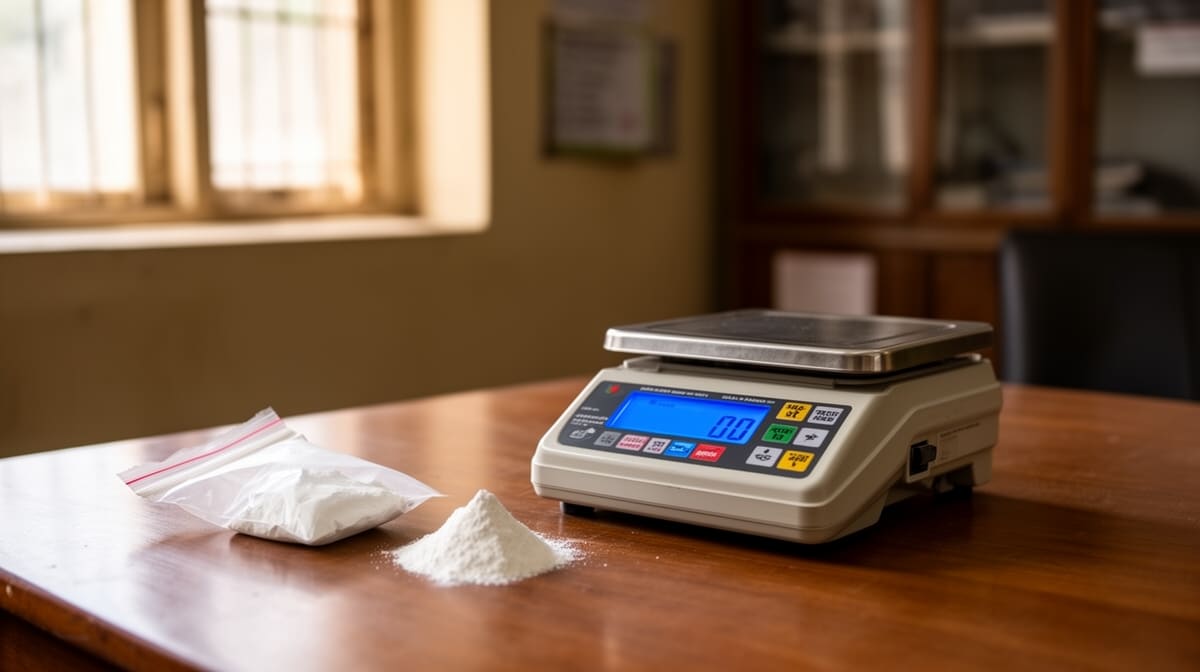
The petitioner, Chuna Ram, was arrested in connection with FIR No. 109/2025 registered at Police Station Nagana, Barmer, for alleged possession of 51.47 grams of Mephedrone under Sections 8, 22, and 25 of the NDPS Act. The prosecution claimed the quantity exceeded the commercial threshold under the Act. However, the inventory prepared by the investigating agency recorded the weight as 50.9 grams, inclusive of the plastic pouch in which the contraband was stored.
Procedural History
- 29 October 2025: Petitioner taken into custody following recovery of contraband
- December 2025: Chargesheet filed under NDPS Act
- February 2026: Bail application filed under Section 483 of the BNSS before the High Court
Relief Sought
The petitioner sought bail on grounds that the actual quantity of Mephedrone, after deducting the weight of the plastic pouch, may fall below or only marginally exceed the commercial quantity. He argued that no further custodial interrogation was necessary, his trial would be protracted, and his detention was disproportionate to the alleged offence.
The Legal Issue
The central question was whether bail can be denied under the NDPS Act solely on the basis that the recovered contraband’s recorded weight, including packaging, is marginally above the statutory commercial quantity, without conclusive evidence of the net drug weight.
Arguments Presented
For the Petitioner
Learned counsel contended that the commercial quantity under the NDPS Act must be determined based on the net weight of the controlled substance, excluding inert packaging. Relying on State of Punjab v. Baldev Singh and Kamaljit Singh v. State of Punjab, he argued that inclusion of packaging material in weight calculation is legally impermissible unless explicitly permitted by the statute. He further submitted that the petitioner had no prior history of drug trafficking and had been in custody for over four months without custodial interrogation being required.
For the Respondent
The Public Prosecutor opposed bail, asserting that the recovered quantity was above the threshold prescribed under the NDPS Act and that the nature of the offence warranted strict adherence to the law. He argued that the investigating officer’s report was prima facie reliable and that the variation in weight was immaterial given the seriousness of drug offences.
The Court's Analysis
The Court declined to accept the prosecution’s position at face value. It emphasized that statutory thresholds under the NDPS Act are not mechanical triggers for denial of bail but must be interpreted with proportionality and fairness. The Court noted that the inventory itself recorded the weight as 50.9 grams including the pouch, and no separate measurement of the pouch was conducted. The investigating officer admitted this omission.
"Considering the fact that the alleged contraband is only marginally above the commercial quantity, and that such weight includes the weight of the plastic pouch, but without expressing any opinion on merits/demerits of the case, I am inclined to grant benefit of bail to the petitioner."
The Court held that the burden of proving exact net weight lies with the prosecution, and in the absence of such evidence, the benefit must go to the accused. It distinguished this case from those involving large-scale trafficking or where the weight clearly exceeds commercial limits by a significant margin. The Court also noted that the petitioner had no history of violent crime and that prolonged pre-trial detention without necessity violated the principle of personal liberty under Article 21.
The Verdict
The petitioner won. The Court held that bail cannot be denied under the NDPS Act merely because the recorded weight of contraband marginally exceeds the commercial threshold when packaging is included. The petitioner was granted bail on a personal bond of ₹50,000 with two sureties of ₹25,000 each, subject to appearing before the trial court.
What This Means For Similar Cases
Weight of Packaging Must Be Deducted
- Practitioners must challenge prosecution claims of commercial quantity if packaging weight is not separately measured
- Courts must require scientific or certified weight reports excluding inert materials
- Failure to do so renders the quantity assessment legally suspect
Proportionality Overrides Automatic Denial
- Bail applications under NDPS Act must be evaluated on individual facts, not blanket assumptions
- Marginal excess over threshold, especially with procedural irregularities, warrants liberal bail consideration
- Pre-trial detention must be justified by necessity, not merely the label of the offence
Custodial Interrogation Not Presumed
- Once chargesheet is filed, continued custody requires specific justification
- Absence of need for further interrogation must be weighed heavily in bail decisions
- Courts should not defer to police assertions without independent scrutiny