The Rajasthan High Court has clarified that mere marginal excess over the commercial quantity under the NDPS Act, coupled with prolonged judicial custody and absence of criminal antecedents, warrants bail even in serious drug offenses. This ruling reinforces the principle that bail is the rule and jail the exception, particularly where trial delays are systemic and the accused poses no flight risk.
Background & Facts
The Dispute
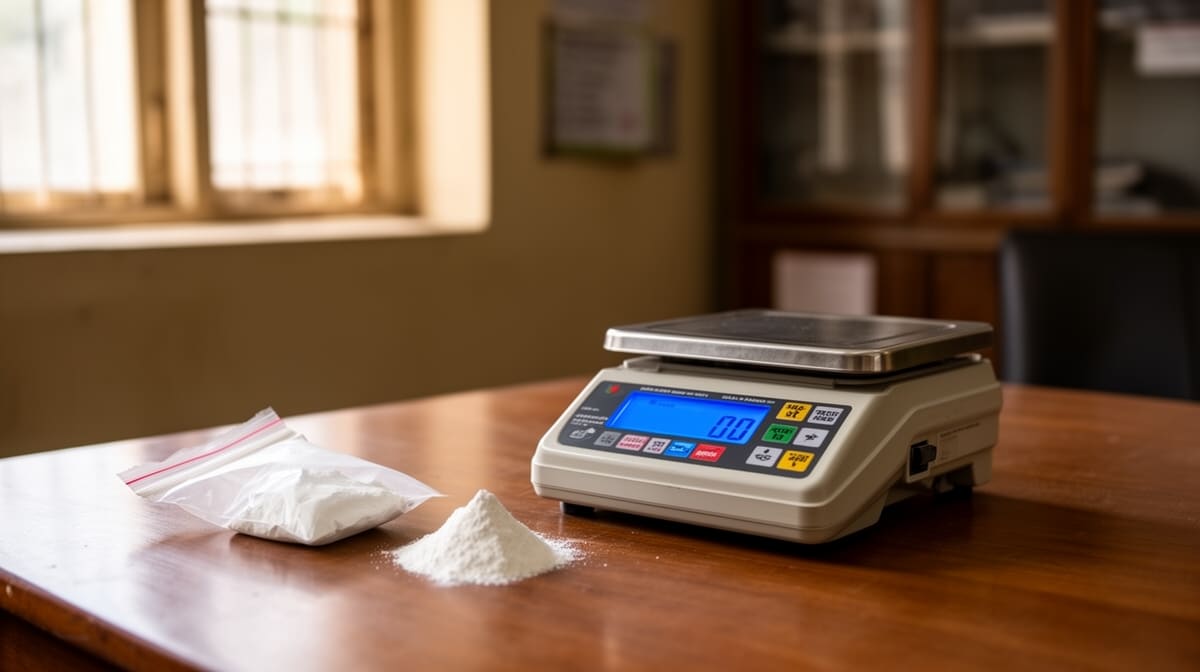
The petitioner, Vishal S/o Jagdish Lohar, aged 28, was arrested in connection with an alleged offense under Sections 8 and 18 of the Narcotic Drugs and Psychotropic Substances Act, 1985. The case stems from the recovery of 2.665 kg of opium, including the sack, from his possession at Gangrar Police Station in Chittorgarh District. The quantity recovered is 165 grams above the statutory commercial quantity threshold of 2.500 kg.
Key Facts
- The opium was recovered on or before 25.04.2025, leading to the registration of FIR No. 114/2025 at Gangrar Police Station
- The petitioner was arrested on 25.04.2025 and has remained in judicial custody since that date
- The recovered quantity of 2.665 kg is marginally above the commercial quantity of 2.500 kg as defined under Section 2(vi) of the NDPS Act
- No prior criminal record or antecedents exist against the petitioner
- The charge sheet has been filed, but only two out of twenty prosecution witnesses have been examined by the trial court as of 18.06.2026
- The petitioner claims false implication, with no corroborative evidence linking him to the contraband beyond recovery
Procedural History
- 25.04.2025: Arrest of petitioner in connection with FIR No. 114/2025
- Between 25.04.2025 and 18.06.2026: Petitioner remained in judicial custody without bail
- Before 18.06.2026: Charge sheet filed in the trial court
- 18.06.2026: Bail application filed under Section 483 of BNSS (equivalent to Section 439 Cr.P.C.) before the High Court
- 18.06.2026: Hearing conducted by Vacation Judge, Justice Mukesh Rajpurohit
Relief Sought
The petitioner sought bail on the grounds of prolonged custody, marginal excess of contraband, no criminal history, and prolonged trial timeline. He requested release on personal bond and sureties, subject to conditions.
The Legal Issue
The central question was whether bail can be granted under Section 483 of BNSS in a case under the NDPS Act where the recovered quantity is only marginally above the commercial threshold, the accused has no prior record, and the trial is significantly delayed due to slow progress in examining witnesses.
Arguments Presented
For the Petitioner
Learned counsel argued that the contraband recovered was only 165 grams over the commercial quantity, which is de minimis in the context of NDPS prosecutions. He emphasized the petitioner’s clean record, the fact that only two of twenty witnesses had been examined, and that the trial would likely take years to conclude. He relied on the principle that bail is the rule, jail the exception, and cited State of Rajasthan v. Balchand to argue that marginal excess does not justify denial of bail when other factors favor liberty.
For the Respondent
The Public Prosecutor did not dispute the factual assertions regarding the quantity, custody duration, or lack of antecedents. He opposed bail on the general ground that NDPS offenses are grave and involve societal harm, but offered no specific rebuttal to the petitioner’s arguments on delay or minimal excess.
The Court's Analysis
The Court examined the balance between the seriousness of the offense and the rights of the accused under Article 21 of the Constitution. It noted that while the NDPS Act imposes strict penalties, the judiciary must not mechanically deny bail merely because a commercial quantity is involved. The Court observed:
"The fact that the quantity recovered is marginally above the commercial threshold, coupled with the absence of any criminal antecedent and the prolonged period of judicial custody without trial progress, tilts the balance in favor of granting bail."
The Court distinguished cases involving large-scale trafficking or organized networks, noting this case lacked any indicia of such involvement. It emphasized that the delay in trial - where only two witnesses have been examined over 14 months - is not attributable to the accused. The Court held that denying bail under these circumstances would amount to punitive pre-trial detention, contrary to the spirit of Section 439 Cr.P.C. as incorporated under Section 483 BNSS.
The Court also rejected the notion that the mere filing of a charge sheet negates the right to bail, reaffirming that the stage of trial and progress thereof are critical factors.
The Verdict
The petitioner succeeded. The Court allowed the bail application and directed the petitioner’s release on a personal bond of Rs. 1,00,000 and two sureties of Rs. 50,000 each, to be furnished before the trial court. The petitioner must appear before the court on every hearing date and whenever called upon until trial completion. The order is effective immediately, subject to the petitioner not being wanted in any other case.
What This Means For Similar Cases
Marginal Excess Does Not Automatically Bar Bail
- Practitioners may now argue that a quantity just above the commercial threshold (e.g., under 200 grams) should not trigger automatic denial of bail
- The burden shifts to the prosecution to show aggravating factors beyond mere quantity
Trial Delay as a Bail Factor
- Where trial progress is slow (e.g., fewer than 10% of witnesses examined after 12+ months), this becomes a compelling ground for bail
- Courts must record reasons for delay and assess whether the accused is being punished pre-trial
Clean Record as a Decisive Factor
- Absence of prior convictions or pending cases must be weighed heavily, especially in borderline quantity cases
- Courts should avoid blanket assumptions about risk of reoffense in first-time NDPS accused
Procedural Takeaway
- Bail applications under BNSS must be supported by affidavits detailing trial progress, witness examination status, and custody duration
- Defense counsel should file a status report from the trial court to substantiate delay claims